Mechanics PYQ — Page 76
JEE Main Physics — Mechanics previous year questions with solutions.
All Mechanics Questions (2069)
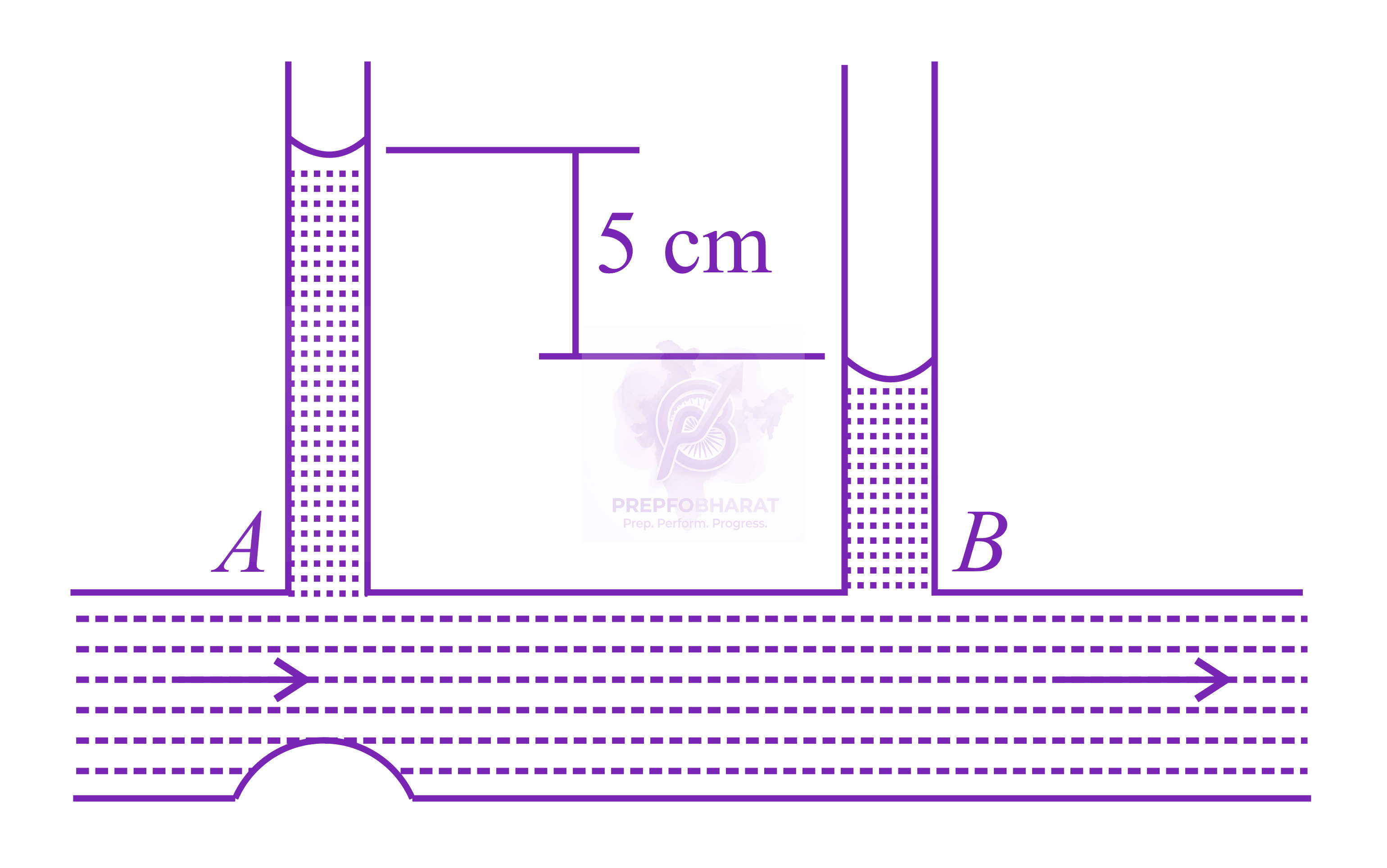 In the diagram shown, the difference in the two tubes of the manometer is $5\mathrm{cm}$, the cross-section of the tube at $A$ and $B$ is $6{\mathrm{mm}}^{2}$ and $10{\mathrm{mm}}^{2}$ respectively. The rate at which water flows through the tube is $(g=10m{s}^{-2})$
When a rubber-band is stretched by a distance x, it exerts a restoring force of magnitude F = ax + bx$^{2}$ where a and b are constants. The work done in stretching the unstretched rubber-band by L is :
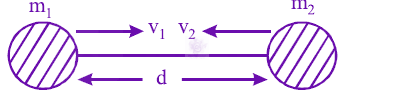 Two hypothetical planets of masses $\mathrm{m}_1$ and $\mathrm{m}_2$ are at rest when they are infinite distance apart. Because of the gravitational force they move towards each other along the line joining their centres. What is their speed when their separation is ' $d$ '? (Speed of $\mathrm{m}_1$ is $\mathrm{v}_1$ and that of $\mathrm{m}_2$ is $\mathrm{v}_2$ )
Three masses $\mathrm{m}, 2 \mathrm{~m}$ and $3 \mathrm{~m}$ are moving in $\mathrm{x}-\mathrm{y}$ plane with speed $3 \mathrm{u}, 2 \mathrm{u}$ and $\mathrm{u}$ respectively as shown in figure. The three masses collide at the same point at $\mathrm{P}$ and stick together. The velocity of resulting mass will be: 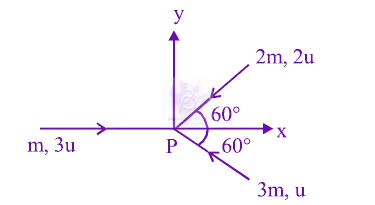
A heavy box is to be dragged along a rough horizontal floor. To do so, the person $A$ pushes it at an angle $30^{\circ}$ from the horizontal and requires a minimum force ${F}_{A}$, while the person $B$ pulls the box at an angle $60^{\circ}$ from the horizontal and needs minimum force ${F}_{B}$. If the coefficient of friction between the box and the floor is $\frac{\sqrt{3}}{5}$, the ratio $\frac{{F}_{A}}{{F}_{B}}$ is
A tank with a small hole at the bottom has been filled with water and kerosene (specific gravity $0.8$ ). The height of water is $3 \mathrm{~m}$ and that of kerosene $2 \mathrm{~m}$. When the hole is opened the velocity of fluid coming out from it is nearly: (take $\mathrm{g}=10 \mathrm{~ms}^{-2}$ and density of water $\left.=10^3 \mathrm{~kg} \mathrm{~m}^{-3}\right)$
The position of a projectile launched from the origin at t = 0 is given by $\vec{\text{r}} = ( 4 0 \hat{ i } + 5 0 \hat{ j } ) \text{m}$ at t = 2s. If the projectile was launched at an angle $\theta$ from the horizontal, then $\theta$ is (take g = 10 ms$^{-2}$).
A small ball of mass $\mathrm{m}$ starts at a point $\mathrm{A}$ with speed $\mathrm{v}_{\mathrm{o}}$ and moves along a frictionless track $\mathrm{AB}$ as shown. The track $\mathrm{BC}$ has coefficient of friction $\mu$. The ball comes to stop at $\mathrm{C}$ after travelling a distance $L$ which is: 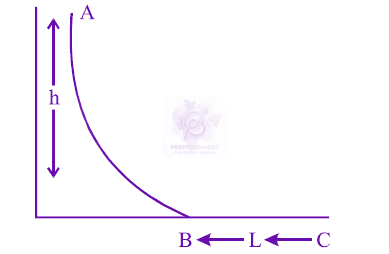
A capillary tube is immersed vertically in water and the height of the water column is $x$. When this arrangement is taken into a mine of depth d, the height of the water column is $y$. If R is the radius of earth, the ratio $\frac{ x }{ y }$ is :
A mass $m$ is supported by a massless string wound around a uniform hollow cylinder of mass m and radius R. If the string does not slip on the cylinder, with what acceleration will the mass fall on release? 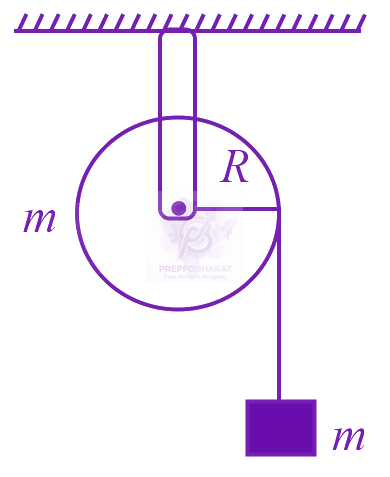
A body of mass $5 \mathrm{~kg}$ under the action of constant force $\vec{F}=F_x \hat{i}+F_y \hat{j}$ has velocity at $\mathrm{t}=0 \mathrm{~s}$ as $\overrightarrow{\mathrm{v}}=(6 \hat{\mathrm{i}}-2 \hat{\mathrm{j}} \mathrm{m} / \mathrm{s})$ and at $\mathrm{t}=10 \mathrm{~s}$ as $\overrightarrow{\mathrm{v}}=+6 \hat{\mathrm{j}} \mathrm{m} / \mathrm{s}$. The force $\overrightarrow{\mathrm{F}}$ is:
Four particles, each of mass $M$ and equidistant from each other, move along a circle of radius $R$ under the action of their mutual gravitational attraction. The speed of each particle is
Two soap bubbles coalesce to form a single bubble. If $\mathrm{V}$ is the subsequent change in volume of contained air and $\mathrm{S}$ change in total surface area, $\mathrm{T}$ is the surface tension and $\mathrm{P}$ atmospheric pressure, then which of the following relation is correct?
The bulk moduli of ethanol, mercury and water are given as $0.9,25$ and $2.2$ respectively in units of $10^9 \mathrm{Nm}^{-2}$. For a given value of pressure, the fractional compression in volume is $\frac{\Delta \mathrm{V}}{\mathrm{V}}$. Which of the following statements about $\frac{\Delta V}{V}$ for these three liquids is correct ?
A particle is moving in a circular path of radius a, with a constant velocity $\mathrm{v}$ as shown in the figure. The centre of circle is marked by ' $\mathrm{C}$ '. The angular momentum from the origin $\mathrm{O}$ can be written as: 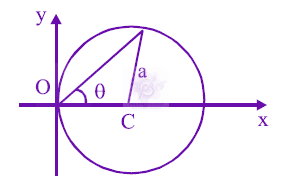
A tennis ball (treated as hollow spherical shell) starting from $\mathrm{O}$ rolls down a hill. At point $\mathrm{A}$ the ball becomes air borne leaving at an angle of $30^{\circ}$ with the horizontal. The ball strikes the ground at $\mathrm{B}$. What is the value of the distance $\mathrm{AB}$ ? (Moment of inertia of a spherical shell of mass $m$ and radius $R$ about its diameter $=\frac{2}{3} m R^2$ ) 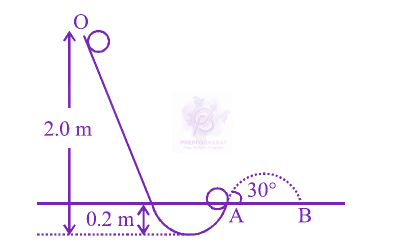
Two blocks of mass $M_1=20 \mathrm{~kg}$ and $M_2=12 \mathrm{~kg}$ are connected by a metal rod of mass $8 \mathrm{~kg}$. The system is pulled vertically up by applying a force of $480 \mathrm{~N}$ as shown. The tension at the mid-point of the rod is: 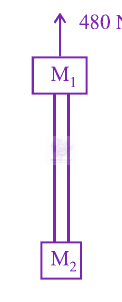
Let $[ {\in }_{0} ]$ denote the dimensional formula of the permittivity of vacuum. If M = mass, L = length, T = time and A = electric current, then :
If the time period $t$ of the oscillation of a drop of liquid of density $d$, radius $r$, vibrating under surface tension $s$ is given by the formula $t=\sqrt{r^{2 b} s^c d^{a / 2}}$. It is observed that the time period is directly proportional to $\sqrt{\frac{d}{s}}$. The value of $b$ should therefore be :
Correct set up to verify Ohm's law is :
The change in the value of acceleration of earth towards sun, when the moon comes from the position of solar eclipse to the position on the other side of earth in line with sun is: (mass of the moon $=7.36 \times 10^{22} \mathrm{~kg}$, radius of the moon's orbit $=3.8 \times 10^8 \mathrm{~m}$ ).
A block is placed on a rough horizontal plane. A time dependent horizontal force $\mathrm{F}=\mathrm{kt}$ acts on the block, where $\mathrm{k}$ is a positive constant. The acceleration - time graph of the block is :
A ring of mass $M$ and radius $R$ is rotating about its axis with angular velocity $\omega$. Two identical bodies each of mass $m$ are now gently attached at the two ends of a diameter of the ring. Because of this, the kinetic energy loss will be :
A wind-powered generator converts wind energy into electrical energy. Assume that the generator converts a fixed fraction of the wind energy intercepted by its blades into electrical energy. For wind speed $v$, the electrical power output will be most likely proportional to