Mechanics PYQ — Page 75
JEE Main Physics — Mechanics previous year questions with solutions.
All Mechanics Questions (2069)
A person climbs up a stalled escalator in $60 \mathrm{~s}$. If standing on the same but escalator running with constant velocity he takes $40 \mathrm{~s}$. How much time is taken by the person to walk up the moving escalator?
Steel ruptures when a shear of $3.5 \times 10^8 \mathrm{~N} \mathrm{~m}^{-2}$ is applied. The force needed to punch a $1 \mathrm{~cm}$ diameter hole in a steel sheet $0.3 \mathrm{~cm}$ thick is nearly:
A cylinder of mass M$_{c}$ and sphere of mass M$_{s}$ are placed at points A and B of two inclines, respectively. (See figure). If they roll on the incline without slipping such that their accelerations are the same, then the ratio $\frac{ sin {\theta }_{\text{c}} }{ sin {\theta }_{\text{s}} }$ is : 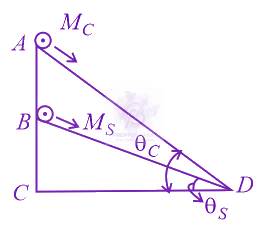
The gravitational field in a region is given by $\vec{g}=(5\hat{\text{i}}+12\hat{j})N{\mathrm{kg}}^{-1}$. The change in the gravitational potential energy of a particle of mass $2\mathrm{kg}$ when it is taken from the origin to a point $(7m,-3m)$ is
The current voltage relation of diode is given by I = (e$^{1000}$$^{ V/T}$ - 1) mA, where the applied voltage V is in volts and the temperature T is in degree Kelvin. If a student makes an error measuring $\pm \text{0.01 V}$ while measuring the current of 5 mA at 300 K, what will be the error in the value of current in mA ?
The velocity of water in a river is $18\mathrm{km}{h}^{-1}$ near the surface. If the river is $5m$ deep, find the shearing stress between the horizontal layers of water. The coefficient of viscosity of water$={10}^{-2}\mathrm{poise}$.
From the following combinations of physical constants (expressed through their usual symbols) the only combination, that would have the same value in different systems of units, is:
In terms of resistance $R$ and time $T$, the dimensions of ratio $\frac{\mu}{\varepsilon}$ of the permeability $\mu$ and permittivity $\varepsilon$ is:
Consider a cylinder of mass M resting on a rough horizontal rug that is pulled out from under it with acceleration 'a' perpendicular to the axis of the cylinder. What is F$_{friction}$ at point P ? It is assumed that the cylinder does not slip. 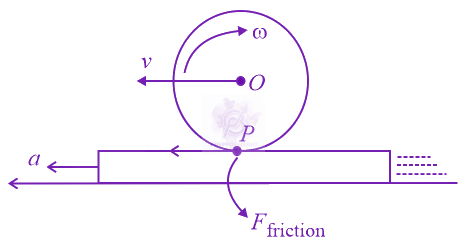
A cylindrical vessel of cross-section A contains water to a height $\mathrm{h}$. There is a hole in the bottom of radius ' $a$ '. The time in which it will be emptied is:
Water is flowing at a speed of 1.5 m s$^{-1}$ through a horizontal tube of cross-sectional area 10$^{-2}$ m$^{2}$$^{ }$and you are trying to stop the flow by your palm. Assuming that the water stops immediately after hitting the palm, the minimum force that you must exert should be (density of water = 10$^{3}$ kg m$^{-3}$)
Match List$‐I$ (Event) with List$‐\mathrm{II}$ (Order of the time interval for the happening of the event) and select the correct option from the options given below the lists. <table class="pyq-table"><tbody><tr><th></th><th>List-I</th><th></th><th>List-II</th></tr><tr><td>$(a)$</td><td>The rotation period of earth</td><td>$(i)$</td><td>${10}^{5}s$</td></tr><tr><td>$(b)$</td><td>Revolution period of earth</td><td>$(\mathrm{ii})$</td><td>${10}^{7}s$</td></tr><tr><td>$(c)$</td><td>Period of a light wave</td><td>$(\mathrm{iii})$</td><td>${10}^{-15}s$</td></tr><tr><td>$(d)$</td><td>Period of a sound wave</td><td>$(\mathrm{iv})$</td><td>${10}^{-3}s$</td></tr></tbody></table>
A student measured the length of a rod and wrote it as 3.50 cm. Which instrument did he use to measure it ?
A block A of mass 4 kg is placed on another block B of mass 5 kg, and the block B rests on a smooth horizontal table. If the minimum force that can be applied on A so that both the blocks move together is 12 N, the maximum force that can be applied on B for the blocks to move together will be :
The initial speed of a bullet fired from a rifle is $630 \mathrm{~m} / \mathrm{s}$. The rifle is fired at the centre of a target $700 \mathrm{~m}$ away at the same level as the target. How far above the centre of the target ?
A block of mass $m$ is placed on a surface with a vertical cross section given by $y=\frac{{x}^{3}}{6}$. If the coefficient of friction is $0.5$, the maximum height above the ground at which the block can be placed without slipping is
A large number of liquid drops each of radius $r$ coalesce to form a single drop of the radius $R$. The energy released in the process is converted into kinetic energy of the big drop so formed. The speed of the big drop is (given surface tension of the liquid $T$, density $\rho$)
The average mass of rain drops is $3.0 \times 10^{-5} \mathrm{~kg}$ and their avarage terminal velocity is $9 \mathrm{~m} / \mathrm{s}$. Calculate the energy transferred by rain to each square metre of the surface at a place which receives $100 \mathrm{~cm}$ of rain in a year.
An experiment is performed to obtain the value of acceleration due to gravity g by using a simple pendulum of length L. In this experiment time for 100 oscillations is measured by using a watch of 1 second least count and the value is 90.0 seconds. The length L is measured by using a meter scale of least count 1 mm and the value is 20.0 cm. The error in the determination of g would be :
There is a circular tube in a vertical plane. Two liquids which do not mix and of densities d$_{1}$ and d$_{2}$ are filled in the tube. Each liquid subtends 90$^{o}$ angle at centre. Radius joining their interface makes an angle $\alpha$ with vertical. Ratio $\frac{{\text{d}}_{1}}{ }$ is : 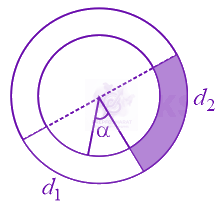
A ball of mass $160g$ is thrown up at an angle of $60^{\circ}$ to the horizontal at a speed of $10m{s}^{-1}$. The angular momentum of the ball at the highest point of the trajectory with respect to the point from which the ball is thrown is nearly $(g=10m{s}^{-2})$
From a tower of height H, a particle is thrown vertically upwards with a speed u. The time taken by the particle, to hit the ground, is n times that taken by it to reach the highest point of its path.The relation between H, u and n is :
A thin bar of length $\mathrm{L}$ has a mass per unit length $\lambda$, that increases linearly with distance from one end. If its total mass is $M$ and its mass per unit length at the lighter end is $\lambda_{\mathrm{O}}$, then the distance of the centre of mass from the lighter end is:
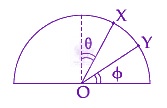 A particle is released on a vertical smooth semicircular track from point $X$ so that, $OX$ makes angle $\theta$ from the vertical (see figure). The normal reaction of the track on the particle vanishes at the point $Y$ where $OY$ makes an angle $\phi$ with the horizontal. Then