Mechanics PYQ — Page 74
JEE Main Physics — Mechanics previous year questions with solutions.
All Mechanics Questions (2069)
If the capacitance of a nanocapacitor is measured in terms of a unit $u$, made by combining the electronic charge $e$, Bohr radius ${a}_{0}^{},$ Planck's constant $h$ and speed of light $c$ then
A uniform solid cylindrical roller of mass $m$ is being pulled on a horizontal surface with force $F$ parallel to the surface and applied at its centre. If the acceleration of the cylinder is $a$ and it is rolling without slipping then the value of $F$ is:
Consider a thin uniform square sheet made of a rigid material. If its side is $a$, mass m and moment of inertia $I$ about one of its diagonals, then:
A particle is moving in a circle of radius $r$ under the action of a force $F=\alpha {r}^{2}$ which is directed towards centre of the circle. Total mechanical energy (kinetic energy + potential energy) of the particle is (take potential energy$=0$ for $r=0$):
Diameter of a steel ball is measured using a Vernier calipers which has divisions of 0.1 cm on its main scale (MS) and 10 divisions of its Vernier scale (VS) match 9 divisions on the main scale. Three such measurements for a ball are given as: <table class="pyq-table"><tbody><tr><td>S.No.</td><td>MS (cm)</td><td>VS divisions</td></tr><tr><td>1.</td><td>0.5</td><td>8</td></tr><tr><td>2.</td><td>0.5</td><td>4</td></tr><tr><td>3.</td><td>0.5</td><td>6</td></tr></tbody></table> If the zero error is - 0.03 cm, then mean corrected diameter is:
A block of mass $m=10 \mathrm{kg}$ rests on a horizontal table. The coefficient of friction between the block and the table is $0.05$. When hit by a bullet of mass $50g$ moving with speed $v$, that gets embedded in it, the block moves and comes to stop after moving a distance of $2m$ on the table. If a freely falling object were to acquire speed $\frac{v}{10}$ after being dropped from height $H$, then neglecting energy losses and taking $g=10 m{s}^{-2}$, the value of $H$ is close to
The period of oscillation of a simple pendulum is $T=2\pi \sqrt{\frac{l}{g}}.$ Measured value of $l$ is $20.0\mathrm{cm}$, known to $1\mathrm{mm}$ accuracy and time for $100$oscillations of the pendulum is found to be $90s$ using a wristwatch of $1s$ resolution. The accuracy in the determination of $g$ is
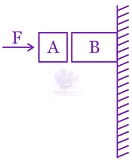 Given in the figure are two blocks $A$ and $B$ of weight $20N$ and $100N$, respectively. These are being pressed against a wall by a force $F$ and kept in equilibrium as shown. If the coefficient of friction between the blocks is $0.1$ and between block $B$ and the wall is $0.15$, the frictional force applied by the wall on block $B$ is:
From a solid sphere of mass $M$ and radius $R\text{,}$ a spherical portion of radius $(\frac{R}{2})$ is removed as shown in the figure. Taking gravitational potential $V=0$ at $r=\infty ,$ the potential at the centre of the cavity thus formed is ($G=$gravitational constant) 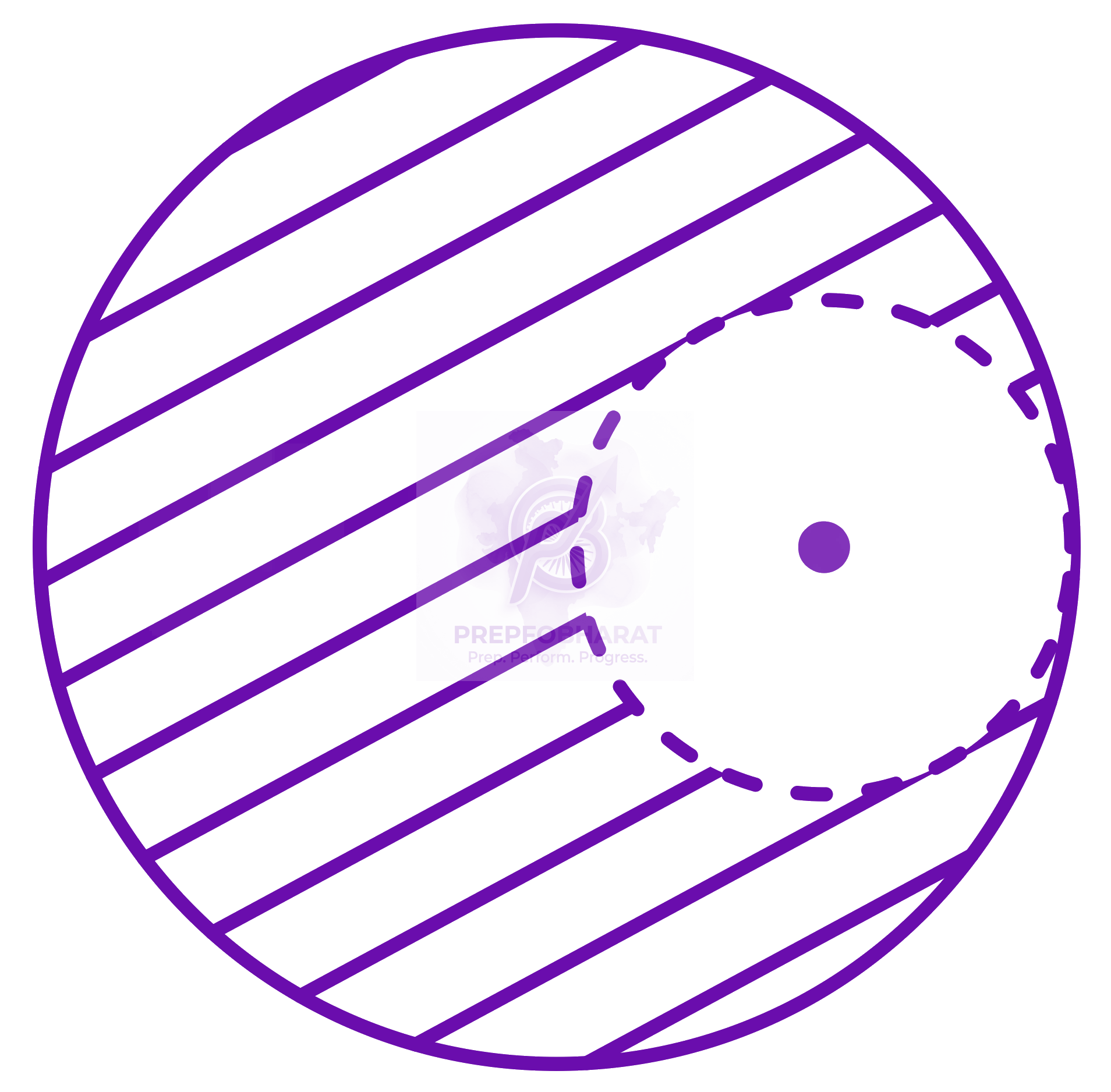
A vector $\vec{A}$ is rotated by a small angle $\Delta \theta$ radians $(\Delta \theta \ll 1)$ to get a new vector $\vec{B}$ . In that case $|\vec{B}-\vec{A}|$ is :
If a body moving in a circular path maintains constant speed of $10 m{s}^{-1}$ , then which of the following correctly describes the relation between acceleration and radius?
Distance of the centre of mass of a solid uniform cone from its vertex is ${z}_{0}$. If the radius of its base is $R$ and its height is $h$ then ${z}_{0}$ is equal to:
A block of mass $m=0.1 \mathrm{kg}$ is connected to a spring of unknown spring constant k. It is compressed to a distance $x$ from its equilibrium position and released from rest. After approaching half the distance $(\frac{x}{2})$ from the equilibrium position, it hits another block and comes to rest momentarily, while the other block moves with velocity $3 m{s}^{-1}$. The total initial energy of the spring is:
On heating water, bubbles being formed at the bottom of the vessel detatch and rise. Take the bubbles to be spheres of radius R and making a circular contact of radius r with the bottom of the vessel. If r << R, and the surface tension of water is T, value of r just before bubbles detatch is : (density of water is ${\rho }_{\text{w}}$) 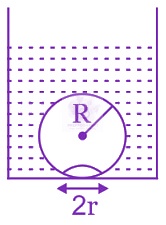
From a sphere of mass $M$ and radius $\mathrm{R}$, a smaller sphere of radius $\frac{\mathrm{R}}{2}$ is carved out such that the cavity made in the original sphere is between its centre and the periphery (See figure). For the configuration in the figure where the distance between the centre of the original sphere and the removed sphere is 3R, the gravitational force between the two sphere is: 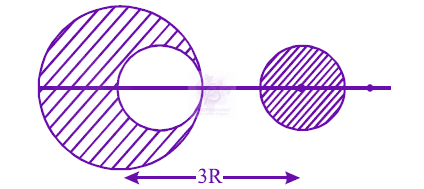
An open glass tube is immersed in mercury in such a way that a length of $8\mathrm{cm}$ extends above the mercury level. The open end of the tube is then closed and sealed and the tube is raised vertically up by additional $46\mathrm{cm}$. What will be length of the air column above mercury in the tube now ? (Atmospheric pressure = $76\mathrm{cm}$ of Hg)
A bullet of mass $4 \mathrm{~g}$ is fired horizontally with a speed of $300 \mathrm{~m} / \mathrm{s}$ into $0.8 \mathrm{~kg}$ block of wood at rest on a table. If the coefficient of friction between the block and the table is $0.3$, how far will the block slide approximately?
In materials like aluminium and copper, the correct order of magnitude of various elastic modulii is :
An air bubble of radius $0.1 \mathrm{~cm}$ is in a liquid having surface tension $0.06 \mathrm{~N} / \mathrm{m}$ and density $10^3 \mathrm{~kg} / \mathrm{m}^3$. The pressure inside the bubble is $1100 \mathrm{Nm}^{-2}$ greater than the atmospheric pressure. At what depth is the bubble below the surface of the liquid? $\left(\mathrm{g}=9.8 \mathrm{~ms}^{-2}\right)$
A bullet loses ${(\frac{1}{n})}^{\mathrm{th}}$ of its velocity passing through one plank. Considering uniform retardation, the number of such planks that are required to stop the bullet can be:
A bob of mass m attached to an inextensible string of length $l$ is suspended from a vertical support. The bob rotates in a horizontal circle with an angular speed $\omega$ rad/s about the vertical. About the point of suspension :
A spring of unstretched length 1 has a mass $m$ with one end fixed to a rigid support. Assuming spring to be made of a uniform wire, the kinetic energy possessed by it if its free end is pulled with uniform velocity $v$ is:
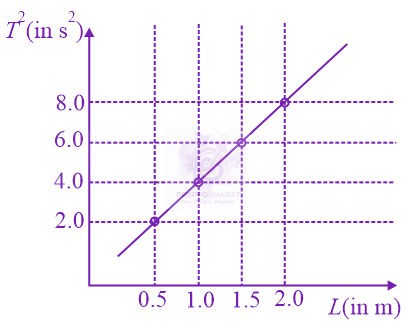 In an experiment to determine the gravitational acceleration $g$ of a place with the help of a simple pendulum, the measured time period squared is plotted against the string length of the pendulum in the figure. What is the value of $g$ at the place?
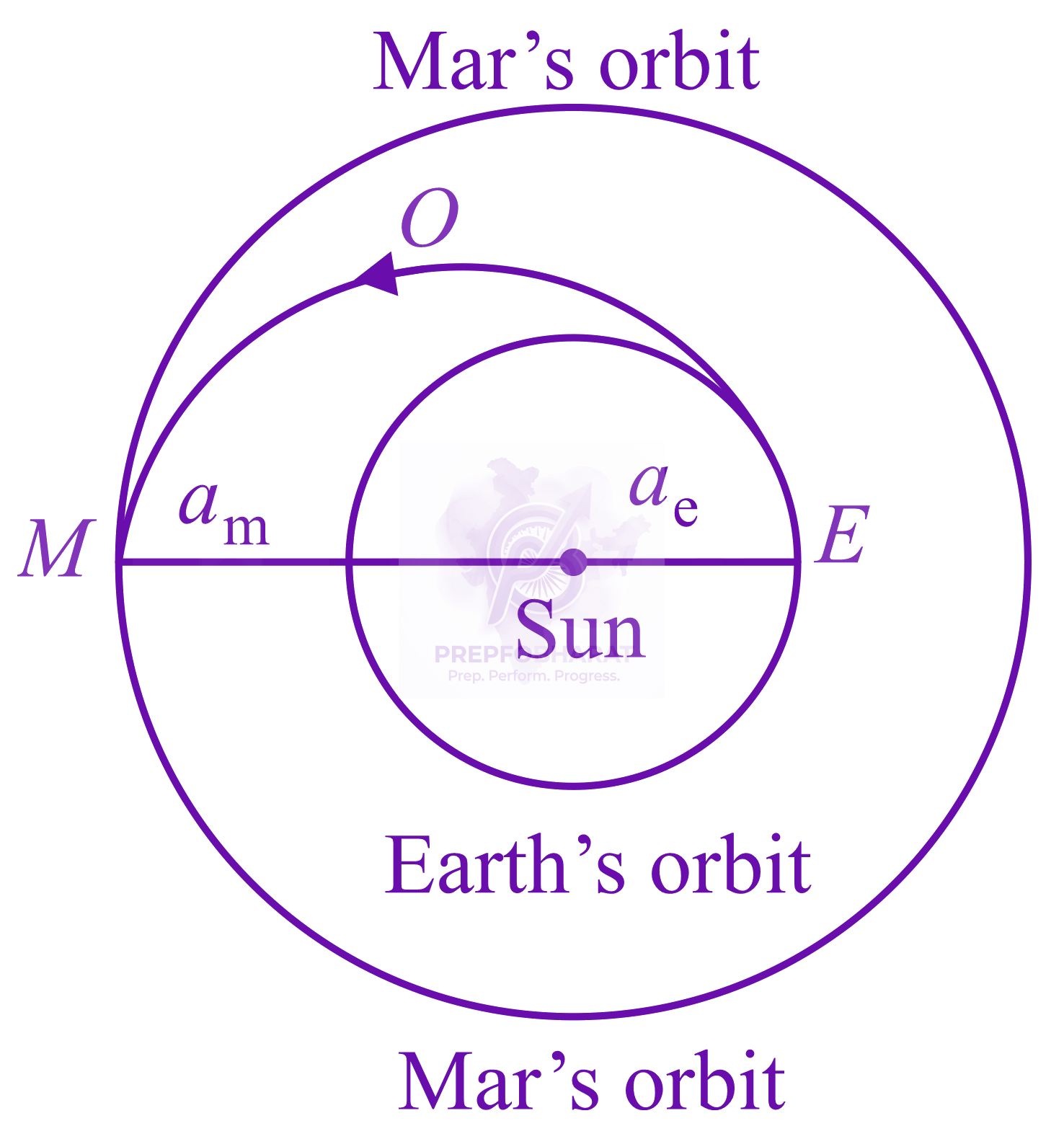
India's Mangalyan was sent to the Mars by launching it into a transfer orbit EOM around the sun. It leaves the earth at $E$ and meets Mars at $M$. If the semi-major axis of Earth's orbit is ${\text{a}}_{\text{e}} = \text{1.5} \times 1 {0}^{ 1 1 } \text{m}$ , that of Mar's orbit ${\text{a}}_{\text{m}} = \text{2.28} \times 1 {0}^{ 1 1 } \text{m}$, taking Kepler's laws, give the estimate of time for Mangalyan to reach Mars from Earth.