Mechanics PYQ — Page 77
JEE Main Physics — Mechanics previous year questions with solutions.
All Mechanics Questions (2069)
The dimensions of angular momentum, latent heat and capacitance are, respectively.
Wax is coated on the inner wall of a capillary tube and the tube is then dipped in water. Then, compared to the unwaxed capillary, the angle of contact $\theta$ and the height $h$ upto which water rises change. These changes are :
This question has Statement-1 and Statement- 2 . Of the four choices given after the Statements, choose the one that best describes the two Statetnents. Statement-1: A capillary is dipped in a liquid and liquid rises to a height $h$ in it. As the temperature of the liquid is raised, the height $h$ increases (if the density of the liquid and the angle of contact remain the same). Statement-2: Surface tension of a liquid decreases with the rise in its temperature.
A uniform sphere of weight $W$ and radius $5 \mathrm{~cm}$ is being held by a string as shown in the figure. The tension in the string will be : 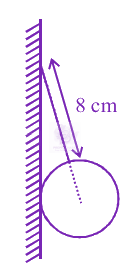
A uniform wire (Young's modulus $2 \times 10^{11} \mathrm{Nm}^{-2}$ ) is subjected to longitudinal tensile stress of $5 \times 10^7 \mathrm{Nm}^{-2}$. If the overall volume change in the wire is $0.02 \%$, the fractional decrease in the radius of the wire is close to:
A hoop of radius $\text{r}$ and mass $\text{m}$ rotating with an angular velocity ${\omega }_{0}$ is placed on a rough horizontal surface. The initial velocity of the centre of the hoop is zero. What will be the velocity of the centre of the hoop when it ceases to slip?
Two blocks of masses $\mathrm{m}$ and $\mathrm{M}$ are connected by means of a metal wire of cross-sectional area A passing over a frictionless fixed pulley as shown in the figure. The system is then released. If $\mathrm{M}=2 \mathrm{~m}$, then the stress produced in the wire is: 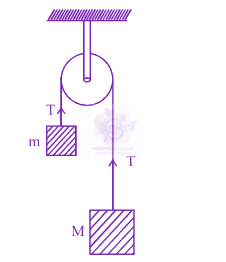
A ball projected from ground at an angle of $45^{\circ}$ just clears a wall in front. If point of projection is $4 \mathrm{~m}$ from the foot of wall and ball strikes the ground at a distance of $6 \mathrm{~m}$ on the other side of the wall, the height of the wall is :
A uniform cylinder of length $\text{L}$ and mass $\text{M}$ having cross-sectional area $\text{A}$ is suspended, with its length vertical, from a fixed point by a massless spring, such that it is half submerged in a liquid of density $\sigma$ at equilibrium position. The extension ${\text{x}}_{0}$ of the spring when it is in equilibrium is :
The maximum range of a bullet fired from a toy pistol mounted on a car at rest is $R_0=40 \mathrm{~m}$. What will be the acute angle of inclination of the pistol for maximum range when the car is moving in the direction of firing with uniform velocity $\mathrm{v}=20 \mathrm{~m} / \mathrm{s}$ on a horizontal surface? $\left(\mathrm{g}=10 \mathrm{~m} / \mathrm{s}^2\right)$
From the following, the quantity (constructed from the basic constants of nature), that has the dimensions, as well as correct order of magnitude, vis-a-vis typical atomic size, is:
If the ratio of lengths, radii and Young's moduli of steel and brass wires in the figure are $a, b$ and $c$ respectively, then the corresponding ratio of increase in their lengths is : 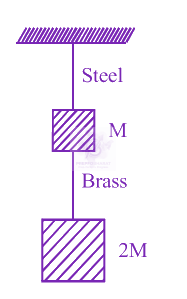
A copper wire of length $1.0 \mathrm{~m}$ and a steel wire of length $0.5 \mathrm{~m}$ having equal cross-sectional areas are joined end to end. The composite wire is stretched by a certain load which stretches the copper wire by $1 \mathrm{~mm}$. If the Young's modulii of copper and steel are respectively $1.0 \times 10^{11}$ $\mathrm{Nm}^{-2}$ and $2.0 \times 10^{11} \mathrm{Nm}^{-2}$, the total extension of the composite wire is :
A bullet of mass $10 \mathrm{~g}$ and speed $500 \mathrm{~m} / \mathrm{s}$ is fired into a door and gets embedded exactly at the centre of the door. The door is $1.0 \mathrm{~m}$ wide and weighs $12 \mathrm{~kg}$. It is hinged at one end and rotates about a vertical axis practically without friction. The angular speed of the door just after the bullet embeds into it will be :
A thin tube sealed at both ends is $100 \mathrm{~cm}$ long. It lies horizontally, the middle $20 \mathrm{~cm}$ containing mercury and two equal ends containing air at standard atmospheric pressure. If the tube is now turned to a vertical position, by what amount will the mercury be displaced ? 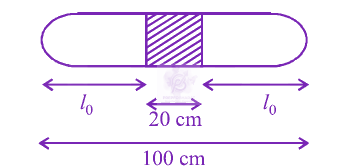 (Given : cross-section of the tube can be assumed to be uniform)
Assume that a drop of a liquid evaporates by a decrease in its surface energy so that its temperature remains unchanged. The minimum radius of the drop for this to be possible is. (The surface tension is $T$, the density of the liquid is$\rho$ and $L$ is its latent heat of vaporisation.)
This question has $Statement - I$ and $Statement - II$ of the four choices given after the Statements, choose the one that best describes the two Statements. $Statement - I:$ A point particle of mass $m$ moving with speed $\nu$ collides with stationary point particle of mass $M$. If the maximum energy loss possible is given as $f(\frac{1}{2}m{\nu }^{2})$ then $f=(\frac{m}{M+m})$. $Statement - II:$ Maximum energy loss occurs when the particles get stuck together as a result of the collision.
In an experiment, a small steel ball falls through a liquid at a constant speed of $10 \mathrm{~cm} / \mathrm{s}$. If the steel ball is pulled upward with a force equal to twice its effective weight, how fast will it move upward ?
A projectile is given an initial velocity of $(\hat{i}+2\hat{j})m{s}^{-1}$, where $\hat{\text{i}}$ is along the ground and $\hat{\text{j}}$ is along the vertical upward. If $g=10m{s}^{-2}$, the equation of its trajectory is :
A $70 \mathrm{~kg}$ man leaps vertically into the air from a crouching position. To take the leap the man pushes the ground with a constant force $F$ to raise himself. The center of gravity rises by $0.5 \mathrm{~m}$ before he leaps. After the leap the c.g. rises by another $1 \mathrm{~m}$. The maximum power delivered by the muscles is : (Take $\mathrm{g}=10 \mathrm{~ms}^{-2}$ )
The gravitational field, due to the 'left over part' of a uniform sphere (from which a part as shown, has been 'removed out'), at a very far off point, $\mathrm{P}$, located as shown, would be (nearly) : 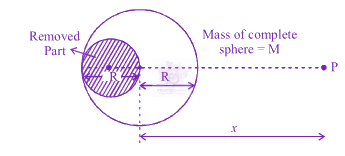
A boy of mass $20 \mathrm{~kg}$ is standing on a $80 \mathrm{~kg}$ free to move long cart. There is negligible friction between cart and ground. Initially, the boy is standing $25 \mathrm{~m}$ from a wall. If he walks $10 \mathrm{~m}$ on the cart towards the wall, then the final distance of the boy from the wall will be
A body of mass ' $m$ ' is tied to one end of a spring and whirled round in a horizontal plane with a constant angular velocity. The elongation in the spring is $1 \mathrm{~cm}$. If the angular velocity is doubled, the elongation in the spring is $5 \mathrm{~cm}$. The original length of the spring is :
A body starts from rest on a long inclined plane of slope $45^{\circ}$. The coefficient of friction between the body and the plane varies as $\mu=0.3 x$, where $x$ is distance travelled down the plane. The body will have maximum speed (for $g=10 \mathrm{~m} / \mathrm{s}^2$ ) when $x=$