JEE Main Chemistry — Physical Chemistry previous year questions with solutions.
Consider the following reaction that goes from $A$ to $B$ in three steps as shown below: 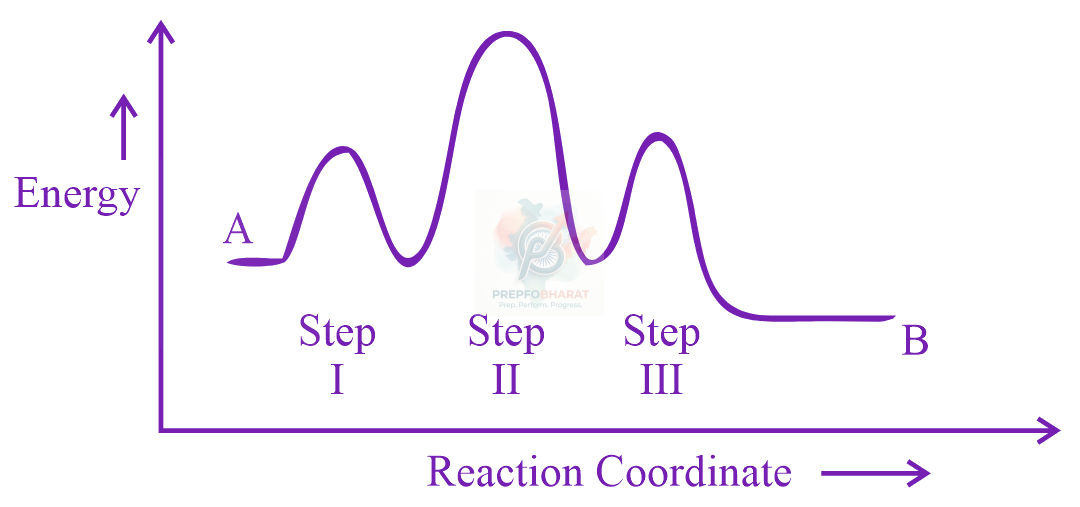 Choose the correct option <table class="pyq-table"><tbody><tr><td></td><td>Number of Intermediates</td><td>Number of Activated Complexes</td><td>Rate determining step</td></tr><tr><td>$(1)$</td><td>$2$</td><td>$3$</td><td>$I$</td></tr><tr><td>$(2)$</td><td>$2$</td><td>$3$</td><td>$\mathrm{III}$</td></tr><tr><td>$(3)$</td><td>$2$</td><td>$3$</td><td>$\mathrm{II}$</td></tr><tr><td>$(4)$</td><td>$3$</td><td>$2$</td><td>$\mathrm{II}$</td></tr></tbody></table>
If $5$ moles of ${\mathrm{BaCl}}_{2}$ is mixed with $2$ moles of ${\mathrm{Na}}_{3}{\mathrm{PO}}_{4},$ the maximum number of moles of ${\mathrm{Ba}}_{3}{({\mathrm{PO}}_{4})}_{2}$formed is $_________$ (Nearest integer)
At $25^{\circ}C$, the enthalpy of the following processes are given: ${H}_{2}(g)+{O}_{2}(g)\rightarrow 2\mathrm{OH}(g)\Delta {H}^{o}=78\mathrm{kJ}{\mathrm{mol}}^{-1}$ ${H}_{2}(g)+1/2{O}_{2}(g)\rightarrow {H}_{2}O(g)\Delta {H}^{0}=-242\mathrm{kJ}{\mathrm{mol}}^{-1}$ ${H}_{2}(g)\rightarrow 2H(g)\Delta {H}^{o}=436\mathrm{kJ}{\mathrm{mol}}^{-1}$ $1/2{O}_{2}(g)\rightarrow O(g)\Delta {H}^{0}=249\mathrm{kJ}{\mathrm{mol}}^{-1}$ What would be the value of X for the following reaction? (Nearest integer) ${H}_{2}O(g)\rightarrow H(g)+\mathrm{OH}(g)\Delta {H}^{o}=X{\mathrm{kJmol}}^{-1}$
The orbital angular momentum of an electron in $3s$ orbital is $\frac{\mathrm{xh}}{2\pi }$. The value of $x$ is (nearest integer)
Given below are two statements Statement I : According to Bohr’s model of hydrogen atom, the angular momentum of an electron in a given stationary state is quantised. Statement II : The concept of electron in Bohr’s orbit, violates the Heisenberg uncertainty principle. In the light of the above statements, choose the most appropriate answer from the options given below
Choose the correct representation of conductometric titration of benzoic acid vs sodium hydroxide.
Values of work function $({W}_{0})$ for a few metals are given below <table class="pyq-table"><tbody><tr><td>Metal</td><td>$\mathrm{Li}$</td><td>$\mathrm{Na}$</td><td>$K$</td><td>$\mathrm{Mg}$</td><td>$\mathrm{Cu}$</td><td>$\mathrm{Ag}$</td></tr><tr><td>$\frac{{W}_{0}}{\mathrm{eV}}$</td><td>$2.42$</td><td>$2.3$</td><td>$2.25$</td><td>$3.7$</td><td>$4.8$</td><td>$4.3$</td></tr></tbody></table>The number of metals which will show photoelectric effect when light of wavelength $400\mathrm{nm}$ falls on it is _____ Given: $h=6.6\times {10}^{–34}Js$ $c=3\times {10}^{8}{\mathrm{ms}}^{–1}$ $e=1.6\times {10}^{–19}C$
$25\mathrm{mL}$ of silver nitrate solution $(1M)$ is added dropwise to $25\mathrm{mL}$ of potassium iodide $(1.05M)$ solution. The ion(s) present in very small quantity in the solution is/are
$2{\mathrm{IO}}_{3}^{-}+{\mathrm{xI}}^{-}+12{H}^{+}\rightarrow 6{I}_{2}+6{H}_{2}$ What is the value of $x$?
See the following chemical reaction: ${\mathrm{Cr}}_{2}{O}_{7}^{2-}+{\mathrm{XH}}^{+}+6{\mathrm{Fe}}^{2+}\rightarrow {\mathrm{YCr}}^{3+}+6{\mathrm{Fe}}^{3+}+{\mathrm{ZH}}_{2}O$ The sum of X, Y and Z is
Consider the graph of Gibbs free energy G vs extent of reaction. The number of statement/s from the following which are true with respect to points (a), (b) and (c) is $______$ 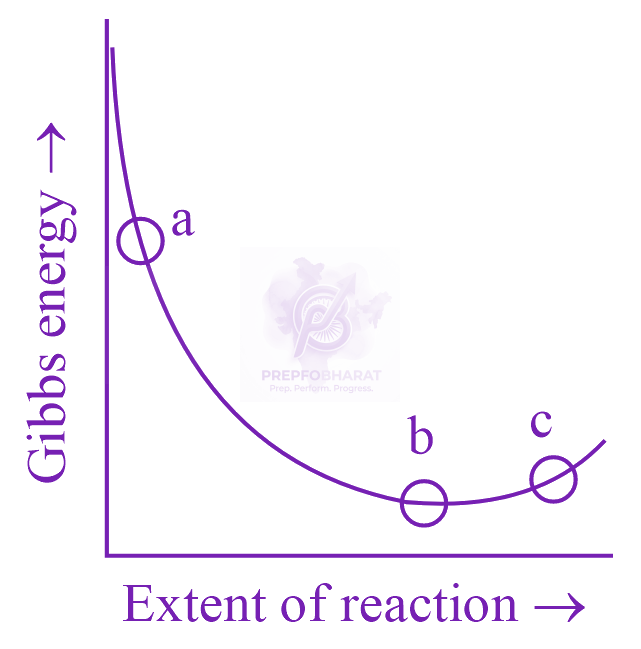 A. Reaction is spontaneous at (a) and (b) B. Reaction is at equilibrium at point (b) and non-spontaneous at point (c) C. Reaction is spontaneous at (a) and non-spontaneous at (c) D. Reaction is non-spontaneous at (a) and (b)
For a reversible reaction $A\rightleftharpoons B$, the $\Delta H$ forward reaction $=20\mathrm{kJ}{\mathrm{mol}}^{–1}$. The activation energy of the uncatalyzed forward reaction is $300\mathrm{kJ}{\mathrm{mol}}^{–1}$. When the reaction is catalysed keeping the reactant concentration same, the rate of the catalysed forward reaction at ${27}^{\circ }C$ is found to be same as that of the uncatalyzed reaction at ${327}^{\circ }C$. The activation energy of the catalysed backward reaction is _______$\mathrm{kJ}{\mathrm{mol}}^{–1}$.
One mole of an ideal monoatomic gas is subjected to changes as shown in the graph. The magnitude of the work done (by the system or on the system) is _______ J (nearest integer) 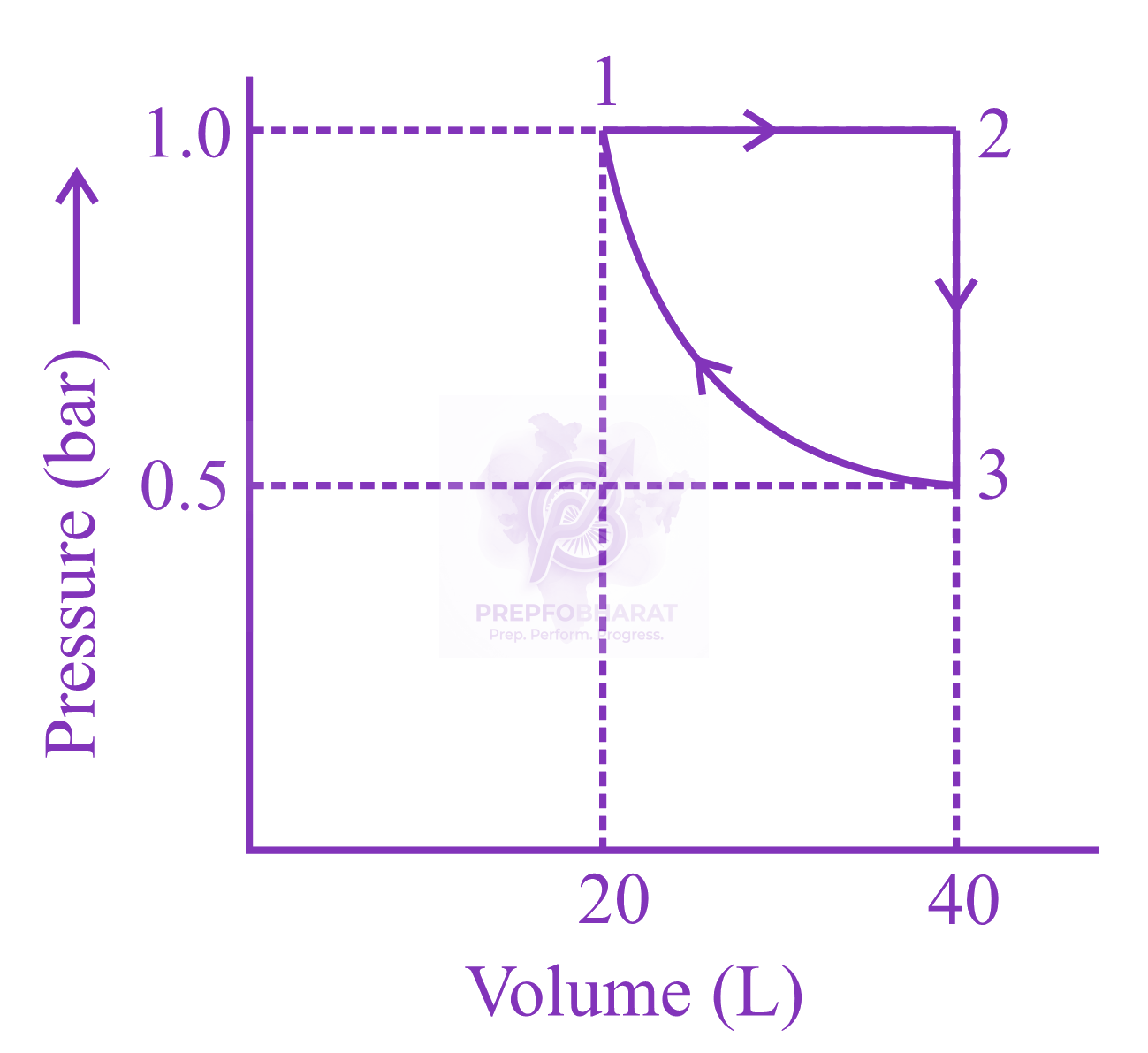 Given : log 2 = 0.3, ln 10 = 2.3
${\mathrm{FeO}}_{4}^{2-}\overset{+2.2V}{\longrightarrow }{\mathrm{Fe}}^{3+}\overset{+0.70V}{\longrightarrow }{\mathrm{Fe}}^{2+}\overset{-0.45V}{\longrightarrow }{\mathrm{Fe}}^{0}$ ${E}_{{\mathrm{FeO}}_{4}^{2-}/{\mathrm{Fe}}^{2+}}^{\theta }$ is $x\times {10}^{-3}V$. The value of $x$ is _______
If the radius of the first orbit of hydrogen atom is ${a}_{0}$, then de Broglie’s wavelength of electron in ${3}^{\mathrm{rd}}$ orbit is
For a concentrated solution of a weak electrolyte (${K}_{\mathrm{eq}}=$equilibrium constant) ${A}_{2}{B}_{3}$ of concentration $‘C’,$ the degree of dissociation $‘\alpha ’$ is
$1\times {10}^{-5}M{\mathrm{AgNO}}_{3}$ is added to $1L$ of saturated solution of $\mathrm{AgBr}$. The conductivity of this solution at $298K$ is $_______\times {10}^{-8}S{m}^{-1}$. [Given : ${K}_{\mathrm{sp}}(\mathrm{AgBr})=4.9\times {10}^{-13}$ at $298K$ ${\lambda }_{{\mathrm{Ag}}^{+}}^{0}=6\times {10}^{-3}{\mathrm{Sm}}^{2}{\mathrm{mol}}^{-1}$ ${\lambda }_{{\mathrm{Br}}^{-}}^{0}=8\times {10}^{-3}{\mathrm{Sm}}^{2}{\mathrm{mol}}^{-1}$ ${\lambda }_{{\mathrm{NO}}_{3}^{-}}^{0}=7\times {10}^{-3}{\mathrm{Sm}}^{2}{\mathrm{mol}}^{-1}]$
Which of the following relations are correct? (A) $\Delta U=q+p\Delta V$ (B) $\Delta G=\Delta H-T\Delta S$ (C) $\Delta S=\frac{{q}_{\mathrm{rev}}}{T}$ (D) $\Delta H=\Delta U-\Delta nRT$ Choose the most appropriate answer from the options given below :
$0.3g$ of ethane undergoes combustion at $27^{\circ}C$ in a bomb calorimeter. The temperature of calorimeter system (including the water) is found to rise by $0.5^{\circ}C$. The heat evolved during combustion of ethane at constant pressure is ${\mathrm{kJmol}}^{-1}$. (Nearest integer) [Given : The heat capacity of the calorimeter system is $20\mathrm{kJ}{K}^{-1},R=8.3{\mathrm{JK}}^{-1}{\mathrm{mol}}^{-1}$. Assume ideal gas behaviour. Assume ideal gas behaviour. Atomic mass of $C$ and $H$ are $12$ and $1g{\mathrm{mol}}^{-1}$ respectively]
Maximum number of electrons that can be accommodated in shell with $n=4$ are:
Consider the following equation: $2{\mathrm{SO}}_{2}(g)+{O}_{2}(g)\rightleftharpoons 2{\mathrm{SO}}_{3}(g),\Delta H=-190\mathrm{kJ}$. The number of factors which will increase the yield of ${\mathrm{SO}}_{3}$ at equilibrium from the following is _____ . A. Increasing temperature B. Increasing pressure C. Adding more ${\mathrm{SO}}_{2}$ D. Adding more ${O}_{2}$ E. Addition of catalyst
Which transition in the hydrogen spectrum would have the same wavelength as the Balmer type transition from $n=4$ to $n=2$ of ${\mathrm{He}}^{+}$spectrum
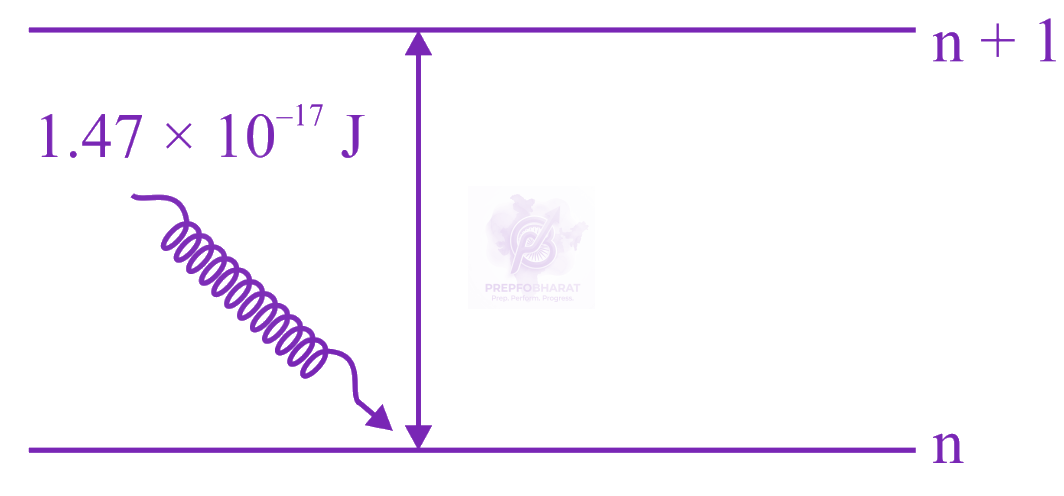 The electron in the ${n}^{\mathrm{th}}$ orbit of ${\mathrm{Li}}^{2+}$ is excited to $(n+1)$ orbit using the radiation of energy $1.47\times {10}^{-17}J$ (as shown in the diagram). The value of $n$ is ___________ Given : ${R}_{H}=2.18\times {10}^{-18}J$
For reaction: ${\mathrm{SO}}_{2}(g)+\frac{1}{2}{O}_{2}(g)\rightleftharpoons {\mathrm{SO}}_{3}(g)$ ${K}_{P}=2\times {10}^{12}$ at $27^{\circ}C$ and $1\mathrm{atm}$ pressure. The ${K}_{c}$ for the same reaction is $\times {10}^{13}.($ Nearest integer) (Given $R=0.082L\mathrm{atm}{K}^{-1}{\mathrm{mol}}^{-1}$ )