JEE Main Chemistry — Physical Chemistry previous year questions with solutions.
Mass of Urea $({\mathrm{NH}}_{2}{\mathrm{CONH}}_{2})$ required to be dissolved in $1000g$ of water in order to reduce the vapour pressure of water by $25%$ is $_______g.$ (Nearest integer) Given : Molar mass of $N,C,O$ and $H$ are $14,12,16$ and $1g{\mathrm{mol}}^{-1}$ respectively.
The number of incorrect statement/s about the black body from the following is______ (A) Emit or absorb energy in the form of electromagnetic radiation. (B) Frequency distribution of the emitted radiation depends on temperature. (C) At a given temperature, intensity vs frequency curve passes through a maximum value. (D) The maximum of the intensity vs frequency curve is at a higher frequency at higher temperature compared to that at lower temperature.
For a first order reaction $A\rightarrow B$, the rate constant, $k=5.5\times {10}^{-14}{s}^{-1}$. The time required for $67%$ completion of reaction is $x\times {10}^{-1}$ times the half life of reaction. The value of $x$ is Nearest integer) (Given : $\mathrm{log}3=0.4771$)
At $30^{\circ}C$, the half life for the decomposition of ${\mathrm{AB}}_{2}$ is $200s$ and is independent of the initial concentration of ${\mathrm{AB}}_{2}$. The time required for $80%$ of the ${\mathrm{AB}}_{2}$ to decompose is (Given: $\mathrm{log}2=0.30$; $\mathrm{log}3=0.48$)
Number of grams of bromine that will completely react with $5.0g$ of pent-$1$-ene is____$\times {10}^{-2}g$. (Atomic mass of $\mathrm{Br}=80g/\mathrm{mol}$) [Nearest integer]
Boiling point of a $2%$ aqueous solution of a nonvolatile solute $A$ is equal to the boiling point of $8%$ aqueous solution of a non-volatile solute $B$. The relation between molecular weights of $A$ and $B$ is.
For the decomposition of azomethane. ${\mathrm{CH}}_{3}{N}_{2}{\mathrm{CH}}_{3}(g)\rightarrow {\mathrm{CH}}_{3}{\mathrm{CH}}_{3}(g)+{N}_{2}$ a first order reaction, the variation in partial pressure with time at $600K$ is given as 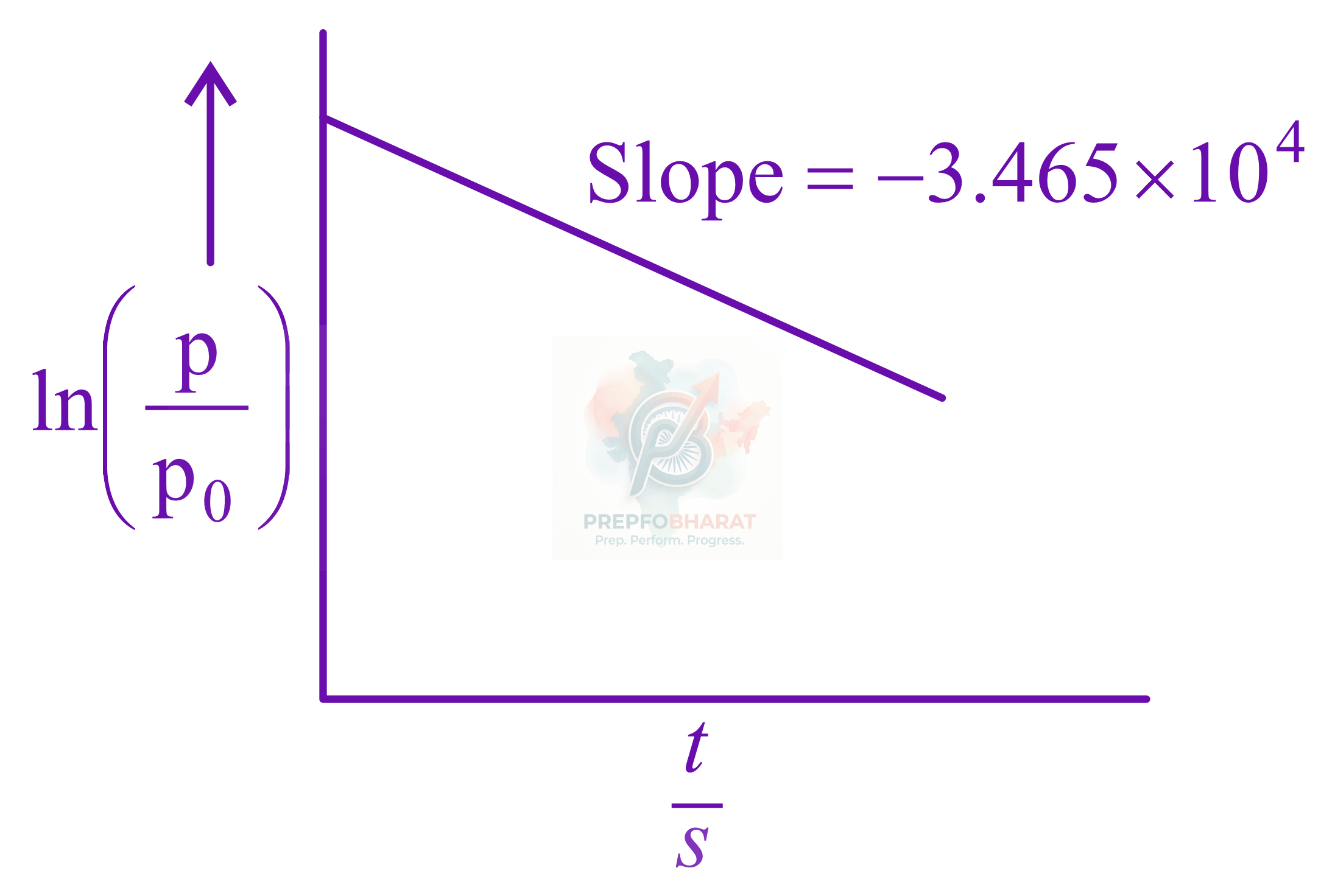 The half life of the reaction is____$\times {10}^{-5}s$
$0.01{\mathrm{MKMnO}}_{4}$ solution was added to $20.0\mathrm{mL}$ of $0.05M\mathrm{Mohr}$ 's salt solution through a burette. The initial reading of $50\mathrm{mL}$ burette is zero. The volume of ${\mathrm{KMnO}}_{4}$ solution left in the burette after the end point is....... $\mathrm{mL}$. (nearest integer)
For the reaction ${H}_{2}{F}_{2}(g)\rightarrow {H}_{2}(g)+{F}_{2}(g)$ $\Delta U=-59.6\mathrm{kJ}{\mathrm{mol}}^{-1}$ at $27^{\circ}C$ The enthalpy change for the above reaction is $(-)$____ ${\mathrm{kJmol}}^{-1}$ (nearest integer) (Given : $R=8.314{\mathrm{JK}}^{-1}{\mathrm{mol}}^{-1}$) .
The complete combustion of $0.492g$ of an organic compound containing '$C$', '$H$' and '$O$' gives $0.793g$ of ${\mathrm{CO}}_{2}$ and $0.442g$ of ${H}_{2}O$. The percentage of oxygen composition in the organic compound is____.(nearest integer)
$20\mathrm{mL}$ of $0.02{\mathrm{MK}}_{2}{\mathrm{Cr}}_{2}{O}_{7}$ solution is used for the titration of $10\mathrm{mL}$ of ${\mathrm{Fe}}^{2+}$ solution in the acidic medium. The molarity of ${\mathrm{Fe}}^{2+}$ solution is____$\times {10}^{-2}M$
$1.80g$ of solute A was dissolved in $62.5{\mathrm{cm}}^{3}$ of ethanol and freezing point of the solution was found to be $155.1K$. The molar mass of solute $A$ is ${\mathrm{gmol}}^{-1}$. [Given: Freezing point of ethanol is $156.0K$. Density of ethanol is $0.80g{\mathrm{cm}}^{-3}$. Freezing point depression constant of ethanol is $2.00K\mathrm{kg}{\mathrm{mol}}^{-1}$]
The limiting molar conductivities of $\mathrm{NaI},{\mathrm{NaNO}}_{3}$ and ${\mathrm{AgNO}}_{3}$ are $12.7,12.0$ and $13.3{\mathrm{mSm}}^{2}{\mathrm{mol}}^{-1}$, respectively (all at $25^{\circ}C$). The limiting molar conductivity of $\mathrm{AgI}$ at this temperature is____${\mathrm{mSm}}^{2}{\mathrm{mol}}^{-1}$.
The minimum energy that must be possessed by photons in order to produce the photoelectric effect with platinum metal is: [Given: The threshold frequency of platinum is $1.3\times {10}^{15}{s}^{-1}$ and $h=6.6\times {10}^{-34}\mathrm{Js}$]
The energy of one mole of photons of radiation of wavelength $300\mathrm{nm}$ is (Given : $h=6.63\times {10}^{-34}Js,{N}_{A}=6.02\times {10}^{23}{\mathrm{mol}}^{-1}c=3\times {10}^{8}m{s}^{-1}$)
${N}_{2(g)}+3{H}_{2(g)}\rightleftharpoons 2{\mathrm{NH}}_{3(g)} 20g5g$ Consider the above reaction. If $20$g of dinitrogen reacts with $5$g of dihydrogen, then the limiting reagent of the reaction and number of moles of ${\mathrm{NH}}_{3}$ formed respectively are
$56.0L$ of nitrogen gas is mixed with excess of hydrogen gas and it is found that $20L$ of ammonia gas is produced, The volume of unused nitrogen gas is found to be_____ $L$.
Among the following the number of state variable is Internal energy $(U)$ Volume $(V)$ Heat $(q)$ Enthalpy $(H)$
Compound $A$ contains $8.7%$ Hydrogen, $74%$ Carbon and $17.3%$ Nitrogen. The molecular formula of the compound is, Given : Atomic masses of $C,H$ and $N$ are $12,1$ and $14$ amu respectively. The molar mass of the compound $A$ is $162g{\mathrm{mol}}^{-1}$.
A radioactive element has a half life of $200$ days. The percentage of original activity remaining after $83$ days is____(Nearest integer) (Given : antilog $0.125=1.333$, antilog $0.693=4.93$)
A flask is filled with equal moles of $A$ and $B$. The half lives of $A$ and $B$ are $100s$ and $50s$ respectively and are independent of the initial concentration. The time required for the concentration of $A$ to be four times that of $B$ is____$s$. (Given : $\mathrm{ln}2=0.693$)
Given below are the quantum numbers for $4$ electrons. A. $n=3,l=2,{m}_{1}=1,{m}_{s}=+\frac{1}{2}$ B. $n=4,l=1,{m}_{1}=0,{m}_{s}=+\frac{1}{2}$ C. $n=4,l=2,{m}_{1}=-2,{m}_{s}=-\frac{1}{2}$ D. $n=3,l=1,{m}_{1}=-1,{m}_{s}=+\frac{1}{2}$ The correct order of increasing energy is
The reaction between $X$ and $Y$ is first order with respect to $X$ and zero order with respect to $Y$. <table class="pyq-table"><tbody><tr><td>Experiment</td><td>$\frac{[X]}{{\mathrm{molL}}^{-1}}$</td><td>$\frac{[Y]}{{\mathrm{molL}}^{-1}}$</td><td>$\frac{\mathrm{Initial}rate}{\mathrm{mol}{L}^{-1}{\mathrm{min}}^{-1}}$</td></tr><tr><td>I</td><td>$0.1$</td><td>$0.1$</td><td>$2\times {10}^{-3}$</td></tr><tr><td>II</td><td>$L$</td><td>$0.2$</td><td>$4\times {10}^{-3}$</td></tr><tr><td>III</td><td>$0.4$</td><td>$0.4$</td><td>$M\times {10}^{-3}$</td></tr><tr><td>IV</td><td>$0.1$</td><td>$0.2$</td><td>$2\times {10}^{-3}$</td></tr></tbody></table>Examine the data of table and calculate ratio of numerical values of $M$ and $L$.
A $0.5$ percent solution of potassium chloride was found to freeze at $-0.24^{\circ}C$. The percentage dissociation of potassium chloride is (Nearest integer) (Molal depression constant for water is $1.80K\mathrm{kg}{\mathrm{mol}}^{-1}$ and molar mass of $\mathrm{KCl}$ is $74.6g{\mathrm{mol}}^{-1}$)