Gause's competitive exclusion principle states that two closely related species competing for the same resources cannot exist indefinitely and the competitively inferior one will be eliminated eventually. This may be true if resources are limiting.
Given below are two statements: Statement I: Gause's competitive exclusion principle states that two closely related species competing for different…
NEET UG 2024 — Zoology Organisms and Populations
2024mcqeasy
Given below are two statements: Statement I: Gause's competitive exclusion principle states that two closely related species competing for different resources cannot exist indefinitely. Statement II: According to Gause's principle, during competition, the inferior will be eliminated. This may be true if resources are limiting. In the light of the above statements, choose the correct answer from the options given below :
Official previous-year question
Held on 30 Apr 2024 · Verified 9 Jul 2026.
Options
- A
Both Statement I and Statement II are false.
- B
Statement I is true but Statement II is false.
- C
Statement I is false but Statement II is true.
- D
Both Statement I and Statement II are true.
Did you get this right?
Sign in to track your attempts and accuracy.
Your note
Sign in to keep a private note on this question. Nothing you write is ever public.
NEET UG Organisms and Populations in other years
Organisms and Populations 2025Organisms and Populations 2023Organisms and Populations 2022Organisms and Populations 2021Organisms and Populations 2020Organisms and Populations 2019Organisms and Populations 2018Organisms and Populations 2017Organisms and Populations 2016Organisms and Populations 2015Organisms and Populations 2014Organisms and Populations 2013
More NEET UG Organisms and Populations questions
Epiphytes that are growing on a mango branch is an example of which of the following?
2025easy
Given below are two statements : Statement I : Fig fruit is a non-vegetarian fruit as it has enclosed fig wasps in it. Statement II : Fig wasp and fig tree exhibit mutual relationship as fig wasp completes its life cycle in fig fruit and fig fruit gets pollinated by fig wasp. In the light of the above statements, choose the most appropriate answer from the options given below :
2025medium
Which one of the following equations represents the Verhulst-Pearl Logistic Growth of population?
2025easy
Who is known as the father of Ecology in India?
2025easy
What do 'a' and 'b' represent in the following population growth curve? 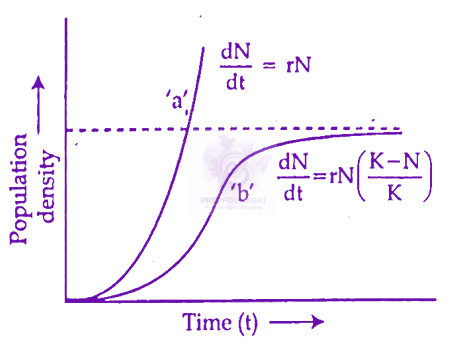
2024medium
Other Zoology topics for NEET UG
Keep practicing Organisms and Populations
Work through every NEET UG Organisms and Populations PYQ, year by year.