NEET UG 2024 — Organisms and Populations
Zoology Organisms and Populations questions from NEET UG 2024.
Other Years
6 Organisms and Populations Questions from 2024
What do 'a' and 'b' represent in the following population growth curve? 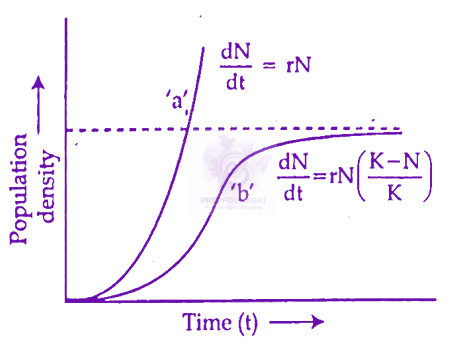
Match List-I with List-II: \begin{array}{|l|l|l|l|}\hline & List I & & List II \\\hline A. & Predator & I. & Ophrys \\\hline B. & Mutualism & II. & Pisaster \\\hline C. & Parasitism & III. & Female wasp and fig \\\hline D & Sexual deceit & IV. & Plasmodium \\\hline\end{array} Chose the correct answer from the options given below:
Given below are two statements: Statement I: Gause's competitive exclusion principle states that two closely related species competing for different resources cannot exist indefinitely. Statement II: According to Gause's principle, during competition, the inferior will be eliminated. This may be true if resources are limiting. In the light of the above statements, choose the correct answer from the options given below :
When will the population density increase, under special conditions? When the number of :
Match List-I with List-II $\begin{array}{|l|l|r|l|}\hline & \text{List-I} & & \text{List-II} \\ \hline A. & \text{Migratory flamingoes and resident fish in South American lakes} & I. & \text{Interference competition} \\ \hline B. & \begin{array}{l} \text{Abingdon tortoise became extinct after introduction of goats in their} \\ \text{habitat} \end{array} & II. & \text{Competitive release} \\ \hline C. & \begin{array}{l} \text{Chathamalus expands its distributional range in the absence of} \\ \text{Balanus} \end{array} & III. & \text{Resource Partitioning} \\ \hline D. & \begin{array}{l} \text{Five closely related species of Warblers feeding in different} \\ \text{locations on same tree} \end{array} & IV. & \text{Interspecific competition} \\ \hline \end{array}$ Choose the correct answer from the options given below:
The equation of Verhulst-Pearl logistic growth is $\frac{\mathrm{dN}}{\mathrm{dt}}=\mathrm{rN}\left[\frac{\mathrm{K}-\mathrm{N}}{\mathrm{K}}\right]$. From this equation, K indicates: