Organisms and Populations PYQ
NEET UG Zoology — Organisms and Populations previous year questions with solutions.
Browse by Year
Organisms and Populations at a glance
Questions per year
97 across 23 yearsDifficulty mix
97 total- easy57 · 59%
- medium33 · 34%
- hard7 · 7%
All Organisms and Populations Questions (97)
Which one of the following equations represents the Verhulst-Pearl Logistic Growth of population?
Given below are two statements : Statement I : Fig fruit is a non-vegetarian fruit as it has enclosed fig wasps in it. Statement II : Fig wasp and fig tree exhibit mutual relationship as fig wasp completes its life cycle in fig fruit and fig fruit gets pollinated by fig wasp. In the light of the above statements, choose the most appropriate answer from the options given below :
Who is known as the father of Ecology in India?
Epiphytes that are growing on a mango branch is an example of which of the following?
What do 'a' and 'b' represent in the following population growth curve? 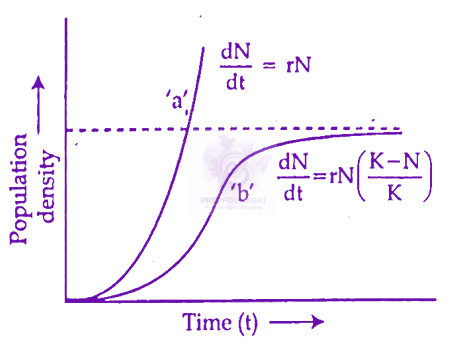
Match List-I with List-II: \begin{array}{|l|l|l|l|}\hline & List I & & List II \\\hline A. & Predator & I. & Ophrys \\\hline B. & Mutualism & II. & Pisaster \\\hline C. & Parasitism & III. & Female wasp and fig \\\hline D & Sexual deceit & IV. & Plasmodium \\\hline\end{array} Chose the correct answer from the options given below:
Given below are two statements: Statement I: Gause's competitive exclusion principle states that two closely related species competing for different resources cannot exist indefinitely. Statement II: According to Gause's principle, during competition, the inferior will be eliminated. This may be true if resources are limiting. In the light of the above statements, choose the correct answer from the options given below :
When will the population density increase, under special conditions? When the number of :
Match List-I with List-II $\begin{array}{|l|l|r|l|}\hline & \text{List-I} & & \text{List-II} \\ \hline A. & \text{Migratory flamingoes and resident fish in South American lakes} & I. & \text{Interference competition} \\ \hline B. & \begin{array}{l} \text{Abingdon tortoise became extinct after introduction of goats in their} \\ \text{habitat} \end{array} & II. & \text{Competitive release} \\ \hline C. & \begin{array}{l} \text{Chathamalus expands its distributional range in the absence of} \\ \text{Balanus} \end{array} & III. & \text{Resource Partitioning} \\ \hline D. & \begin{array}{l} \text{Five closely related species of Warblers feeding in different} \\ \text{locations on same tree} \end{array} & IV. & \text{Interspecific competition} \\ \hline \end{array}$ Choose the correct answer from the options given below:
The equation of Verhulst-Pearl logistic growth is $\frac{\mathrm{dN}}{\mathrm{dt}}=\mathrm{rN}\left[\frac{\mathrm{K}-\mathrm{N}}{\mathrm{K}}\right]$. From this equation, K indicates:
Given below are two statements: Statement I: Gause's 'Competitive Exclusion Principle' states that two closely related species competing for the same resources cannot co- exist indefinitely and competitively inferior one will be eliminated eventually. Statement II: In general, carnivores are more adversely affected by competition than herbivores. In the light of the above statements, choose the correct answer from the options given below:
Match List I with List II: <table class="pyq-table"><tbody><tr><td>List I (Interacting species)</td><td>List II (Name of Interaction)</td></tr><tr><td>A. A Leopard and a Lion in a forest/grassland</td><td>I. Competition</td></tr><tr><td>B. A Cuckoo laying egg in a Crow's nest</td><td>II. Brood parasitism</td></tr><tr><td>C. Fungi and root of a higher plant in Mycorrhizae</td><td>III. Mutualism</td></tr><tr><td>D. A cattle egret and a Cattle in a field</td><td>IV. Commensalism</td></tr></tbody></table>Choose the correct answer from the options given below:
Given below are two statements: one is labelled as Assertion (A) and the other is labelled as Reason (R). Assertion (A) : A person goes to high altitude and experiences "Altitude Sickness" with symptoms like breathing difficulty and heart palpitations. Reason (R) : Due to low atmospheric pressure at high altitude, the body does not get sufficient oxygen. In the light of the above statements, choose the correct answer from the options given below :
Match List I with List II: <table class="pyq-table"><tbody><tr><td>List I (Interaction)</td><td>List II (Species A and B)</td></tr><tr><td>A. Mutualism</td><td>I. +(A), 0(B)</td></tr><tr><td>B. Commensalism</td><td>II. -(A), 0(B)</td></tr><tr><td>C. Amensalism</td><td>III. +(A), -(B)</td></tr><tr><td>D. Parasitism</td><td>IV. +(A), +(B)</td></tr></tbody></table>Choose the correct answer from the options given below:
Plants offer rewards to animals in the form of pollen and nectar and the animals facilitate the pollination process. This is an example of :
For chemical defence against herbivores, Calotropis has
If there are 250 snails in a pond, and within a year their number increases to 2500 by reproduction. What should be their birth rate per snail per year?
Match List I with List II: <table class="pyq-table"><tbody><tr><td>List I</td><td>List II</td></tr><tr><td>A. Logistic growth</td><td>I. Unlimited resource availability condition</td></tr><tr><td>B. Exponential growth</td><td>II. Limited resource availability condition</td></tr><tr><td>C. Expanding age pyramid</td><td>III. The percent individuals of pre-reproductive age is largest followed by reproductive and post reproductive age groups</td></tr><tr><td>D. Stable age pyramid</td><td>IV. The percent individuals of pre-reproductives and reproductive age group are same</td></tr></tbody></table>Choose the correct answer from the options given below:
While explaining interspecific interaction of population, $(+)$ sign is assigned for beneficial interaction, $(-)$ sign is assigned for detrimental interaction and $(0)$ for neutral interaction. Which of the following interactions can be assigned $(+)$ for one species and $(-)$ for another species involved in the interaction?
If '$8$' Drosophila in a laboratory population of '$80$' died during a week, the death rate in the population is ____ individuals per Drosophila per week.
Which one of the following statements cannot be connected to Predation?
Frugivorous birds are found in large numbers in tropical forests mainly because of :
The species that come to appear in bare area are called :
Two butterfly species are competing for the same nectar of a flower in a garden. To survive and coexist together, they may avoid competition in the same garden by: