Organisms and Populations PYQ — Page 2
NEET UG Zoology — Organisms and Populations previous year questions with solutions.
All Organisms and Populations Questions (97)
Inspite of interspecific competition in nature, which mechanism the competing species might have evolved for their survival?
Match List$-I$ with List$-\mathrm{II}$. <table class="pyq-table"><tbody><tr><td colspan="2" rowspan="1">List$-I$</td><td colspan="2" rowspan="1">List$-\mathrm{II}$</td></tr><tr><td>(a)</td><td>Allen's Rule</td><td>(i)</td><td>Kangaroo rat</td></tr><tr><td>(b)</td><td>Physiological adaptation</td><td>(ii)</td><td>Desert lizard</td></tr><tr><td>(c)</td><td>Behavioural adaptation</td><td>(iii)</td><td>Marine fish at depth</td></tr><tr><td>(d)</td><td>Biochemical adaptation</td><td>(iv)</td><td>Polar seal</td></tr></tbody></table>
Amensalism can be represented as:
In the exponential growth equation ${N}_{t}={N}_{0}{e}^{\mathrm{rt}},e,$ represents:
Assertion (A): A person goes to high altitude and experiences 'altitude sickness' with symptoms like breathing difficulty and heart palpitations. Reason (R): Due to low atmospheric pressure at high altitude, the body does not get sufficient oxygen. In the light of the above statements, choose the correct answer from the options given below.
Which of the following is not an attribute of a population?
Match the items in Column$-I$ with those in Column$-\mathrm{II}$: <table class="pyq-table"><tbody><tr><td colspan="2" rowspan="1">Column$-I$</td><td colspan="2" rowspan="1">Column$-\mathrm{II}$</td></tr><tr><td>(a)</td><td>Herbivores-Plants</td><td>(i)</td><td>Commensalism</td></tr><tr><td>(b)</td><td>Mycorrhiza-Plants</td><td>(ii)</td><td>Mutualism</td></tr><tr><td>(c)</td><td>Sheep-Cattle</td><td>(iii)</td><td>Predation</td></tr><tr><td>(d)</td><td>Orchid-Tree</td><td>(iv)</td><td>Competition</td></tr></tbody></table>Select the correct option from following:
The impact of immigration on population density is:
Between which among the following, the relationship is not an example of commensalism?
Carnivorous animals-lions and leopards, occupy the same niche but lions predate mostly larger animals and leopards take smaller ones. This mechanism of competition is referred to as
A population of a species invades a new area. Which of the following conditions will lead to adaptive radiation?
Match Column - I with Column - II<table class="pyq-table"><tbody><tr><th></th><th>Column-I</th><th></th><th>Column-II</th></tr><tr><td>$(a)$</td><td>Saprophyte</td><td>$(i)$</td><td>Symbiotic association of fungi with plant roots</td></tr><tr><td>$(b)$</td><td>Parasite</td><td>$(ii)$</td><td>Decomposition of dead organic materials</td></tr><tr><td>$(c)$</td><td>Lichens</td><td>$(iii)$</td><td>Living on living plants</td></tr><tr><td>$(d)$</td><td>Mycorrhiza</td><td>$(iv)$</td><td>Symbiotic association of algae and fungi</td></tr></tbody></table> Choose the correct answer from the options given below:
Which one of the following population interactions is widely used in medical science for the production of antibiotics?
Natality refers to
Niche is
In a growing population of the country,
Asymptote is a logistic growth curve is obtained when
The principle of competitive exclusion was stated by
Which of the following is correct for r-selected species?
When does the growth rate of a population following the logistic model equal zero? The logistic model is given as $dN/dt=rN(1-N/K):$
If ' $+$ ' sign is assigned to beneficial interaction, ' $–$ ' sign to detrimental and ' $0$ ' sign to neutral interaction, then the population interaction represented by '+' '-' refers to
Gause's principle of competitive exclusion states that:
The primary producers of the deep-sea hydrothermal vent ecosystem are
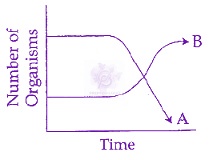
The following graph depicts changes in two populations (A and B) of herbivores in a grassy field. A possible reason for these changes is that.