Organisms and Populations PYQ — Page 3
NEET UG Zoology — Organisms and Populations previous year questions with solutions.
All Organisms and Populations Questions (97)
Root does not help in the absorption of water in which of the following plant?
The species confined to a particular region and not found elsewhere termed as:
Most animals are tree dwellers in a:
In which of the following interaction both partners are adversely affected?
Match the following and select the correct option: <table class="pyq-table"><tbody><tr><td>(a)</td><td>Earthworm</td><td>(p)</td><td>Pioneer species</td></tr><tr><td>(b)</td><td>Succession</td><td>(q)</td><td>Detrivore</td></tr><tr><td>(c)</td><td>Ecosystem service</td><td>(r)</td><td>Natality</td></tr><tr><td>(d)</td><td>Population growth</td><td>(s)</td><td>Pollination</td></tr></tbody></table>
A sedentary sea anemone gets attached to the shell lining of hermit crab. The association is
A biologist studied the population of rats in a barn. He found that the average natality was 250 , average mortality 240, immigration 20 and emigration 30. The net increase in population is
Consider the following four conditions (I-IV) and select the correct pair of them as adaptation to environment in desert lizards. The conditions : I. Burrowing in soil to escape high temperature II. Losing heat rapidly from the body during high temperature III. Bask in sun when temperature is low IV. Insulating body due to thick fatty dermis
Large woody vines are more commonly found in
The logistic population growth is expressed by the equation
Consider the following statements (I)-(IV) each with one or two blanks. I. Bears go into (1) during winter to ......(2) ...... cold weather. II. A conical age pyramid with a broad base represents......(3)..... human population. III. A wasp pollinating a fig flower is an example of (4) ...... IV. An area with high levels of species richness is known as ......(5)...... Which one of the following options give the correct fill up the respective blanks numbers from (1) to (5) in the statements.
Study the four statements (1-4) given below and select the two correct ones out of them. (1) A lion eating a deer and a sparrow feeding on grain are ecologically similar in being consumers (2) Predator star fish Pisaster helps in maintaining species diversity of some invertebrates (3) Predators ultimately lead to the extinction of prey species (4) Production of chemicals such as nicotine, strychnine by the plants are metabolic disorders The two correct statements are
Which one of the following is most appropriately defined?
The figure given below is a diagrammatic representation of response of organisms to abiotic factors. What do A, B and C represent respectively? 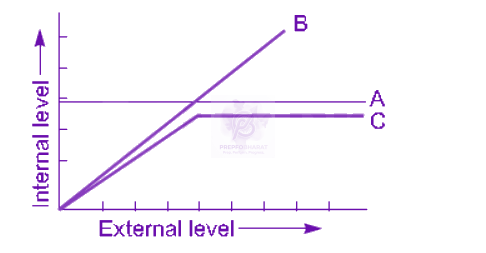 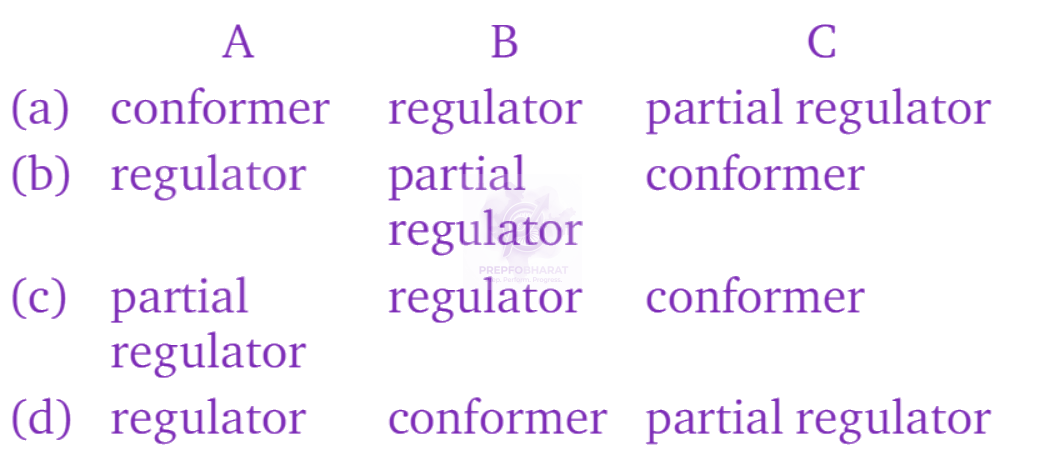
Which one of the following is one of the characteristics of a biological community?
A country with a high rate of population growth took measures to reduce it. The figure below shows age-sex pyramids of populations $A$ and $B$ twenty years apart. Select the correct interpretation about them :- 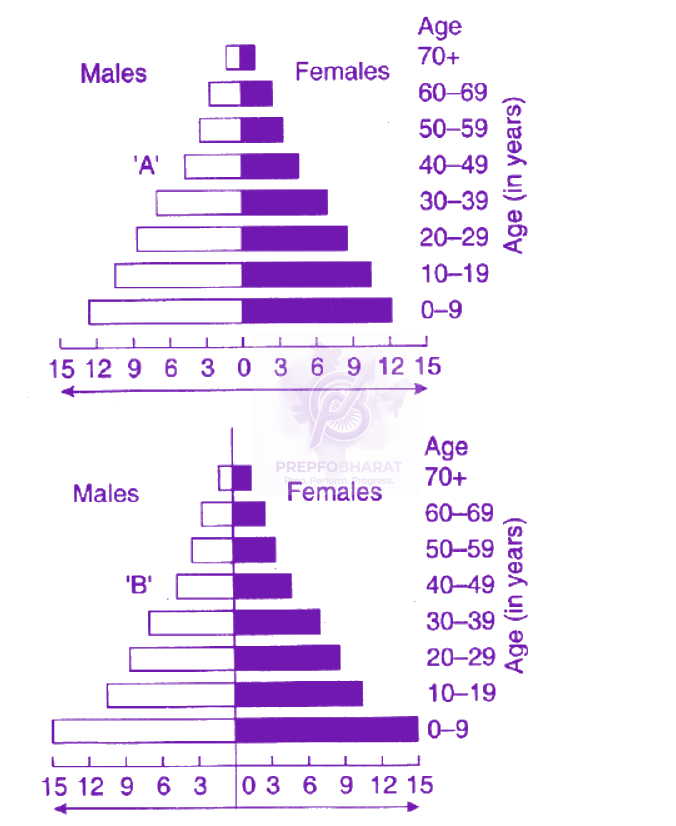
Consider the following four statements (A-D) about certain desert animals such as kangaroo rat A. they have dark colour and high rate of reproduction and excrete solid urine. B. they do not drink water, breathe at a slow rate to conserve water and have their body covered with thick hairs. C. they feed on dry seeds and do not require drinking water. D. they excrete very concentrated urine and do not use water to regulate body temperature. Which two of the above statements for such animals are true?
Consider the following four statements $(\mathrm{a}-\mathrm{d})$ about certain desert animals such as kangaroo rat. (a) They have dark colour and high rate of reproduction and excrete solid urine (b) They do not drink water, breathe at a slow rate to conserve water and have their body covered with thick hairs (c) They feed on dry seeds and do not require drinking water (d) They excrete very concentrated urine and do not use water to regulate body temperature Which two of the above statements for such animals are true?
What is true about the isolated small tribal populations?
What is true about the isolated small tribal populations?
The table below gives the populations (in thousands) of ten species $(\mathrm{A}-\mathrm{J})$ in four areas $(a-d)$ consisting of the number of habitats given within brackets against each. Study the table and answer the question which follows 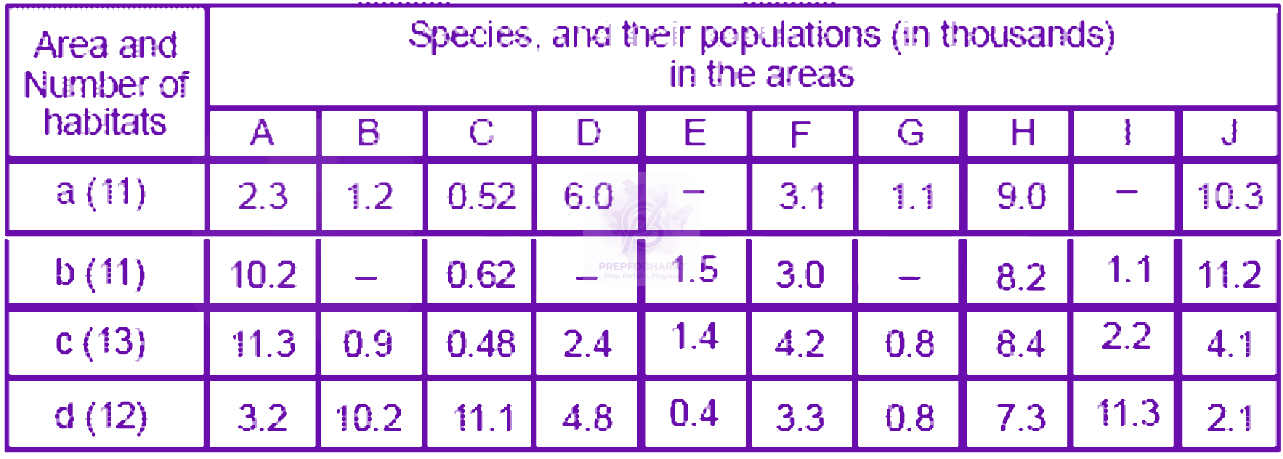 Which area out of a to $\mathrm{d}$ shows maximum species diversity?
Quercus species are the dominant component in
About $70 \%$ of total global carbon is found in
The table below gives the populations (in thousands) of ten species $(A-J)$ in four areas (a-d) consisting of the number of habitats given within brackets against each. Study the table and answer the question which follows: 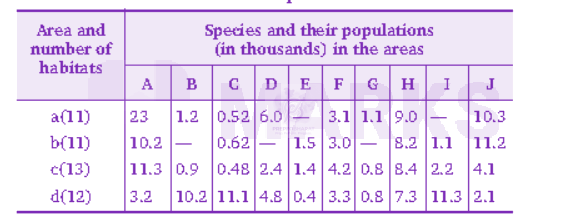 Which area out of a to d shows maximum species diversity?