NEET UG 2008 — Organisms and Populations
Zoology Organisms and Populations questions from NEET UG 2008.
Other Years
8 Organisms and Populations Questions from 2008
Consider the following four statements $(\mathrm{a}-\mathrm{d})$ about certain desert animals such as kangaroo rat. (a) They have dark colour and high rate of reproduction and excrete solid urine (b) They do not drink water, breathe at a slow rate to conserve water and have their body covered with thick hairs (c) They feed on dry seeds and do not require drinking water (d) They excrete very concentrated urine and do not use water to regulate body temperature Which two of the above statements for such animals are true?
What is true about the isolated small tribal populations?
What is true about the isolated small tribal populations?
The table below gives the populations (in thousands) of ten species $(\mathrm{A}-\mathrm{J})$ in four areas $(a-d)$ consisting of the number of habitats given within brackets against each. Study the table and answer the question which follows 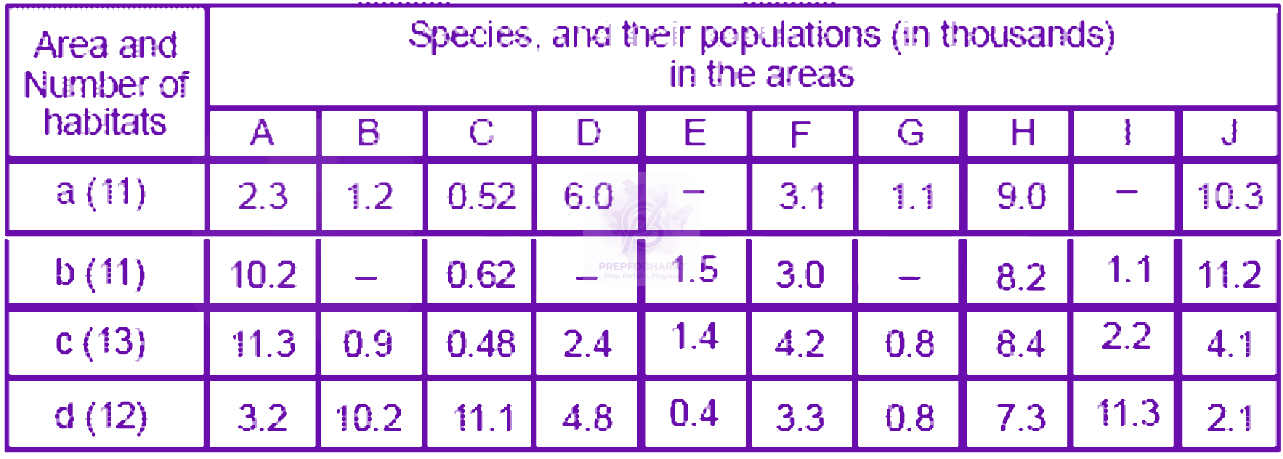 Which area out of a to $\mathrm{d}$ shows maximum species diversity?
Quercus species are the dominant component in
About $70 \%$ of total global carbon is found in
The table below gives the populations (in thousands) of ten species $(A-J)$ in four areas (a-d) consisting of the number of habitats given within brackets against each. Study the table and answer the question which follows: 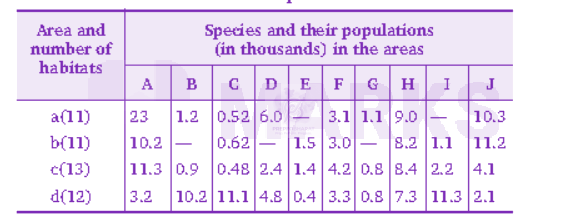 Which area out of a to d shows maximum species diversity?
Consider the following four statements (A-D) about certain desert animals such as kangaroo rat A. they have dark colour and high rate of reproduction and excrete solid urine. B. they do not drink water, breathe at a slow rate to conserve water and have their body covered with thick hairs. C. they feed on dry seeds and do not require drinking water. D. they excrete very concentrated urine and do not use water to regulate body temperature. Which two of the above statements for such animals are true?