| Species | Cranial capacity |
| Homo habilis | 650-800 cc |
| Homo neanderthalensis | 1400 cc |
| Homo erectus | 900 cc |
| Homo sapiens | 1350 cc |
Match the hominids with their correct brain size: Column - I Column - II (a) Homo habilis (i) 900 cc (b) Homo neanderthalensis (ii) 1350 cc (c) Homo…
NEET UG 2019 — Zoology Evolution
2019mcqmedium
Match the hominids with their correct brain size:
| Column - I | Column - II | ||
|---|---|---|---|
| (a) | Homo habilis | (i) | 900 cc |
| (b) | Homo neanderthalensis | (ii) | 1350 cc |
| (c) | Homo erectus | (iii) | 650-800 cc |
| (d) | Homo sapiens | (iv) | 1400 cc |
Select the correct option.
Official previous-year question
Held on 30 Apr 2019 · Verified 9 Jul 2026.
Options
- A
a−(iii);b−(i);c−(iv);d−(ii)
- B
a−(iii);b−(ii);c−(i);d−(iv)
- C
a−(iii);b−(iv);c−(i);d−(ii)
- D
a−(iv);b−(iii);c−(i);d−(ii)
Did you get this right?
Sign in to track your attempts and accuracy.
Your note
Sign in to keep a private note on this question. Nothing you write is ever public.
NEET UG Evolution in other years
More NEET UG Evolution questions
Sweet potato and potato represent a certain type of evolution. Select the correct combination of terms to explain the evolution.
2025easy
Match List I with List II: 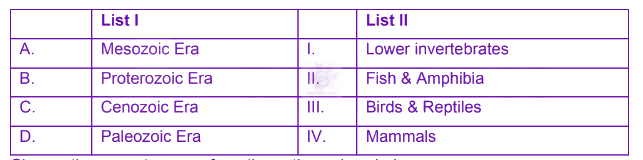 Choose the correct answer from the options given below :
2024easy
Which one of the following factors will not affect the Hardy-Weinberg equilibrium?
2024easy
Given below are some stages of human evolution. Arrange them in correct sequence. (Past to Recent) A. Homo habilis B. Homo sapiens C. Homo neanderthalensis D. Homo erectus Choose the correct sequence of human evolution from the options given below:
2024medium
The flippers of the Penguins and Dolphins are the example of the
2024medium
Other Zoology topics for NEET UG
Keep practicing Evolution
Work through every NEET UG Evolution PYQ, year by year.