Modern Physics PYQ — Page 3
NEET UG Physics — Modern Physics previous year questions with solutions.
All Modern Physics Questions (300)
Let ${T}_{1}$ and ${T}_{2}$ be the energy of an electron in the first and second excited states of hydrogen atom, respectively. According to the Bohr's model of an atom, the ratio ${T}_{1}:{T}_{2}$ is
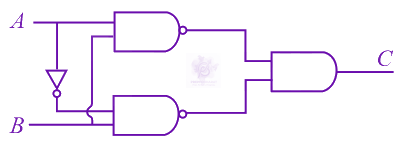 The truth table for the given logic circuit is:
Given below are two statements: Statement I: The law of radioactive decay states that the number of nuclei undergoing the decay per unit time is inversely proportional to the total number of nuclei in the sample. Statement II: The half life of a radionuclide is the sum of the life time of all nuclei, divided by the initial concentration of the nuclei at time $t=0$. In the light of the above statements, choose the most appropriate answer from the options given below:
Let $R_1$ be the radius of the second stationary orbit and $R_2$ be the radius of the fourth stationary orbit of an electron in Bohr's model. The ratio $\frac{R_1}{R_2}$ is:
In the given nuclear reaction, the element $X$ is $\mathrm{Na}1122\rightarrow X+{e}^{+}+v$
The photoelectric effect was explained by
Consider the following statements (A) and (B) and identify the correct answer. (A) A Zener diode is connected in reverse bias when used as a voltage regulator. (B) The potential barrier of $p-n$ junction lies between $0.1V$ to $0.3V$.
A radioactive nucleus $\begin{matrix}A \\ Z\end{matrix}X$ undergoes spontaneous decay in the sequence $\begin{matrix}A \\ Z\end{matrix}X\rightarrow \begin{matrix} \\ (Z-1)\end{matrix}B\rightarrow \begin{matrix} \\ (Z-3)\end{matrix}C\rightarrow \begin{matrix} \\ (Z-2)\end{matrix}D$, where $Z$ is the atomic number of element $X$. The possible decay particles in the sequence are:
An electromagnetic wave of wavelength $\lambda$ is incident on a photosensitive surface of negligible work function. If $m$ mass is of photoelectron emitted from the surface has de-Broglie wavelength ${\lambda }_{d}$, then :
A nucleus with mass number $240$ breaks into two fragments each of mass number $120,$ the binding energy per nucleon of unfragmented nuclei is $7.6\mathrm{MeV}$ while that of fragments is $8.5\mathrm{MeV}$. The total gain in the binding energy in the process is :
For the given circuit, the input digital signals are applied at the terminals $A,B$ and $C$. What would be the output at the terminal $y$ ? 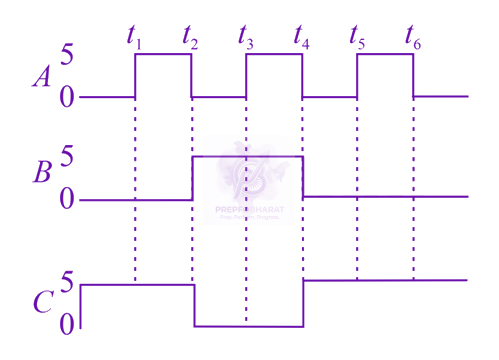 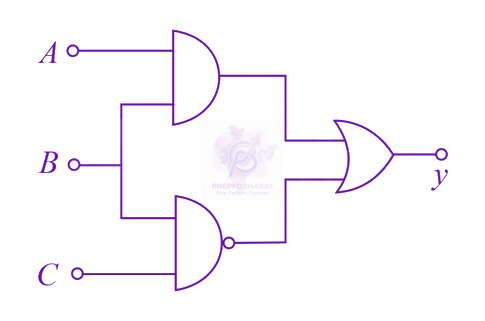
The electron concentration in an undefined $n$-type semiconductor is the same as hole concentration in a undefined $p$-type semiconductor. An external field (electric) is applied across each of them. Compare the currents in them.
The number of photons per second on an average emitted by the source of monochromatic light of wavelength $600\mathrm{nm}$, when it delivers the power of $3.3\times {10}^{-3}W$ will be $:(h=6.6\times {10}^{-34}Js)$
The half-life of a radioactive nuclide is $100$ hours. The fraction of original activity that will remain after $150$ hours would be :
In Bohrs model, the radius of nth orbit is proportional to
An intrinsic semiconductor is converted into $n$-type extrinsic semiconductor by doping it with:-
The total energy of an electron in the ${n}^{\text{th }}$ stationary orbit of the hydrogen atom can be obtained by
Which of the following gate is called universal gate?
For the logic circuit shown, the truth table is: 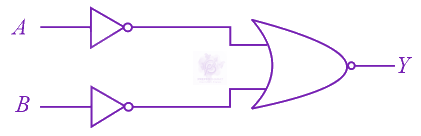
The de-Broglie wavelength of an electron moving with kinetic energy of $144\mathrm{eV}$ is nearly
What happens to the mass number and atomic number of an element when it emits $\gamma$-radiation
The increase in the width of the depletion region in a p-n junction diode is due to:
Light of frequency $1.5$ times the threshold frequency is incident on a photosensitive material. What will be the photoelectric current if the frequency is halved and intensity is doubled?
The half life of radioactive sample undergoing $\alpha$-decay is $1.4\times {10}^{17}s.$ If the number of nuclei in the sample is $2.0\times {10}^{21},$ the activity of the sample is nearly: