Modern Physics PYQ — Page 4
NEET UG Physics — Modern Physics previous year questions with solutions.
All Modern Physics Questions (300)
Out of the following which one is a forward biased diode?
When a uranium isotope $U92235$ is bombarded with a neutron, it generates $\mathrm{Kr}3689$, three neutrons and:
The energy equivalent of $0.5g$ of a substance is:
An electron is accelerated from rest through a potential difference of $V$ volt. If the de Broglie wavelength of the electron is $1.227\times {10}^{–2} \mathrm{nm}$, the potential difference is:
The solids which have the negative temperature coefficient of resistance are:
For which one of the following, Bohr model is not valid?
The binding energy per nucleon is maximum for
An electron is accelerated through a potential difference of $10,000 V.$ Its de Broglie wavelength is (nearly): $({m}_{e}=9\times 1{0}^{-31} kg)$
The total energy of an electron in an atom in an orbit is $-3.4 eV.$ Its kinetic and potential energies are, respectively,
The work function of a photosensitive material is $4.0 \mathrm{eV}$. This longest wavelength of light that can cause photon emission from the substance is (approximately)
The rate of radioactive disintegration at an instant for a radioactive sample of half life $2.2 \times 10^9 \mathrm{~s}$ is $10^{10} \mathrm{~s}^{-1}$. The number of radioactive atoms in that sample at that instant is
For a $p-$type semiconductor, which of the following statements is true?
$\text{α}$-particle consists of
The radius of the first permitted Bohr orbit for the electron, in a hydrogen atom equals $0.51 Å$ and its ground state energy equals $-13.6 \mathrm{eV}$. If the electron in the hydrogen atom is replaced by muon $\left(\mu^{-1}\right)$ [Charge same as electron and mass $207 \mathrm{~m}_{\mathrm{e}}$ ], the first Bohr radius and ground state energy will be
The circuit diagram shown here corresponds to the logic gate, 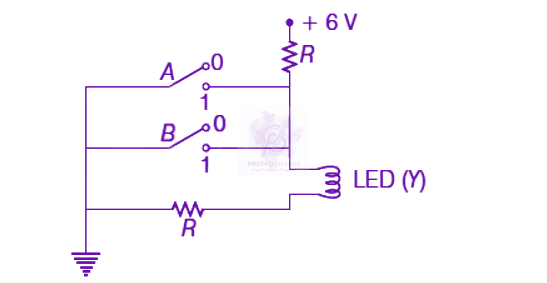
The correct Boolean operation represented by the circuit diagram drawn is, 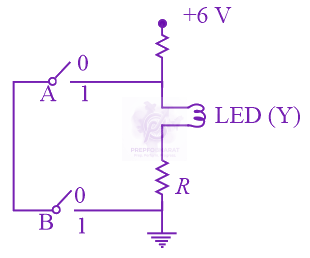
An LED is constructed from a p-n junction diode using GaAsP. The energy gap is $1.9 \mathrm{eV}$. The wavelength of the light emitted will be equal to
A proton and an $\alpha$-particle are accelerated from rest to the same energy. The de-Broglie wavelengths $\lambda_p$ and $\lambda_\alpha$ are in the ratio
In the circuit shown in the figure, the input voltage ${V}_{i} \text{is} 20 V, {V}_{BE}=0 \text{and} {V}_{CE}=0$. The values of ${I}_{B},{I}_{C} \text{and} \beta$ are given by 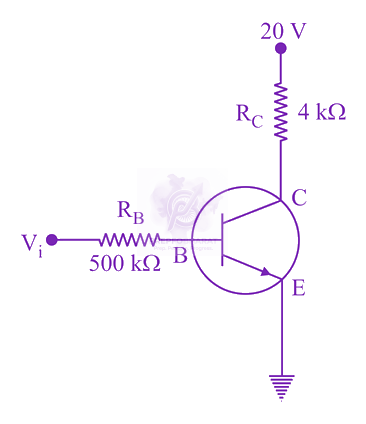
In the combination of the following gates the output $Y$ can be written in terms of inputs $A$ and $B$ as 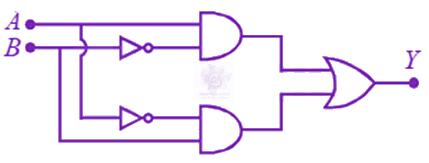
The ratio of kinetic energy to the total energy of an electron in a Bohr orbit of the hydrogen atom is
An electron of mass $m$ with an initial velocity $\vec{V}={V}_{0} \hat{i} ({V}_{0}>0)$ enters in an electric field $\vec{E}={-E}_{0}\hat{i}({E}_{0}>0$ and is a constant$)$ at $t=0$. If ${\lambda }_{0}$ is its de-Broglie wavelength initially, then its de-Broglie wavelength at time $t$ is
When the light of frequency $2{\nu }_{0}$ (where ${\nu }_{0}$ is threshold frequency), is incident on a metal plate, the maximum velocity of electrons emitted is ${v}_{1}$. When the frequency of the incident radiation is increased to $5{\nu }_{0},$ the maximum velocity of electrons emitted from the same plate is ${v}_{2}.$ The ratio of ${v}_{1} to {v}_{2}$ is
In a $p-n$ junction diode, change in temperature due to heating