Modern Physics PYQ — Page 2
NEET UG Physics — Modern Physics previous year questions with solutions.
All Modern Physics Questions (300)
In hydrogen spectrum, the shortest wavelength in the Balmer series is$\lambda$. The shortest wavelength in the Brackett series is :
The minimum wavelength of $X$-rays produced by an electron accelerated through a potential difference of$V$ volts is proportional to:
The given circuit is equivalent to 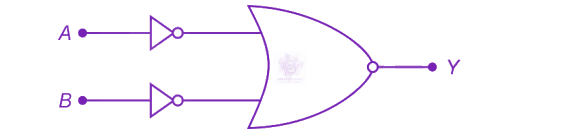
The wavelength of Lyman series of hydrogen atom appears in
A full wave rectifier circuit consists of two $p-n$ junction diodes, a centre-tapped transformer, capacitor and a load resistance. Which of these components remove the ac ripple from the rectified output?
For the following logic circuit, the truth table is: 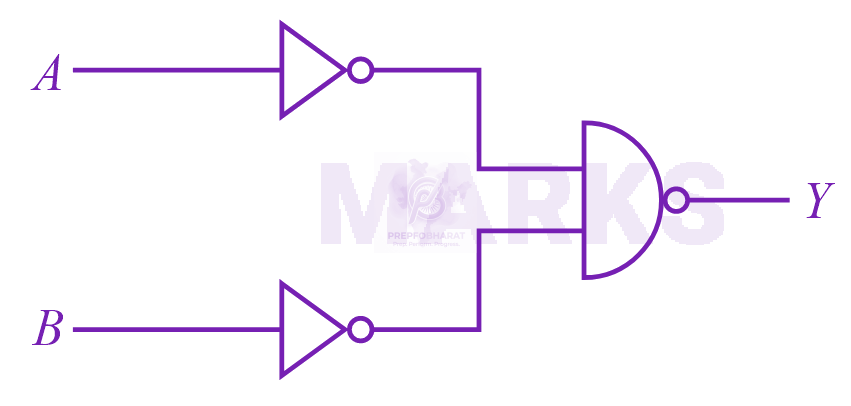
A p-type extrinsic semiconductor is obtained when Germanium is doped with
The half life of a radioactive substance is$20$minutes. In how much time, the activity of substance drops to $(\frac{1}{16})th$ of its initial value?
The maximum kinetic energy of the emitted photoelectrons in photoelectric effects is independent of:
The work functions of Caesium $(Cs)$, Potassium$(K)$ and Sodium $(Na)$ $2.14\mathrm{eV},2.30\mathrm{eV}\text{and}2.75\mathrm{eV}$ are respectively. If incident electromagnetic radiation has an incident energy of $2.20\mathrm{eV}$, which of these photosensitive surfaces may emit photoelectrons?
Given below are two statements: Statement$I$: Photovoltaic devices can convert optical radiation into electricity. Statement$II$: Zener diode is designed to operate under reverse bias in breakdown region. In the light of the above statements, choose the most appropriate answer from the options given below:
The radius of inner most orbit of hydrogen atom is $5.3\times {10}^{-11}m$. What is the radius of third allowed orbit of hydrogen atom?
The angular momentum of an electron moving in an orbit of hydrogen atom is $1.5\left(\frac{\mathrm{h}}{\pi}\right)$. The energy in the same orbit is nearly
The de Broglie wavelength associated with an electron, accelerated by a potential difference of $81 \mathrm{~V}$ is given by:
The ground state energy of hydrogen atom is $-13.6 \mathrm{eV}$. The energy needed to ionize hydrogen atom from its second excited state will be
The incorrect statement about the property of a Zener diode is:
When two monochromatic lights of frequency, $\nu$ and $\frac{\nu }{2}$ are incident on a photoelectric metal, their stopping potential becomes $\frac{{V}_{S}}{2}$ and ${V}_{s}$ respectively. The threshold frequency for this metal is:
The threshold frequency of a photoelectric metal is $v_0$. If light of frequency $4 v_0$ is incident on this metal, then the maximum kinetic energy of emitted electrons will be:
A nucleus of mass number $189$ splits into two nuclei having mass number $125$ and $64$. The ratio of radius of two daughter nuclei respectively is:
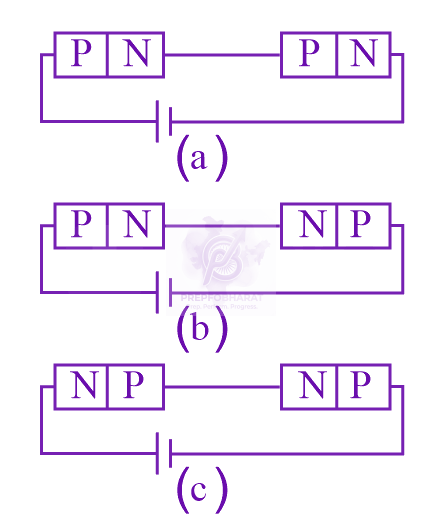 In the given circuits (a), (b) and (c), the potential drop across the two $p-n$ junctions are equal in:
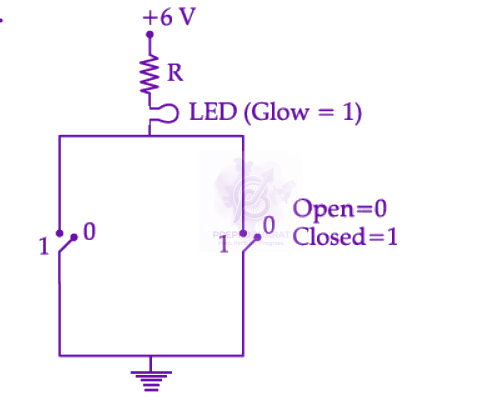 Identify the equivalent logic gate represented by the given circuit:
The light rays having photons of energy $4.2 \mathrm{eV}$ are falling on a metal surface having a work function of $2.2 \mathrm{eV}$. The stopping potential of the surface is:
The graph which shows the variation of the de Broglie wavelength $(\lambda )$ of a particle and its associated momentum $(p)$ is :
At any instant, two elements $X_1$ and $X_2$ have same number of radioactive atoms. If the decay constant of $X_1$ and $X_2$ are $10 \lambda$ and $\lambda$ respectively. Then the time when the ratio of their atoms becomes $\frac{1}{e}$ respectively will be: