NEET UG 2012 — Modern Physics
Physics Modern Physics questions from NEET UG 2012.
Other Years
15 Modern Physics Questions from 2012
A $200 \mathrm{~W}$ sodium street lamp emits yellow light of wavelength $0.6 \mu \mathrm{m}$. Assuming it to be $25 \%$ efficient in converting electrical energy to light, the number of photons of yellow light it emits per second is
An $\alpha$-particle moves in a circular path of radius $0.83 \mathrm{~cm}$ in the presence of a magnetic field of $0.25 \mathrm{~Wb} / \mathrm{m}^2$. The de-Broglie wavelength associated with the particle will be
An electron of a stationary hydrogen atom passes from the fifth energy level to the ground level. The velocity that the atom acquired as a result of photon emission will be ( $m$ is the mass of the electron, $R$ Rydberg constant and $h$ Planck's constant)
Two radiations of photon energies $1 \mathrm{eV}$ and $2.5 \mathrm{eV}$, successively illuminate a photosensitive metallic surface of work function $0.5 \mathrm{eV}$. The ratio of the maximum speeds of the emitted electrons is
The transition from the state $n=3$ to $n=1$ in a hydrogen like atom results in ultraviolet radiation. Infrared radiation will be obtained in the transition from
The half life of a radioactive nucleus is 50 days. The time interval $\left(t_2-t_1\right)$ between the time $t_2$ when $\frac{2}{3}$ of it has decayed and the time $t_1$ when $\frac{1}{3}$ of it had decayed is
If the momentum of an electron is changed by $p$, then the de-Broglie wavelength associated with it changes by $0.5 \%$. The initial momentum of electron will be
To get an output $Y=1$ in given circuit which of the following input will be correct 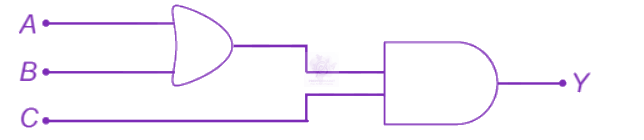
A mixture consists of two radioactive materials $A_1$ and $A_2$ with half lives of $20 \mathrm{~s}$ and $10 \mathrm{~s}$ respectively. Initially the mixture has $40 \mathrm{~g}$ of $A_1$ and $160 \mathrm{~g}$ of $A_2$. The amount of the two in the mixture will become equal after
The figure shows a logic circuit with two inputs $A$ and $B$ and the output $C$. The voltage wave forms across $A, B$ and $C$ are as given. The logic circuit gate is 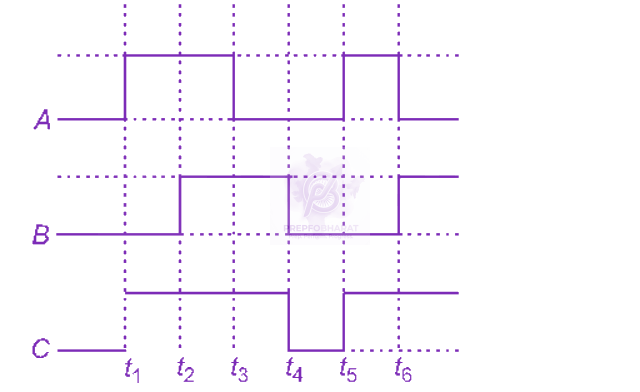
Two ideal diodes are connected to a battery as shown in the circuit. The current supplied by the battery is 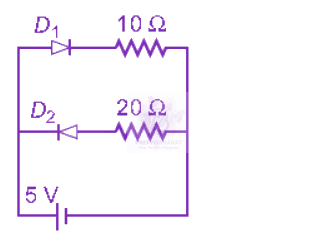
If the nuclear radius of ${ }^{27} \mathrm{Al}$ is $3.6 \mathrm{Fermi}$, the approximate nuclear radius of ${ }^{64} \mathrm{Cu}$ in Fermi is
$C$ and Si both have same lattice structure, having 4 bonding electrons in each. However, $C$ is insulator whereas $\mathrm{Si}$ is intrinsic semiconductor. This is because
Electron in hydrogen atom first jumps from third excited state to second excited state and then from second excited to the first excited state. The ratio of the wavelengths $\lambda_1: \lambda_2$ emitted in the two cases is
Monochromatic radiation emitted when electron on hydrogen atom jumps from first excited to the ground state irradiates a photosensitive material. The stopping potential is measured to be $3.57 \mathrm{~V}$. The threshold frequency of the material is