Electromagnetism PYQ — Page 6
NEET UG Physics — Electromagnetism previous year questions with solutions.
All Electromagnetism Questions (503)
Given below are two statements: Statement I : Biot-Savart's law gives us the expression for the magnetic field strength of an infinitesimal current element $(Idl)$ of a current carrying conductor only. Statement II : Biot-Savart's law is analogous to Coulomb's inverse square law of charge $q$, with the former being related to the field produced by a scalar source, $Idl$ while the latter being produced by a vector source, $q$. In light of above statements choose the most appropriate answer from the options given below:
The distance between the two plates of a parallel plate capacitor is doubled and the area of each plate is halved. If $\mathrm{C}$ is its initial capacitance, its final capacitance is equal to:
Two very long, straight, parallel conductors A and $\mathrm{B}$ carry current of $5 \mathrm{~A}$ and $10 \mathrm{~A}$ respectively and are at a distance of $10 \mathrm{~cm}$ from each other. The direction of current in two conductors is same. The force acting per unit length between two conductors is $\left(\mu_0=4 \pi \times 10^{-7}\right.$ SI unit):
Six charges $+q,-q,+q,-q,+q$ and $-q$ are fixed at the corners of a hexagon of side $d$ as shown in the figure. The work done in bringing a charge $q_0$ to the centre of the hexagon from infinity is $\left(\varepsilon_0-\right.$ permittivity of free space): 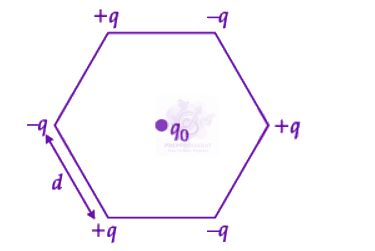
Ohms law is valid for
In a potentiometer circuit a cell of EMF $1.5V$ gives balance point at $36\mathrm{cm}$ length of wire. If another cell of EMF $2.5V$ replaces the first cell, then at what length of the wire, the balance point occurs?
An inductor of inductance $L$, a capacitor of capacitance $C$ and a resistor of resistance $R$ are connected in series to an ac source of potential difference $V$ volt as shown in figure.Potential difference across $L,C$ and $R$ is $40V,10V$ and $40V$, respectively. The amplitude of current flowing through $\text{L-C-R}$ series circuit is $10\sqrt{2}A$. The impedance of the circuit is : 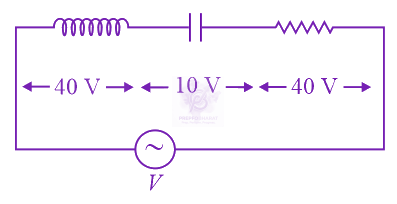
Polar molecules are the molecules:
A uniform conducting wire of length $12a$ and resistance $R$ is wound up as a current-carrying coil in the shape of, (i) an equilateral triangle of side $a$. (ii) a square of side $a$. The magnetic dipole moments of the coil in each case respectively are:
For a plane electromagnetic wave propagating in $x$-direction, which one of the following combinations gives the correct possible directions for the electric field ($E$) and magnetic field ($B$) respectively?
The equivalent capacitance of the combination shown in the figure is: 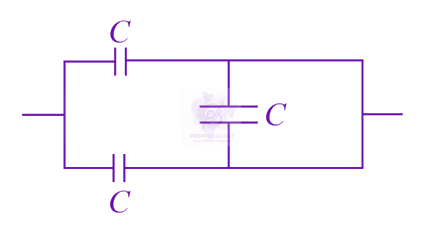
Column - I gives certain physical terms associated with flow of current through a metallic conductor. Column - II gives some mathematical relations involving electrical quantities. Match Column - I and Column - II with appropriate relations. <table class="pyq-table"><tbody><tr><td>Column - I</td><td>Column - II</td></tr><tr><td>(A) Drift Velocity</td><td>$(P)\frac{m}{n{e}^{2}\rho }$</td></tr><tr><td>(B) Electrical Resistivity</td><td>$(Q)ne{v}_{d}$</td></tr><tr><td>(C) Relaxation Period</td><td>$(R)\frac{eE}{m}\tau$</td></tr><tr><td>(D) Current Density</td><td>$(S)\frac{E}{J}$</td></tr></tbody></table>
Twenty seven drops of same size are charged at $220V$ each. They combine to form a bigger drop. Calculate the potential of the bigger drop.
An infinitely long straight conductor carries a current of $5A$ as shown. An electron is moving with a speed of ${10}^{5}m{s}^{-1}$ parallel to the conductor. The perpendicular distance between the electron and the conductor is $20\mathrm{cm}$ at an instant. Calculate the magnitude of the force experienced by the electron at that instant. 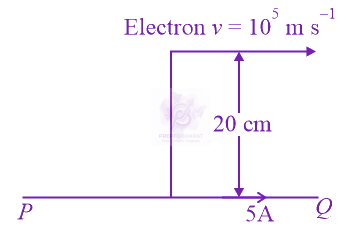
Two conducting circular loops of radii ${R}_{1}$ and ${R}_{2}$ are placed in the same plane with their centres coinciding. If ${R}_{1}\gg {R}_{2}$, the mutual inductance $M$ between them will be directly proportional to:
A dipole is placed in an electric field as shown. In which direction will it move? 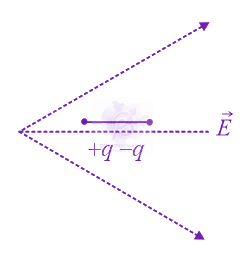
Two charged spherical conductors of radius ${R}_{1}$ and ${R}_{2}$ are connected by a wire. Then the ratio of surface charge densities of the spheres $({\sigma }_{1}/{\sigma }_{2})$ is :
A step down transformer connected to an ac mains supply of $220V$ is made to operate at $11V,44W$ lamp. Ignoring power losses in the transformer, what is the current in the primary circuit?
A thick current carrying cable of radius $R$ carries current $I$ uniformly distributed across its cross-section. The variation of magnetic field $B(r)$ due to the cable with the distance $r$ from the axis of the cable is represented by:
The effective resistance of a parallel connection that consists of four wires of equal length, equal area of cross-section and same material is $0.25\Omega$. What will be the effective resistance if they are connected in series?
A capacitor of capacitance $C$, is connected across an ac source of voltage $V$, given by $V={V}_{0}\mathrm{sin}(\omega t)$. The displacement current between the plates of the capacitor would then be given by___
A series $L-C-R$ circuit containing $5.0H$ inductor, $80\mu F$ capacitor and $40\Omega$ resistor is connected to $230V$ variable frequency ac source. The angular frequencies of the source at which power transferred to the circuit is half the power at the resonant angular frequency are likely to be:
In the product $\vec{F}=q(\vec{v}\times \vec{B})$ $=q\vec{v}\times (B\hat{i}+B\hat{j}+{B}_{0}\hat{k})$ For $q=1$ and $\vec{v}=2\hat{i}+4\hat{j}+6\hat{k}$ and $\vec{F}=4\hat{i}-20\hat{j}+12\hat{k}$ What will be the complete expression for $\vec{B}$?
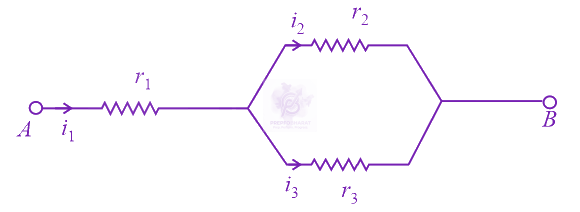
Three resistors having resistances ${r}_{1},{r}_{2}$ and ${r}_{3}$ are connected as shown in the given circuit. The ratio $\frac{{i}_{3}}{{i}_{1}}$ of currents in terms of resistances used in the circuit is :