Electromagnetism PYQ — Page 7
NEET UG Physics — Electromagnetism previous year questions with solutions.
All Electromagnetism Questions (503)
A parallel plate capacitor has a uniform electric field $\vec{E}$ in the space between the plates. If the distance between the plates is $d$ and the area of each plate is $A$, the energy stored in the capacitor is: ${\epsilon }_{0}=$ permittivity of free space)
The SI unit of resistance is
The electric field at a point on the equatorial plane at a distance r from the centre of a dipole having dipole moment $\vec{p}$ is given by ($r>>$ separation of two charges forming the dipole, ${\epsilon }_{0}$- permittivity of free space)
The magnetic flux linked with a coil (in $\mathrm{Wb}$) is given by the equation $\phi =5{t}^{2}+3t+16$. The magnitude of induced emf in the coil at the fourth second will be:
A short electric dipole has a dipole moment of $16\times {10}^{–9} C m$. The electric potential due to the dipole at a point at a distance of $0.6 m$ from the centre of the dipole, situated on a line making an angle of $60^{\circ}$ with the dipole axis is: $(\frac{1}{4\pi {\epsilon }_{0}}=9\times {10}^{9} N {m}^{2}{C}^{-2})$
The variation of electrostatic potential with radial distance $r$ from the centre of a positively charged metallic thin shell of radius $R$ is given by the graph
For the circuit shown in the figure, the current $I$ will be 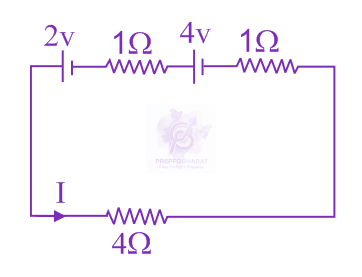
A light bulb and an inductor coil are connected to an ac source through a key as shown in the figure below. The key is closed and after sometime an iron rod is inserted into the interior of the inductor. The glow of the light bulb 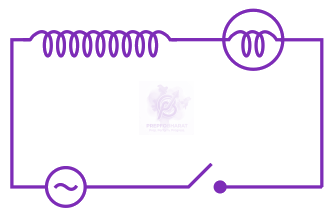
In a certain region of space with volume $0.2 {m}^{3}$, the electric potential is found to be $5 V$ throughout. The magnitude of electric field in this region is:
Light with an average flux of $20W{\mathrm{cm}}^{-2}$ falls on a non-reflecting surface at normal incidence having surface area $20{\mathrm{cm}}^{2}$. The energy received by the surface during time span of $1\mathrm{min}$ is:
A parallel plate capacitor having cross-sectional area $A$ and separation $d$ has air in between the plates. Now an insulating slab of the same area but the thickness, $\frac{d}{2}$, is inserted between the plates as shown in figure having dielectric constant $K(=4).$ The ratio of new capacitance to its original capacitance will be, 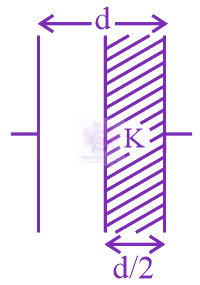
A resistance wire connected in the left gap of a metre bridge balances a $10 \Omega$ resistance in the right gap at a point which divides the bridge wire in the ratio $3:2$. If the length of the resistance wire is $1.5 m$, then the length of $1 \Omega$ of the resistance wire is:
The E.M. wave with shortest wavelength among the following is
The wave nature of electrons was experimentally verified by,
Two solid conductors are made up of same material, have same length and same resistance. One of them has a circular cross section of area ${A}_{1}$ and the other one has a square cross section of area ${A}_{2}.$ The ratio $\frac{{A}_{1}}{{A}_{2}}$ is
A $40\mu F$ capacitor is connected to a $200V$, $50\mathrm{Hz}$ AC supply. The rms value of the current in the circuit is, nearly:
Which of the following graph represents the variation of resistivity $(\rho )$ with temperature $(T)$ for copper?
For the circuit given below, the Kirchhoff's loop rule for the loop $BCDEB$ is given by the equation 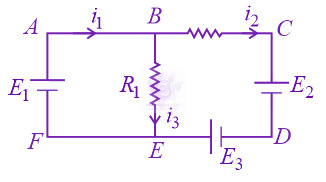
A series$LCR$ circuit is connected to an ac voltage source. When $L$ is removed from the circuit, the phase difference between current and voltage is $\frac{\pi }{3}$. If instead $C$ is removed from the circuit, the phase difference is again $\frac{\pi }{3}$ between current and voltage. The power factor of the circuit is:
A spherical conductor of radius 10 cm has a charge of \(3.2 \times 10^{-7} \mathrm{C}\) distributed uniformly. What is the magnitude of electric field at a point 15 cm from the centre of the sphere? \(\left(\frac{1}{4 \pi \varepsilon_0}=9 \times 10^9 \mathrm{Nm}^2 \mathrm{C}^{-2}\right)\)
A charged particle having drift velocity of $7.5\times {10}^{-4}m{s}^{-1}$ in an electric field of $3\times {10}^{-10}V{m}^{-1}$, has a mobility in ${m}^{2}{V}^{–1}{s}^{–1}$ of:
A wire of length $L$ metre carrying a current of $I$ ampere is bent in the form of a circle. Its magnetic moment is,
A wheel with $20$ metallic spokes each $1m$ long is rotated with a speed of $120\mathrm{rpm}$ in a plane perpendicular to a magnetic field of $0.4G.$ The induced emf between the axle and rim of the wheel will be, $(1G={10}^{-4}T)$
A long solenoid of $50\mathrm{cm}$ length having $100$ turns carries a current of $2.5A$. The magnetic field at the centre of the solenoid is: $({\mu }_{0}=4\pi \times {10}^{-7}Tm{A}^{-1})$