2I−⟶I2+2e−(Oxidation half-reaction) Eoxi. ∘=−0.536 V. Fe3++e−⟶Fe2+ (Reduction half-reaction) 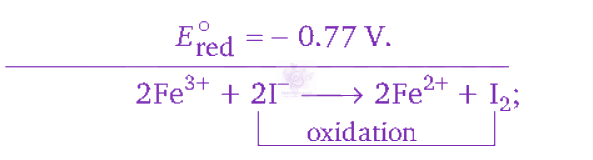
E∘=Eoxi ∘+Ered ∘=+ve So, reaction will take place.
NEET UG 2011 — Chemistry Physical Chemistry
A solution contains Fe2+,Fe3+ and I−ions. This solution was treated with iodine at 35∘C. E∘ for Fe3+/Fe2+ is +0.77 V and E∘ for I2/2I−=0.536 V. The favourable redox reaction is
Held on 30 Apr 2011 · Verified 9 Jul 2026.
I2 will be reduced to I−
There will be no redox reaction
I−will be oxidised to I2
Fe2+ will be oxidised to Fe3+
Sign in to track your attempts and accuracy.
Sign in to keep a private note on this question. Nothing you write is ever public.
For the reaction 2SO₂(g) + O₂(g) ⇌ 2SO₃(g), ΔH = -198 kJ. Which condition favours forward reaction?
The unit of rate constant for a first-order reaction is:
$\begin{aligned} &\text { Consider the following compounds: }\\ &\mathrm{\underline{K}O}_2, \mathrm{H}_2 \mathrm{\underline{O}}_2 \text { and } \mathrm{H}_2 \mathrm{\underline{S}O}_4 \text {. } \end{aligned}$ The oxidation states of the underlined elements in them are, respectively,
If the molar conductivity $\left(\Lambda_{\mathrm{m}}\right)$ of a $0.050 \mathrm{~mol} \mathrm{~L}^{-1}$ solution of a monobasic weak acid is $90 \mathrm{~S} \mathrm{~cm}^2 \mathrm{~mol}^{-1}$, its extent (degree) of dissociation will be [Assume $\Lambda_{+}^{\circ}=349.6 \mathrm{~S} \mathrm{~cm}^2 \mathrm{~mol}^{-1}$ and $\left.\Lambda_{-}^{\circ}=50.4 \mathrm{~S} \mathrm{~cm}^2 \mathrm{~mol}^{-1}.\right]$
If the rate constant of a reaction is $0.03 \mathrm{~s}^{-1}$, how much time does it take for $7.2 \mathrm{~mol} \mathrm{~L}^{-1}$ concentration of the reactant to get reduced to $0.9 \mathrm{~mol} \mathrm{~L}^{-1}$ ? (Given $: \log 2=0.301$ )
Work through every NEET UG Physical Chemistry PYQ, year by year.