NEET UG 2008 — Physical Chemistry
Chemistry Physical Chemistry questions from NEET UG 2008.
Other Years
41 Physical Chemistry Questions from 2008
If the concentration of $\mathrm{OH}^{-}$ions in the reaction $\mathrm{Fe}(\mathrm{OH})_3(\mathrm{~s}) \rightleftharpoons \mathrm{Fe}^{3+}(\mathrm{aq})+3 \mathrm{OH}^{-}(\mathrm{aq})$ is decreased by $\frac{1}{4}$ times, then equilibrium concentration of $\mathrm{Fe}^{3+}$ will increase by
What volume of oxygen gas $\left(\mathrm{O}_2\right)$ measured at $0^{\circ} \mathrm{C}$ and 1 atm, is needed to burn completely $1 \mathrm{~L}$ of propane gas $\left(\mathrm{C}_3 \mathrm{H}_8\right)$ measured under the same conditions?
The value of equilibrium constant of the reaction $$ \mathrm{HI}(\mathrm{g}) \rightleftharpoons \frac{1}{2} \mathrm{H}_2(\mathrm{~g})+\frac{1}{2} \mathrm{I}_2 \text { is } 8.0 $$ The equilibrium constant of the reaction $\mathrm{H}_2(\mathrm{~g})+\mathrm{I}_2(\mathrm{~g}) \rightleftharpoons 2 \mathrm{HI}(\mathrm{g})$ will be
Equimolar solutions of the following were prepared in water separately. Which one of the solutions will record the highest $\mathrm{pH}$ ?
Standard free energies of formation (in $\mathrm{kJ} / \mathrm{mol}$ ) at $298 \mathrm{~K}$ are $-237.2,-394.4$ and -8.2 for $\mathrm{H}_2 \mathrm{O}(\mathrm{l}), \mathrm{CO}_2(\mathrm{~g})$ and pentane $(\mathrm{g})$ respectively. The value of $\mathrm{E}_{\text {cell }}^{\circ}$ for the pentaneoxygen fuel cell is
If the lattice parameter for a crystalline structure is $3.6 \%$, then the atomic radius in fcc crystal is
If ' $a$ ' stands for the edge length of the cubic systems : simple cubic, body centred cubic and face centred cubic, then the ratio of radii of the spheres in these systems will be respectively,
Bond dissociation enthalpy of $\mathrm{H}_2, \mathrm{Cl}_2$ and $\mathrm{HCl}$ Enthalpy of formation of $\mathrm{HCl}$ is
Volume occupied by one molecule of water (density $\left.=1 \mathrm{~g} \mathrm{~cm}^{-3}\right)$ is
The rate constants $k_1$ and $k_2$ for two different reactions are $10^{16} \cdot e^{-2000 / T}$ and $10^{15} \cdot e^{-1000 / T}$, respectively. The temperature at which $k_1=k_2$ is
Kohlrausch's law states that at
The measurement of the electron position is associated with an uncertainty in momentum, which is equal to $1 \times 10^{-18} \mathrm{~g} \mathrm{~cm} \mathrm{~s}^{-1}$. The uncertainty in electron velocity is, (mass of an electron is $9 \times 10^{-28} \mathrm{~g}$ )
An organic compound contains carbon, hydrogen and oxygen. Its elemental analysis gave $\mathrm{C}, 38.71 \%$ and $\mathrm{H}, 9.67 \%$. The empirical formula of the compound would be
On the basis of the following $\mathrm{E}^{\circ}$ values, the strongest oxidizing agent is $$ \begin{array}{ll} {\left[\mathrm{Fe}(\mathrm{CN})_\theta\right]^{4-} \rightarrow\left[\mathrm{Fe}(\mathrm{CN})_\theta\right]^{3-}+\mathrm{e}^{-1} ;} & \mathrm{E}^0=-0.35 \mathrm{~V} \\ \mathrm{Fe}^{2+} \rightarrow \mathrm{Fe}^{3+}+\mathrm{e}^{-1} ; & \mathrm{E}^0=-0.77 \mathrm{~V} \end{array} $$
An organic compound contains carbon, hydrogen and oxygen. Its elemental analysis gave C, $38.71 \%$ and $\mathrm{H}, 9.67 \%$. The empirical formula of the compound would be
The values of $K_{P 1}$ and $K_{\mathrm{P} 2}$ for the reactions $$ \begin{aligned} & X \rightleftharpoons Y+Z . \\ & A \rightleftharpoons 2 B . . \end{aligned} $$ are in ratio of 9:1. If degree of dissociation of $X$ and $\mathrm{A}$ be equal, then total pressure at equilibrium (1) and (2) are in the ratio
How many moles of lead (II) chloride will be formed from a reaction between $6.5 \mathrm{~g}$ of $\mathrm{PbO}$ and $3.2 \mathrm{~g}$ of $\mathrm{HCl}$ ?
Number of moles of $\mathrm{MnO}_4^{-}$required to oxidize one mole of ferrous oxalate completely in acidic medium will be
Number of moles of $\mathrm{MnO}_4^{-}$required to oxidise one mole of ferrous oxalate completely in acidic medium will be
The measurement of the electron position is associated with an uncertainty in momentum, which is equal to $1 \times 10^{-18} \mathrm{~g} \mathrm{~cm} \mathrm{~s}^{-1}$. The uncertainty in electron velocity is, (mass of an electron is $9 \times 10^{-28} \mathrm{~g}$ )
If uncertainty in position and momentum are equal, then uncertainty in velocity is
Which of the following are not state functions? (I) $q+W$ (II) $q$ (III) $W$ (IV) $H-T S$
Percentage of free space in a body centred cubic unit cell is
For the gas phase reaction, $\mathrm{PCl}_5(\mathrm{~g}) \rightleftharpoons \mathrm{PCl}_3(\mathrm{~g})+\mathrm{Cl}_2(\mathrm{~g})$ Which of the following conditions is correct?
The relative reactivities of acyl compounds towards nucleophilic substitution are in the order of
The bromination of acetone that occurs in acid solution is represented by this equation $\mathrm{CH}_3 \mathrm{COCH}_3(\mathrm{aq})+\mathrm{Br}_2(\mathrm{aq}) \rightarrow \mathrm{CH}_3 \mathrm{COCH}_2 \mathrm{Br}(\mathrm{aq})+\mathrm{H}^{+}(\mathrm{aq})+\mathrm{Br}^{-}(\mathrm{aq})$ These kinetic data were obtained for given reaction concentrations Initial concentrations, M 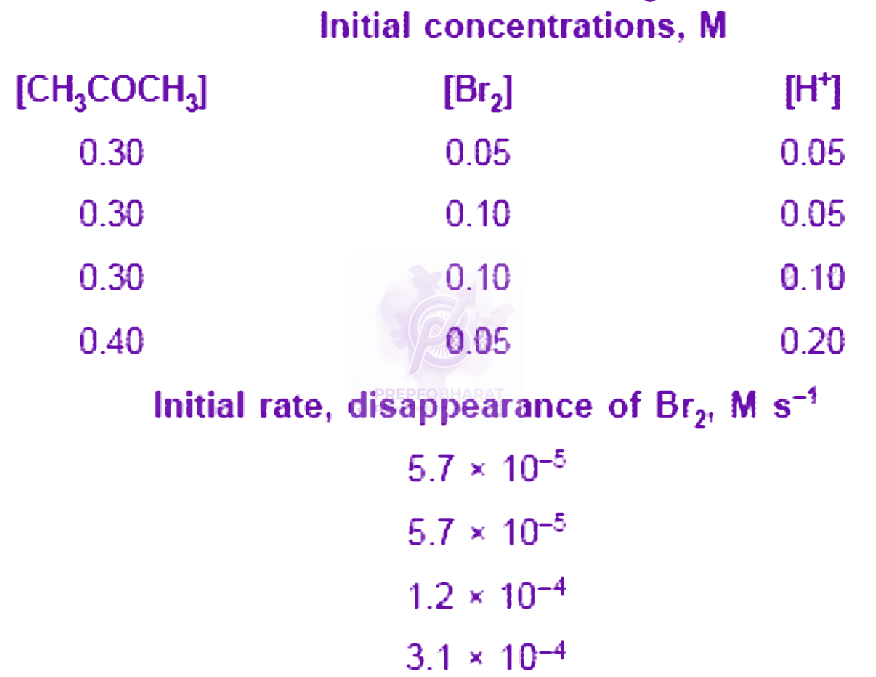 Based on these data, the rate equation is
If uncertainty in position and momentum are equal, then uncertainty in velocity is
The dissociation equilibrium of a gas $\mathrm{AB}_2$ can be represented as, $2 \mathrm{AB}_2(\mathrm{~g}) \rightleftharpoons 2 \mathrm{AB}(\mathrm{g})+\mathrm{B}_2(\mathrm{~g})$. The degree of dissociation is ' $\mathrm{x}$ ' and is small compared to 1. The expression relating the degree of dissociation $(\mathrm{x})$ with equilibrium constant $K_P$ and total pressure $\mathrm{P}$ is
If a gas expands at constant temperature, it indicates that
In DNA, the complimentary bases are
The rate constants $\mathrm{k}_1$ and $\mathrm{k}_2$ for two different reactions are $10^{16} \cdot \mathrm{e}^{-2000 / T}$ and $10^{15} \cdot \mathrm{e}^{-1000 / T}$ respectively. The temperature at which $\mathrm{k}_1=\mathrm{k}_2$ is
Kohlrausch's law states that at
Green chemistry means such reactions which
Which of the following are not state functions? (I) $q+w$ (II) $q$ (III) $\mathrm{w}$ (IV) H-TS
What volume of oxygen gas $\left(\mathrm{O}_2\right)$ measured at $0^{\circ} \mathrm{C}$ and $1 \mathrm{~atm}$, is needed to burn completely $1 \mathrm{~L}$ of propane gas $\left(\mathrm{C}_3 \mathrm{H}_8\right)$ measured under the same conditions?
Bond dissociation enthalpy of $\mathrm{H}_2, \mathrm{Cl}_2$ and $\mathrm{HCl}$ are 434,242 and $431 \mathrm{kJmol}^{-}$ ${ }^1$ respectively. Enthalpy of formation of $\mathrm{HCl}$ is
With which one of the following elements silicon should be doped so as to give p-type of semiconductor?
The bromination of acetone that occurs in acid solution is represented by this equation. $\mathrm{CH}_3 \mathrm{COCH}_3(a q)+\mathrm{Br}_2(a q) \longrightarrow \mathrm{CH}_3 \mathrm{COCH}_2 \mathrm{Br}(a q)+\mathrm{H}^{+}(a q)+\mathrm{Br}^{-}(a q)$ These kinetic data were obtained for given reaction concentrations. $\begin{array}{|l|} \hline \text {Initial concentrations, } M & \\ \begin{array}{c|l|l|l} {\left[\mathrm{CH}_3 \mathrm{COCH}_3\right]} & {\left[\mathrm{Br}_2\right]} & {\left[\mathrm{H}^{+}\right]} & \text{Initial rate, disappearance of } \mathrm{Br}_2, \mathrm{Ms}^{-1} \\ \hline 0.30 & 0.05 & 0.05 & 5.7 \times 10^{-5} \\ 0.30 & 0.10 & 0.05 & 5.7 \times 10^{-5} \\ 0.30 & 0.10 & 0.10 & 1.2 \times 10^{-4} \\ 0.40 & 0.05 & 0.20 & 3.1 \times 10^{-4} \end{array} \\ \hline \end{array}$ Based on these data, the rate equation is
A galvanometer of resistance $50 \Omega$ is connected to a battery of $3 \mathrm{~V}$ along with a resistance of $2950 \Omega$ in series. A full scale deflection of 30 divisions is obtained in the galvanometer. In order to reduce this deflection to 20 divisions, the resistance in series should be
The angular shape of ozone molecule $\left(\mathrm{O}_3\right)$ consists of
Equal volumes of three acid solutions of $\mathrm{pH} 3,4$ and 5 are mixed in a vessel. What will be the $\mathrm{H}^{+}$ion concentration in the mixture?