Reactivity in case of SN1 reaction depends upon formation of carbocation. Allyl and benzyl carbocations are stabilised by resonance. Tertiary carbocation is more stable than primary carbocation.
Which of the following will NOT undergo S_N1 reaction with OH^-?
NEET UG 2020 — Chemistry Organic Chemistry
2020mcqmedium
Which of the following will NOT undergo SN1 reaction with OH−?
Official previous-year question
Held on 30 Apr 2020 · Verified 9 Jul 2026.
Options
- A
CH2=CH−CH2Cl
- B
(CH3)3CCl
- C
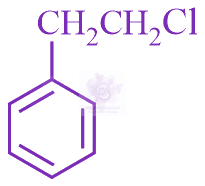
- D
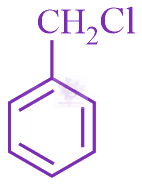
Did you get this right?
Sign in to track your attempts and accuracy.
Your note
Sign in to keep a private note on this question. Nothing you write is ever public.
NEET UG Organic Chemistry in other years
More NEET UG Organic Chemistry questions
Which of the following is a reducing sugar?
2026easy
Markovnikov's rule is applicable to:
2026easy
Match List-I with List-II $\begin{array}{|l|l|l|l|}\hline & \text{List-I (Mixture)} & & \text{List-II (Method of Separation)} \\\hline A. & \mathrm{CHCl}_3+\mathrm{C}_6 \mathrm{H}_5 \mathrm{NH}_2 & I. & \text{Distillation under reduced pressure} \\\hline B. & \text{Crude oil in petroleum industry} & II. & \text{Steam distillation} \\\hline C. & \text{Glycerol from spent-lye} & III. & \text{Fractional distillation} \\\hline D. & \text{Aniline-water} & IV. & \text{Simple distillation} \\\hline\end{array}$ Choose the correct answer from the options given below :-
2025medium
The major product of the following reaction is 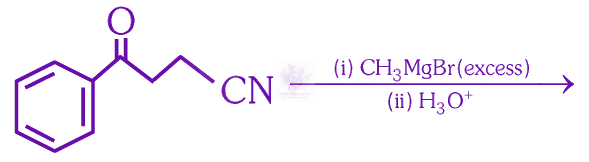
2025medium
Predict the major product ' P ' in the following sequence of reactions- 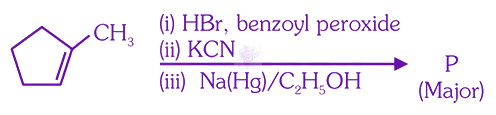
2025medium
Other Chemistry topics for NEET UG
Keep practicing Organic Chemistry
Work through every NEET UG Organic Chemistry PYQ, year by year.