NEET UG 2025 — Organic Chemistry
Chemistry Organic Chemistry questions from NEET UG 2025.
Other Years
23 Organic Chemistry Questions from 2025
The major product of the following reaction is 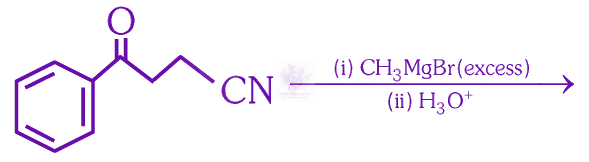
Predict the major product ' P ' in the following sequence of reactions- 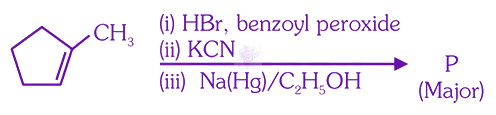
Match List I with List II: $\begin{array}{|l|l|l|l|}\hline & \text{List - I} & & \text{List - II} \\\hline \text{A}. & \text{Adenosine} & \text{(i)} & \text{Nitrogen base} \\\hline \text{B.} & \text{Adenylic acid} & \text{(ii)} & \text{Nucleotide} \\\hline \text{C.} & \text{Adenine} & \text{(iii)} & \text{Nucleoside} \\\hline \text{D.} & \text{Alanine} & \text{(iv)} & \text{Amino acid} \\\hline\end{array}$ Choose the option with all correct matches.
Match List-I with List-II $\begin{array}{|l|l|l|l|}\hline & \text{List-I (Mixture)} & & \text{List-II (Method of Separation)} \\\hline A. & \mathrm{CHCl}_3+\mathrm{C}_6 \mathrm{H}_5 \mathrm{NH}_2 & I. & \text{Distillation under reduced pressure} \\\hline B. & \text{Crude oil in petroleum industry} & II. & \text{Steam distillation} \\\hline C. & \text{Glycerol from spent-lye} & III. & \text{Fractional distillation} \\\hline D. & \text{Aniline-water} & IV. & \text{Simple distillation} \\\hline\end{array}$ Choose the correct answer from the options given below :-
The correct order of decreasing acidity of the following aliphatic acids is :-
Given below are two statements : Statement I : Benzenediazonium salt is prepared by the reaction of aniline with nitrous acid at 273-278 K. It decomposes easily in the dry state. Statement II : Insertion of iodine into the benzene ring is difficult and hence iodobenzene is prepared through the reaction of benzenediazonium salt with KI. In the light of the above statements, choose the most appropriate answer from the options given below :
Which one of the following reactions does NOT give benzene as the product?
Match List - I with List - II $\begin{array}{llll} & \begin{array}{l} \text { List-I } \\ \text { (Name of the } \end{array} & & \begin{array}{l} \text { List-II } \\ \text { (Deficiency } \end{array} \\ & \text { Vitamin) } & & \begin{array}{l} \text { disease) } \end{array} \\ \text { A. } & \text { Vitamin } B_{12} & \text { I. } & \text { Cheilosis } \\ \text { B. } & \text { Vitamin D } & \text { II. } & \text { Convulsions } \\ \text { C. } & \text { Vitamin } B_2 & \text { III. } & \text { Rickets } \\ \text { D. } & \text { Vitamin } B_6 & \text { IV. } & \text { Pernicious anaemia } \end{array}$ Choose the correct answer from the options given below:
Which one of the following reactions does NOT belong to "Lassaigne's test" ?
Sugar 'X' A. is found in honey. B. is a keto sugar. C. exists in $\alpha$ and $\beta$ - anomeric forms. D. is laevorotatory. ' X ' is :
Why can't insulin be given orally to diabetic patients?
The correct order of decreasing basic strength of the given amines is :
Which one of the following compounds does not decolourize bromine water?
Among the given compound I-III, the correct order of bond dissociation energy of $\mathrm{C}-\mathrm{H}$ bond marked with * is :- 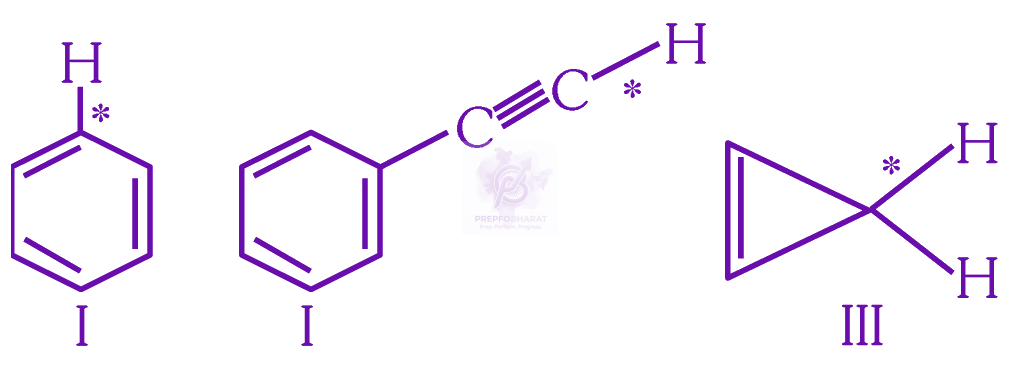
How many products (including stereoisomers) are expected from monochlorination of the following compound? 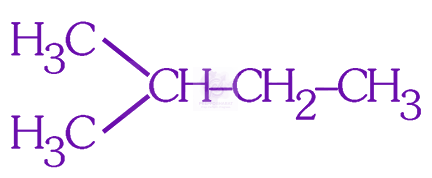
The IUPAC name of CH₃-CO-CH₂-CHO is:
Which one of the following compounds can exist as cis-trans isomers?
Which one of the following enzymes contains 'Haem' as the prosthetic group?
The protein portion of an enzyme is called:
Total number of possible isomers (both structural as well as stereoisomers) of cyclic ethers of molecular formula $\mathrm{C}_4 \mathrm{H}_8 \mathrm{O}$ is :
Given below are two statements : one is labelled as Assertion (A) and the other is labelled as Reason (R). Assertion (A) :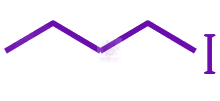 undergoes $\mathrm{S}_{\mathrm{N}} 2$ reaction faster than Reason (R) : Iodine is a better leaving group because of its large size. In the light of the above statements, choose the correct answer from the options given below :
Identify the suitable reagent for the following conversion 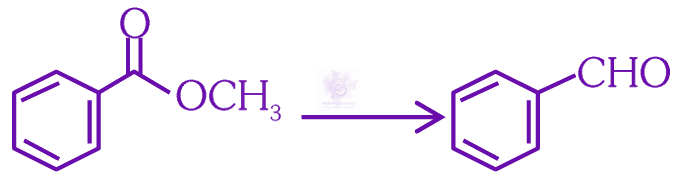
Name the class of enzyme that usually catalyze the following reaction : $\mathrm{S}-\mathrm{G}+\mathrm{S}^{\#} \rightarrow \mathrm{~S}+\mathrm{S}^{\#}-\mathrm{G}$ Where, $G \rightarrow$ a group other than hydrogen $S \rightarrow$ a substrate $\mathrm{S}^{\#} \rightarrow$ another substrate