NEET UG 2024 — Organic Chemistry
Chemistry Organic Chemistry questions from NEET UG 2024.
Other Years
28 Organic Chemistry Questions from 2024
The compound that does not undergo Friedel-Crafts alkylation reaction but gives a positive carbylamine test is :
The compound that will undergo $S_N 1$ reaction with the fastest rate is
A steam volatile organic compound which is immiscible with water has a boiling point of $250^{\circ} \mathrm{C}$. During steam distillation, a mixture of this organic compound and water will boil :
The major product C in the below mentioned reaction is: $\mathrm{CH}_3 \mathrm{CH}_2 \mathrm{CH}_2 \mathrm{Br} \xrightarrow[\Delta]{\text { alc. } \mathrm{KOH}} \mathrm{A} \xrightarrow{\mathrm{HBr}} \mathrm{B} \xrightarrow[\Delta]{\text { aq. } \mathrm{KOH}} \mathrm{C}$
The major product $X$ formed in the following reaction sequence is: 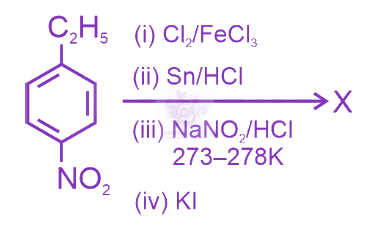
The major product D formed in the following reaction sequence is: 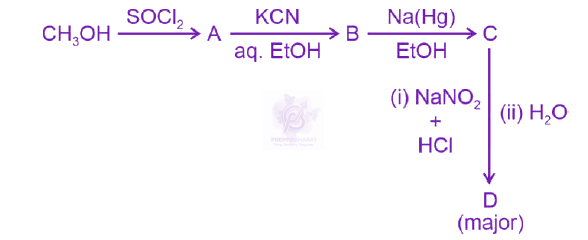
On heating, some solid substances change from solid to vapour state without passing through liquid state. The technique used for the purification of such solid substances based on the above principle is known as
Match List I with List II. 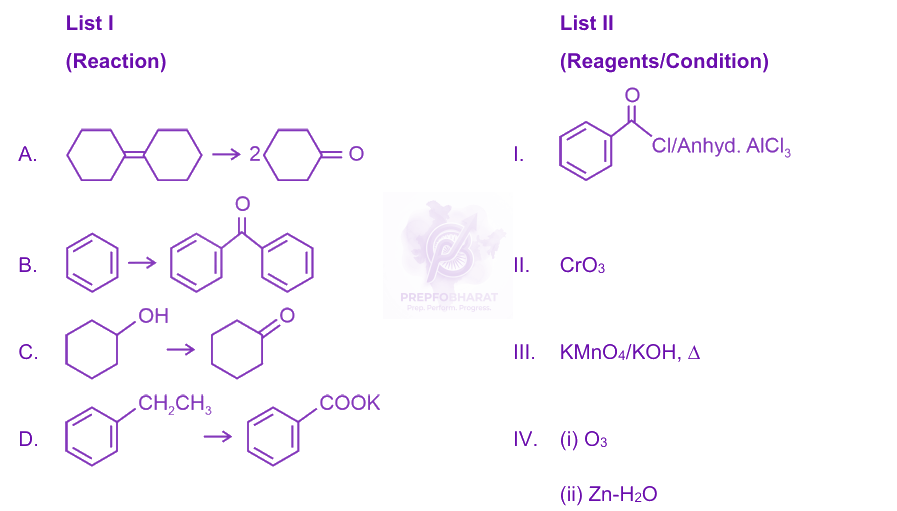 Choose the correct answer from the options given below:
The most stable carbocation among the following is :
Identify D in the following sequence of reactions: 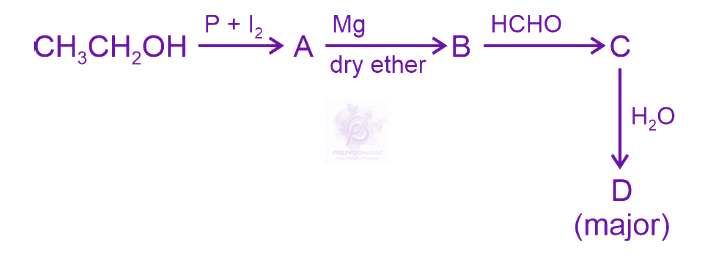
For the given reaction: 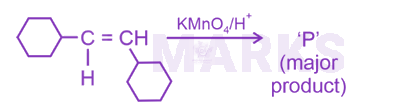 'P' is
Identify the correct reagents that would bring about the following transformation. 
Select the incorrect reaction among the following:
Given below are two statements : Statement I: Glycogen is similar to amylose in its structure. Statement II : Glycogen is| found in yeast and fungi also. In the light of the above statements, choose the correct answer from the options given below :
Given below are two statements: Statement I : The boiling point of three isomeric pentanes follows the order n-pentane $\gt$ isopentane $\gt$ neopentane Statement II : When branching increases, the molecule attains a shape of sphere. This results in smaller surface area for contact, due to which the intermolecular forces between the spherical molecules are weak, thereby lowering the boiling point. In the light of the above statements, choose the most appropriate answer from the options given below:
Identify the major product C formed in the following reaction sequence: 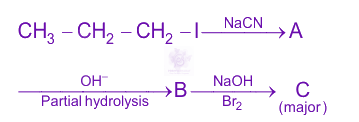
Given below are two statements: Statement I : Aniline does not undergo Friedel-Crafts alkylation reaction. Statement II : Aniline cannot be prepared through Gabriel synthesis. In the light of the above statements, choose the correct answer from the options given below:
The following reaction method  is not suitable for the preparation of the corresponding haloarene products, due to high reactivity of halogen, when X is :
A compound with a molecular formula of $\mathrm{C}_6 \mathrm{H}_{14}$ has two tertiary carbons. Its IUPAC name is :
Fehling's solution ' $A$ ' is
On complete combustion, 0.3 g of an organic compound gave 0.2 g of $\mathrm{CO}_2$ and 0.1 g of $\mathrm{H}_2 \mathrm{O}$. The percentage composition of carbon and hydrogen in the compound, respectively is:
The correct IUPAC name of the compound 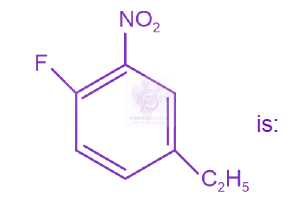
Major products A and B formed in the following reaction sequence, are 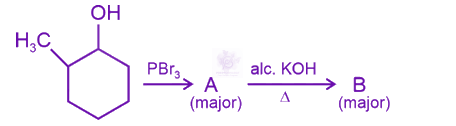
The alkane that can be oxidized to the corresponding alcohol by $\mathrm{KMnO}_4$ as per the equation 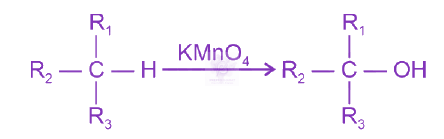 is, when:
Methyl group attached to a positively charged carbon atom stabilizes the carbocation due to
Which one of the following alcohols reacts instantaneously with Lucas reagent?
The reagents with which glucose does not react to give the corresponding tests/products are A. Tollen's reagent B. Schiff's reagent C. HCN D. $\mathrm{NH}_2 \mathrm{OH}$ E. $\mathrm{NaHSO}_3$ Choose the correct options from the given below:
Given below are two statements: Statement I: Propene on treatment with diborane gives an addition product with the formula $\left(\left(\mathrm{CH}_3\right)_2-\mathrm{CH}_{)_3} \mathrm{~B}\right.$. Statement II: Oxidation of $\left(\left(\mathrm{CH}_3\right)_2-\mathrm{CH}\right)_3 \mathrm{~B}$ with hydrogen peroxide in presence of NaOH gives propan-2ol. In the light of the above statements, choose the most appropriate answer from the options given below: