NEET UG 2022 — Organic Chemistry
Chemistry Organic Chemistry questions from NEET UG 2022.
Other Years
29 Organic Chemistry Questions from 2022
Compound $X$ on reaction with ${O}_{3}$ followed by $\mathrm{Zn}/{H}_{2}O$ gives formaldehyde and $2$-methyl propanal as products. The compound $X$ is:
Given below are two statements : one is labelled as Assertion (A) and the other is labelled as Reason (R). Assertion (A): Chlorine is an electron withdrawing group but it is ortho, para directing in electrophilic aromatic substitution. Reason (R) : Inductive effect of chlorine destabilises the intermediate carbocation formed during the electrophilic substitution, however due to the more pronounced resonance effect, the halogen stabilises the carbocation at ortho and para positions. In the light of the above statements, choose the most appropriate answer from the options given below:
Given below are two statements: Statement I: In Lucas test, primary, secondary and tertiary alcohols are distinguished on the basis of their reactivity with conc. $\mathrm{HCl}+{\mathrm{ZnCl}}_{2}$, known as Lucas Reagent. Statement II: Primary alcohols are most reactive and immediately produce turbidity at room temperature on reaction with Lucas Reagent. In the light of the above statements, choose the most appropriate answer from the options given below:
Given below are two statements: Statement I: Primary aliphatic amines react with ${\mathrm{HNO}}_{2}$ to give unstable diazonium salts. Statement II : Primary aromatic amines react with ${\mathrm{HNO}}_{2}$ to form diazonium salts which are stable even above $300K$. In the light of the above statements, choose the most appropriate answer from the options given below
Given below are two statements: Statement I: The acidic strength of mono substituted nitrophenol is higher than phenol because of electron withdrawing nitro group. Statement II: $o$-nitrophenol, $m$-nitrophenol and $p$-nitrophenol will have same acidic strength as they have one nitro group attached to the phenolic ring. In the light of the above statements, choose the most appropriate answer from the options given below :
Match List - I with List - II. <table class="pyq-table"><tbody><tr><td colspan="2" rowspan="1">List - I (Products formed)</td><td colspan="2" rowspan="1">List - II (Reaction of carbonyl compound with)</td></tr><tr><td>(a)</td><td>Cyanohydrin</td><td>(i)</td><td>${\mathrm{NH}}_{2}\mathrm{OH}$</td></tr><tr><td>(b)</td><td>Acetal</td><td>(ii)</td><td>${\mathrm{RNH}}_{2}$</td></tr><tr><td>(c)</td><td>Schiff's base</td><td>(iii)</td><td>alcohol</td></tr><tr><td>(d)</td><td>Oxime</td><td>(iv)</td><td>$\mathrm{HCN}$</td></tr></tbody></table>Choose the correct answer from the options given below:
Match List-I with List-II : $\begin{array}{|l|l|} \hline \text{List-I } & \text{List-II } \\ \text{(Reaction) } & \text{(Product formed) } \\ \hline \text{(a) Gabriel synthesis} & \text{(i) Benzaldehyde} \\ \text{(b) Kolbe synthesis} & \text{(ii) Ethers} \\ \text{(c) Williamson synthesis} & \text{(iii) Primary amines} \\ \text{(d) Etard synthesis} & \text{(iv) Salicyclic acid} \\ \hline \end{array}$ Choose the correct answer from the options given below :
Match the regents (List-I) with the product (ListII) obtained from phenol. 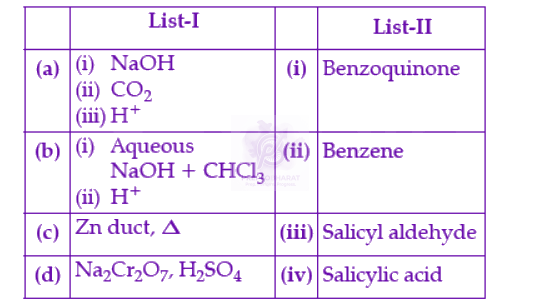 Choose the correct answer from the options given below :
DNA contains which sugar?
IUPAC name of CH₃COCH₃ is
Predict the order of reactivity of the following four isomers towards $\mathrm{S}_{\mathrm{N}} 2$ reaction. (I) $\mathrm{CH}_3 \mathrm{CH}_2 \mathrm{CH}_2 \mathrm{CH}_2 \mathrm{Cl}$ (II) $\mathrm{CH}_3 \mathrm{CH}_2 \mathrm{CH}(\mathrm{Cl}) \mathrm{CH}_3$ (III) $\left(\mathrm{CH}_3\right)_2 \mathrm{CHCH}_2 \mathrm{Cl}$ (IV) $\left(\mathrm{CH}_3\right)_3 \mathrm{CCl}$
The correct IUPAC name of the following compound is: 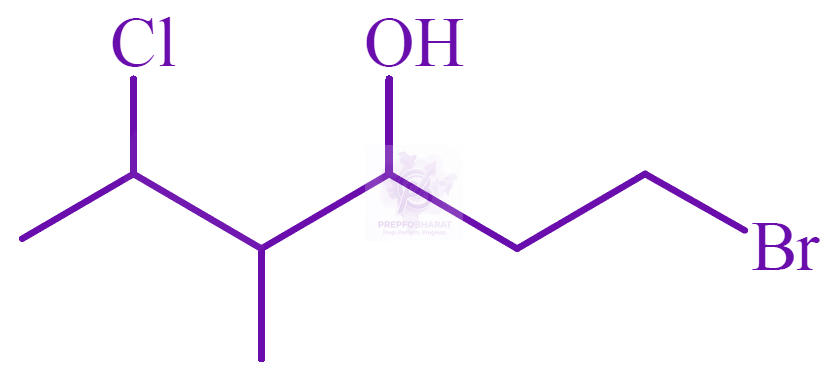
The incorrect method for the synthesis of alkenes is:
The incorrect method to synthesize benzaldehyde is:
The incorrect statement about denaturation of proteins is
The incorrect statement regarding chirality is :
The incorrect statement regarding enzymes is:
The Kjeldahl's method for the estimation of nitrogen can be used to estimate the amount of nitrogen in which one of the following compounds?
The product formed from the following reaction sequence is 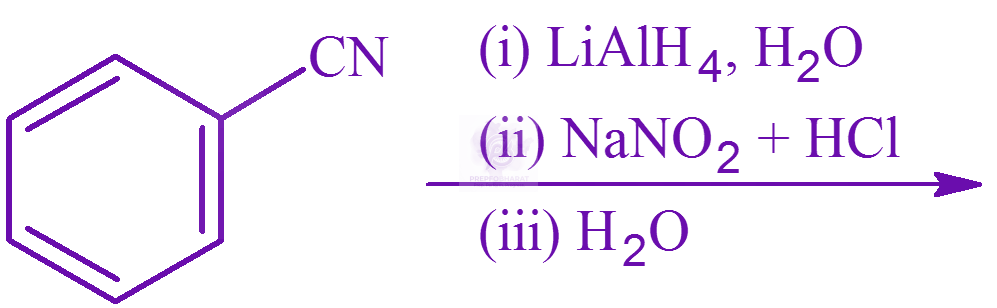
The product formed from the following reaction sequence is 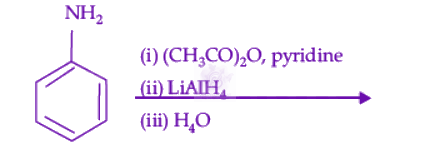
The product formed from the following reaction sequence is: 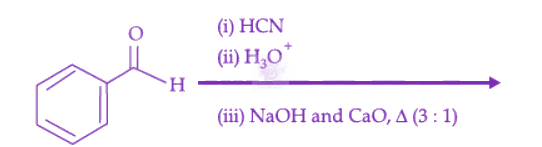
The products $A$ and $B$ in the following reaction sequence are: 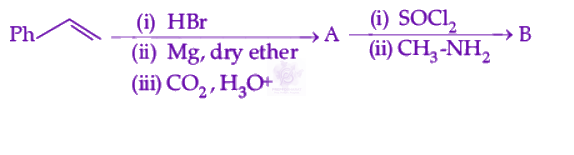
$\mathrm{RMgX}+{\mathrm{CO}}_{2}\rightarrow _{\mathrm{ether}}^{\mathrm{dry}}Y\overset{{H}_{3}{O}^{+}}{\longrightarrow }\mathrm{RCOOH}$ What is $Y$ in the above reaction?
Which compound amongst the following is not an aromatic compound?
Which of the following is the most stable carbocation?
Which of the following reactions is not an example for nucleophilic addition-elimination reaction?
Which of the following sequence of reactions is suitable to synthesise chlorobenzene?
Which one of the following is not formed when acetone reacts with $2$-pentanone in the presence of dilute $\mathrm{NaOH}$ followed by heating?
Which one of the following reaction sequence is incorrect method to prepare phenol?