In aldehydes, −C=O has the presence of at least one alkyl group except formaldehyde which has the +I effect and which decreases the positive charge of carbon, thereby making the attack of nucleophiles difficult. The nucleophilic attack becomes more difficult in ketones having a minimum of two alkyl groups. Hence, by attachment of the alkyl groups (due to the +I effect), the rate of nucleophilic addition decreases. Order of nucleophilic addition. 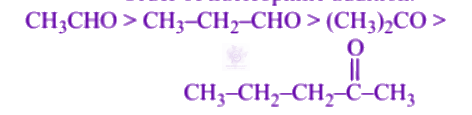
Related Theory The carbonyl compounds undergo a nucleophilic addition reaction because oxygen is more electronegative than carbon. As such, it withdraws the shared pi electron pair towards itself and gets a partial negative charge; therefore, carbon gets a partial positive charge and becomes susceptible to a nucleophilic attack.