NEET UG 2006 — Organic Chemistry
Chemistry Organic Chemistry questions from NEET UG 2006.
Other Years
12 Organic Chemistry Questions from 2006
The general molecular formula, which represents the homologous series of alkanols is:
Nucleophilic addition reaction will be most favoured in:
In a set of reactions propionic acid yielded a compound 'd'. \(\mathrm{CH}_2 \mathrm{CH}_2 \mathrm{COOH}\xrightarrow{\mathrm{SOCl}_2}{ }^{\prime} b^{\prime} \xrightarrow{\mathrm{NH}_3}{ }^{\prime} c^{\prime} \xrightarrow[\mathrm{Br}_2]{\mathrm{KOH}}{ }^{\prime} \mathrm{d}^{\prime}\) The structure of 'd' would be:
Self condensation of two moles of ethyl acetate in presence of sodium ethoxide yields:
The human body does not produce:
The major organic product in the reaction, $\mathrm{CH}_3-\mathrm{O}-\mathrm{CH}\left(\mathrm{CH}_3\right)_2+\mathrm{HI} \rightarrow$ products is:
Which of the following is not a chiral compound?
Ethylene oxide when treated with Grignard reagent yields:
The IUPAC name of 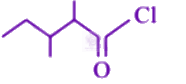
Which one of the following is a peptide hormone?
A carbonyl compound reacts with hydrogen cyanide to form cyanohydrine which on hydrolysis forms a racemic mixture of $\alpha$-hydroxy acid. The carbonyl compound is:
Which of the following is more basic than aniline?