NEET UG 2003 — Organic Chemistry
Chemistry Organic Chemistry questions from NEET UG 2003.
Other Years
15 Organic Chemistry Questions from 2003
Phospholipids are esters of glycerol with
The compound 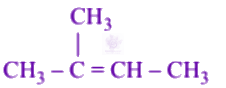 on reaction with $\mathrm{NaIO}_3$ in the present of $\mathrm{KMnO}_4$ gives:
Glycolysis is:
Which one of the following orders of acid strength is correct?
Name of the compound given below is: 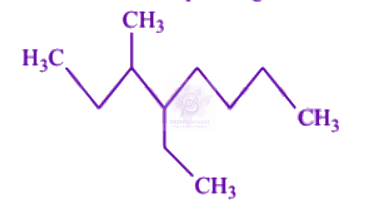
When m-chlorobenzaldehyde is treated with $50 \% \mathrm{KOH}$ solution, the products (s) obtained is (are):
The correct order of reactivity towards the electrophillic substitution of the compounds aniline (I), benzene (II) and nitrobenzene (III) is:
Which one of the following is a free radical substitution reaction?
$\text { ' } a \text { ' and ' } b \text { ' in the following reactions are: }$ 
In a set of the given reactions, acetic acid yielded a product ' $c$ '. 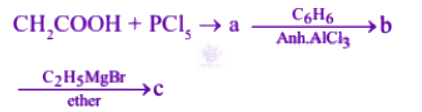 Product ' $c$ ' would be:
The final product ' $\mathrm{c}$ ', obtained in this reaction would be 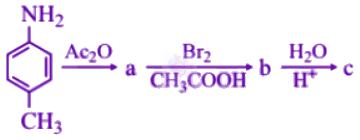
Which of the following pairs of compounds are enantiomers?
In this reaction: $\begin{aligned} \mathrm{CH}_3 \mathrm{CHO}+\mathrm{HCN} & \rightarrow \mathrm{CH}_3 \mathrm{CH}(\mathrm{OH}) \mathrm{CN} \\ \stackrel{\mathrm{H} . \mathrm{OH}}{\longrightarrow} & \mathrm{CH}_3 \mathrm{CH}(\mathrm{OH}) \mathrm{COOH} \end{aligned}$ an symmetric centre is generated. The acid obtained would be:
Chargaff's rule states that in an organism
Vitamin $B_{12}$ contains: