In the complex: K4[Fe(CN)6], Fe exists as Fe2+.
Electronic configuration=[Ar]3d6
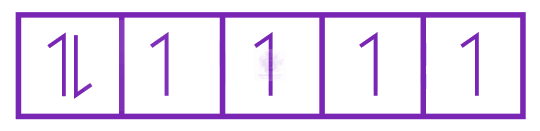
∵CN is a strong ligand, it will cause pairing up →
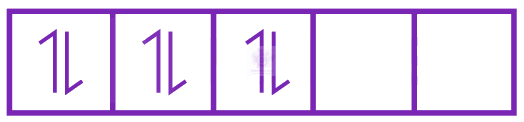
∴ Electronic configuration is t2g6eg0
NEET UG 2019 — Chemistry Inorganic Chemistry
What is the correct electronic configuration of the central atom in K4[Fe(CN)6] based on crystal field theroy?
Held on 30 Apr 2019 · Verified 9 Jul 2026.
t2g4eg2
t2g6eg0
e3t23
e4t22
Sign in to track your attempts and accuracy.
Sign in to keep a private note on this question. Nothing you write is ever public.
Which of the following is the most electronegative element?
Which of the following are paramagnetic? A. $\left[\mathrm{NiCl}_4\right]^{2-}$ B. $\mathrm{Ni}(\mathrm{CO})_4$ C. $\left[\mathrm{Ni}(\mathrm{CN})_4\right]^{2-}$ D. $\left[\mathrm{Ni}\left(\mathrm{H}_2 \mathrm{O}\right)_6\right]^{2+}$ E. $\mathrm{Ni}\left(\mathrm{PPh}_3\right)_4$ Choose the correct answer from the options given below :
Which of the following statements are true? A. Unlike Ga that has a very high melting point, Cs has a very low melting point. B. On Pauling scale, the electronegativity values of N and Cl are not the same. C. $\mathrm{Ar}, \mathrm{K}^{+}, \mathrm{Cl}^{-}, \mathrm{Ca}^{2+}$, and $\mathrm{S}^{2-}$ are all isoelectronic species. D. The correct order of the first ionization enthalpies of $\mathrm{Na}, \mathrm{Mg}, \mathrm{Al}$, and Si is $\mathrm{Si}\gt\mathrm{Al}\gt\mathrm{Mg}\gt\mathrm{Na}$. E. The atomic radius of Cs is greater than that of Li and Rb . Choose the correct answer from the options given below
Given below are two statements: Statement I : Like nitrogen that can form ammonia, arsenic can form arsine. Statement II : Antimony cannot form antimony pentoxide. In the light of the above statements, choose the most appropriate answer from the options given below:
Given below are two statements : Statement I : Ferromagnetism is considered as an extreme form of paramagnetism. Statement II : The number of unpaired electrons in a $\mathrm{Cr}^{2+}$ ion $(\mathrm{Z}=24)$ is the same as that of a $\mathrm{Nd}^{3+}$ ion $(Z=60)$. In the light of the above statements, choose the correct answer from the options given below :
Work through every NEET UG Inorganic Chemistry PYQ, year by year.