Waves & Oscillations PYQ — Page 11
JEE Main Physics — Waves & Oscillations previous year questions with solutions.
All Waves & Oscillations Questions (340)
An oscillator of mass $M$ is at rest in its equilibrium position in a potential, $V=\frac{1}{2}k{(x –X)}^{2}$ . A particle of mass $m$ comes from the right with speed $u$ and collides completely inelastic with $M$ and sticks to it. This process repeats every time the oscillator crosses its equilibrium position. The amplitude of oscillations after $13$ collisions is: $(M=10,m=5,u=1,k=1)$
The end correction of a resonance column is $1\mathrm{cm}$. If the shortest length resonating with the tuning fork is $10\mathrm{cm}$, the next resonating length should be
A body of mass $M$ and charge $q$ is connected to a spring of spring constant $k$. It is oscillating along $x$-direction about its equilibrium position in the horizontal plane, taken to be at $x=0$, with an amplitude $A$. An electric field $E$ is applied along the $x$-direction. Which of the following statements is correct?
A silver atom in a solid oscillates in simple harmonic motion in some direction with a frequency of ${10}^{12}{s}^{-1}$ . What is the force constant of the bonds connecting one atom with the other? (Mole wt. of silver,$=108g{\mathrm{mol}}^{-1}$ and Avogadro number $=6.02\times {10}^{23}$)
A tuning fork vibrates with frequency $256 \mathrm{~Hz}$ and gives one best per second with the third normal mode of vibration of an open pipe. What is the length of the pipe? (Speed of sound of air is $340 \mathrm{~ms}^{-1}$ )
A particle executes simple harmonic motion and it is located at $x=a, b$ and $c$ at time ${t}_{0}, 2{t}_{0} and 3{t}_{0}$ respectively. The frequency of the oscillation is:
A tuning fork vibrates with frequency $256\mathrm{Hz}$ and gives one beat per second with the third normal mode of vibration of an open pipe. What is the length of the pipe? (speed of sound in air is $340m{s}^{-1}$)
5 beats/ second are heard when a turning fork is sounded with a sonometer wire under tension, when the length of the sonometer wire is either $0.95 \mathrm{~m}$ or $1 \mathrm{~m}$. The frequency of the fork will be:
Two simple harmonic motions, as shown, are at right angles. They are combined to form Lissajous figures. $x(t)=A \sin (a t+\delta)$ $y(t)=B \sin (b t)$ Identify the correct match below
Two sitar strings, $A$ and $B$ playing the note '$Dha$' are slightly out of tune and produce beats of frequency $5\mathrm{Hz}$. The tension of the string $B$ is slightly increased and the beat frequency is found to decrease by $3\mathrm{Hz}$. If the frequency of $A$ is $425\mathrm{Hz}$. The original frequency of $B$ is
Two wires ${W}_{1}$ and ${W}_{2}$ have the same radius $r$and respective, densities ${\rho }_{1}$ and ${\rho }_{2}$, such that ${\rho }_{2}=4{\rho }_{1}$ . They are joined together at the point $O$, as shown in the figure. The combination is used as a sonometer wire and kept under tension $T$. The point $O$ is midway between the two bridges. When a stationary wave is set up in the composite wire, the joint is found to be a node. The ratio of the number of antinodes formed in ${W}_{1}$ to ${W}_{2}$ is 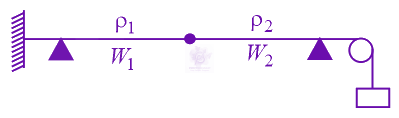
A particle is executing simple harmonic motion with a time period $T$. At time $t=0$, it is at its position of equilibrium. The kinetic energy - time graph of the particle will look like:
A block of mass $0.1\mathrm{kg}$ is connected to an elastic spring of spring constant $640N{m}^{-1}$ and oscillates in a damping medium of damping constant ${10}^{-2} \mathrm{kg} {s}^{-1}$ . The system dissipates its energy gradually. The time taken for its mechanical energy of vibration to drop to half of its initial value, is closest to-
A $1\mathrm{kg}$ block attached to a spring vibrates with a frequency of $1\mathrm{Hz}$ on a frictionless horizontal table. Two springs identical to the original spring are attached in parallel to a$8\mathrm{kg}$block placed on the same table. So, the frequency of vibration of the $8\mathrm{kg}$ block is
In an experiment to determine the period of a simple pendulum of length $1m$, it is attached to different spherical bobs of radii ${r}_{1}$ and ${r}_{2}$ . The two spherical bobs have uniform mass distribution. If the relative difference in the periods, is found to be $5\times {10}^{-4}s$, the difference in radii, $|{r}_{1}-{r}_{2}|$ is best-given by
A standing wave is formed by the superposition of two waves travelling in opposite directions. The transverse displacement is given by, $y(x, t)=0.5\mathrm{sin}(\frac{5\pi }{4}x)\mathrm{cos}(200\pi t)$. What is the speed of the travelling wave moving in the positive $x$ direction? ($x$ and $t$are in meter and second, respectively)
The ratio of maximum acceleration to maximum velocity in a simple harmonic motion is $10 {s}^{-1}.$ At, $t=0$ the displacement is $5m.$ What is the maximum acceleration? The initial phase is $\frac{\pi }{4}$ .
A pipe open at both ends has a fundamental frequency $f$ in air. The pipe is dipped vertically in water so that half of it is in water. The fundamental frequency of the air column is now:
A uniform string of length $20m$ is suspended from a rigid support. A short wave pulse is introduced at its lowest end. It starts moving up the string. The time taken to reach the support is (Take, $g=10 m{s}^{-2}$)
A particle performs simple harmonic motion with amplitude A. Its speed is tripled at the instant that it is at a distance $\frac{2A}{3}$ from equilibrium position. The new amplitude of the motion is:
Two particles are performing simple harmonic motion in a straight line about the same equilibrium point. The amplitude and time period for both particles are same and equal to $A$ and $T$, respectively. At time $t=0$ one particle has displacement $A$ while the other one has displacement $-\frac{A}{2}$ and they are moving towards each other. If they cross each other at time $t$, then $t$ is:
In an engine the piston undergoes vertical simple harmonic motion with amplitude 7cm. A washer rests on top of the piston and moves with it. The motor speed is slowly increased. The frequency of the piston at which the washer no longer stays in contact with the piston, is close to :
A simple harmonic oscillator of angular frequency $2\mathrm{rad}{s}^{-1}$ is acted upon by an external force $F=\mathrm{sin}t N.$If the oscillator is at rest in its equilibrium position at $t=0,$ its position at later times is proportional to:
$x and y$ displacements of a particle are given as $x(t)=a sin \omega t and y(t)=a sin 2\omega t.$ Its trajectory will look like: