Waves & Oscillations PYQ — Page 10
JEE Main Physics — Waves & Oscillations previous year questions with solutions.
All Waves & Oscillations Questions (340)
A string is clamped at both the ends and it is vibrating in its ${4}^{th}$ harmonic. The equation of the stationary wave is $y=0.3\mathrm{sin}(0.157x) cos(200\pi t)$. The length of the string is (All quantities are in $SI$ units.)
The pressure wave, $P=0.01\mathrm{sin}[1000t-3x]N {m}^{–2}$ , corresponds to the sound produced by a vibrating blade on a day when atmospheric temperature is $0^{\circ}C$ . On some other day when temperature is $T$ , the speed of sound produced by the same blade and at the same frequency is found to be $336 m {s}^{–1}$ . Approximate value of $T$ is:
A string $2.0 m$ long and fixed at its ends is driven by a $240 Hz$ vibrator. The string vibrates in its third harmonic mode. The speed of the wave and its fundamental frequency is
A damped harmonic oscillator has a frequency of $5$ oscillations per second. The amplitude drops to half its value for every 10 oscillations. The time it will take to drop to $\frac{1}{1000}$ of the original amplitude is close to:
The correct figure that shows, schematically, the wave pattern produced by the superposition of two waves of frequencies $9 Hz$ and$11 Hz$, is
A string of length $1 m$ and mass $5 g$ is fixed at both ends. The tension in the string is $8.0 N$. The string is set into vibration using an external vibrator of frequency $100 \mathrm{Hz}$. The separation between successive nodes on the string is close to
A progressive wave travelling along the positive $x-$ direction is represented by $y(x,t)=A sin(kx-\omega t+\phi )$ . Its snapshot at $t=0$ is given in the figure. 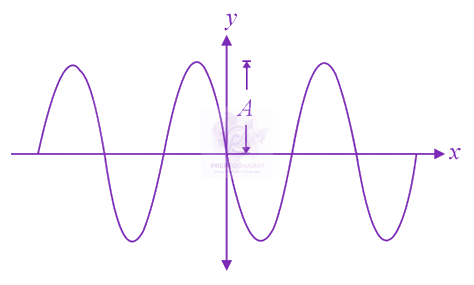 For this wave, the phase $\phi$ is:
A closed organ pipe has a fundamental frequency of $1.5 \mathrm{kHz}$. The number of overtones that can be distinctly heard by a person with this organ pipe will be $($Assume that the highest frequency a person can hear is $20,000 \mathrm{Hz}$).
A simple harmonic motion is represented by: $y=5(\mathrm{sin}3\pi t+\sqrt{3}\mathrm{cos}3\pi t)\mathrm{cm}$ The amplitude and time period of the motion are:
A cylindrical plastic bottle of negligible mass is filled with $310 ml$ of water and left floating in a pond with still water. If pressed downward slightly and released, it starts performing simple harmonic motion at angular frequency $\omega .$ If the radius of the bottle is $2.5 cm$ then $\omega$ is close to: $($ density of water $={10}^{3}kg/{m}^{3})$
A small speaker delivers $2 W$ of audio output. At what distance from the speaker will one detect $120 dB$ intensity sound? [Given reference intensity of sound as ${10}^{-12}W/{m}^{2}$ ]
Two light identical springs of spring constant $k$ are attached horizontally at the two ends of a uniform horizontal rod $AB$ of length $l$ and mass $m.$ The rod is pivoted at its center 'O' and can rotate freely in horizontal plane. The other ends of the two springs are fixed to rigid supports as shown in figure. The rod is gently pushed through a small angle and released. The frequency of resulting oscillation is: 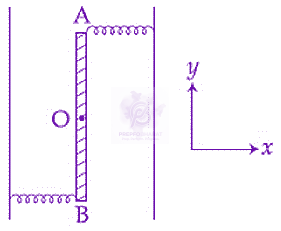
A wire of length $2L,$ is made by joining two wires $A$ and $B$ of same length but different radii $r$ and $2r$ and made of the same material. It is vibrating at a frequency such that the joint of the two wires forms a node. If the number of antinodes in wire $A$ is $p$ and that in $B$ is $q$ then ratio $p:q$ is: 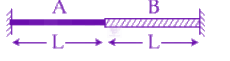
A simple pendulum oscillating in air has period $T$ . The bob of the pendulum is completely immersed in a non-viscous liquid. The density of the liquid is $\frac{1}{16}th$ of the material of the bob. If the bob is inside liquid all the time, its period of oscillation in this liquid is:
Equation of travelling wave on a stretched string of linear density $5 \mathrm{~g} / \mathrm{m}$ is $\mathrm{y}=0.03 \sin (450 \mathrm{t}-9 \mathrm{x})$ where distance and time are measured in SI units. The tension in the string is:
A resonance tube is old and has a jagged end. It is still used in the laboratory to determine the velocity of sound in air. A tuning fork of frequency $512 \mathrm{Hz}$ produces first resonance when the tube is filled with water to a mark $11 \mathrm{cm}$ below a reference mark, near the open end of the tube. The experiment is repeated with another fork of frequency $256 \mathrm{Hz}$ which produces first resonance when water reaches a mark $27 \mathrm{cm}$ below the reference mark. The velocity of sound in air, obtained in the experiment, is close to
A particle is executing simple harmonic motion $(SHM)$ of amplitude $A,$ along the $x$ -axis, about $x=0.$ When its potential Energy $(PE)$ equal kinetic energy $(KE),$ the position of the particle will be:
A rod of mass $M$ and length $2L$ is suspended at its middle by a wire. It exhibits torsional oscillations. If two masses, each of mass $m$, are attached at a distance $L/2$ from its centre on both sides, it reduces the oscillation frequency by $20%$. The value of ratio $m/M$ is close to
The displacement of a damped harmonic oscillator is given by $x(t)={e}^{-0.1t}\mathrm{cos}(10\pi t+\phi ).$ Here $t$ is in seconds. The time taken for its amplitude of vibration to drop to half of its initial value is close to:
A simple pendulum of length $1 \mathrm{~m}$ is oscillating with an angular frequency $10 \mathrm{rad} / \mathrm{s}$. The support of the pendulum starts oscillating up and down with a small angular frequency of $1 \mathrm{rad} / \mathrm{s}$ and an amplitude of $10^{-2} \mathrm{~m}$. The relative change in the angular frequency of the pendulum is best given by :
A travelling harmonic wave is represented by the equation $y(x, t)={10}^{-3}\mathrm{sin}(50t+2x)\text{,}$ where $x$ and $y$ are in meter and $t$ is in seconds. Which of the following is a correct statement about the wave?
A pendulum is executing simple harmonic motion and its maximum kinetic energy is $\mathrm{K}_{1}$. If the length of the pendulum is doubled and it performs simple harmonic motion with the same amplitude as in the first case, its maximum kinetic energy is $\mathrm{K}_{2}$
A particle undergoing simple harmonic motion has time dependent displacement given by $x(t)=\mathrm{A} \sin \frac{\pi t}{90}$. The ratio of kinetic to potential energy of this particle at $\mathrm{t}=210 \mathrm{~s}$ will be
A granite rod of $60\mathrm{cm}$ length is clamped at its middle point and is set into longitudinal vibrations. The density of granite is $2.7\times {10}^{3} \mathrm{kg}{m}^{-3}$ and its Young's modulus is $9.27\times {10}^{10} \mathrm{Pa}$. What will be the fundamental frequency of the longitudinal vibrations?