Optics PYQ — Page 14
JEE Main Physics — Optics previous year questions with solutions.
All Optics Questions (489)
A Young's double-slit experiment is performed using monochromatic light of wavelength $\lambda$. The intensity of light at a point on the screen, where the path difference is $\lambda$, is $K$ units. The intensity of light at a point where the path difference is $\frac{\lambda }{6}$ is given by $\frac{\mathrm{nK}}{12}$, where $n$ is an integer. The value of $n$ is
A prism of angle $A=1^{\circ}$ $\mu =1.5$. A good estimate for the minimum angle of deviation (in degrees) is close to $\frac{N}{10}.$ Value of $N$ is $\ldots \ldots \ldots$
In a Young’s double slit experiment, the separation between the slits is $0.15mm$ . In the experiment, a source of light of wavelength $589nm$ is used and the interference pattern is observed on a screen kept $1.5m$ away. The separation between the successive bright fringes on the screen is:
A thin lens made of glass (refractive index $=1.5$ ) of focal length $f=16cm$ is immersed in a liquid of refractive index $1.42$ . If its focal length in liquid is ${f}_{l}$ , then the ratio ${f}_{l}/f$ is closest to the integer:
A polarizer - analyser set is adjusted such that the intensity of light coming out of the analyser is just $36%$ of the original intensity. Assuming that the polarizer - analyser set does not absorb any light, the angle by which the analyser needs to be rotated further, to reduce the output intensity to zero, is $({\mathrm{sin}}^{-1}(\frac{3}{5})=37^{\circ})$
Interference fringes are observed on a screen by illuminating two thin slits $1\mathrm{mm}$ apart with a light source $(\lambda =632.8\mathrm{nm})$. The distance between the screen and the slits is $100\mathrm{cm}$. If a bright fringe is observed on a screen at distance of $1.27\mathrm{mm}$ from the central bright fringe, then the path difference between the waves, which are reaching this point from the slits is close to :
For a concave lens of focal length $f$, the relation between object and image distance $u$ and $v,$ respectively, from its pole can best be represented by ($u=v$ is the reference line):
The aperture diameter of a telescope is $5m$ . The separation between the moon and the earth is $4\times {10}^{5}km$ . With light of wavelength of $5500Å$ , the minimum separation between objects on the surface of moon, so that they are just resolved, is close to:
In a compound microscope, the magnified virtual image is formed at a distance of $25\text{ cm}$ from the eye-piece. The focal length of its objective lens is $1\text{ cm}$. If the magnification is $100$ and the tube length of the microscope is $20\text{ cm}$, then the focal length of the eye-piece lens (in $\text{cm}$) is ______
A vessel of depth $2h$ is half filled with a liquid of refractive index $2\sqrt{2}$ and the upper half with another liquid of refractive index $\sqrt{2}$ . The liquids are immiscible. The apparent depth of the inner surface of the bottom of the vessel will be
An object is gradually moving away from the focal point of a concave mirror along the axis of the mirror. The graphical representation of the magnitude of linear magnification $(m)$ versus distance of the object from the mirror $(x)$ is correctly given by (Graphs are drawn schematically and are not to scale)
A compound microscope consists of an objective lens of focal length $1\mathrm{cm}$ and an eye piece of focal length $5\mathrm{cm}$ with a separation of $10\mathrm{cm}.$ The distance between an object and the objective lens, at which the strain on the eye is minimum is $\frac{n}{40}\mathrm{cm}.$ The value of $n$ is.......
Visible light of wavelength $6000\times {10}^{-8}cm$ falls normally on a single slit and produces a diffraction pattern. It is found that the second diffraction minimum is at ${60}^{o}$ from the central maximum. If the first minimum is produced at ${\theta }_{1},$ then ${\theta }_{1}$ is close to
In Youngs double slit experiment the fringe width is β...
A double convex lens has power $P$ and same radii of curvature $r$ of both the surfaces. The radius of curvature of a surface of a plano-convex lens made of the same material with power $1.5P$ is :
In a Young's double slit experiment $15$ fringes are observed on a small portion of the screen when light of wavelength $500nm$ is used. Ten fringes are observed on the same section of the screen when another light source of wavelength $\lambda$ is used. Then the value of $\lambda$ is (in $nm$ ) __________.
If we need a magnification of $375$ from a compound microscope of tube length $150mm$ and an objective of focal length $5mm,$ the focal length of the eye-piece, should be close to:
The magnifying power of a telescope with tube length $60cm$ is $5.$ What is the focal length of its eye piece?
The distance between an object and a screen is $100\mathrm{cm}$. A lens can produce real image of the object on the screen for two different positions between the screen and the object. The distance between these two positions is $40\mathrm{cm}$. If the power of the lens is close to $(\frac{N}{100})D$ where $N$ is an integer, the value of $N$ is _________
A beam of plane polarized light of large cross-sectional area and uniform intensity of $3.3W{m}^{–2}$ falls normally on a polarizer (cross-sectional area $3\times {10}^{–4}{m}^{2}$), which rotates about its axis with an angular speed of $31.4\mathrm{rad}{s}^{-1}$. The energy of light passing through the polarizer per revolution, is close to:
Two light waves having the same wavelength $\lambda$ in vacuum are in phase initially. Then the first wave travels a path ${L}_{1}$ through a medium of refractive index ${n}_{1}$while the second wave travels a path of length ${L}_{2}$ through a medium of refractive index ${n}_{2}$. After this the phase difference between the two waves is:
In a Young's double slit experiment,$16$ fringes are observed in a certain segment of the screen when light of wavelength $700\mathrm{nm}$ is used. If the wavelength of light is changed to $400\mathrm{nm}$, the number of fringes observed in the same segment of the screen would be :
A spherical mirror is obtained as shown in the figure from a hollow glass sphere, if an object is positioned in front of the mirror, what will be the nature and magnification of the image of the object? (Figure down as schematic and not to scale) 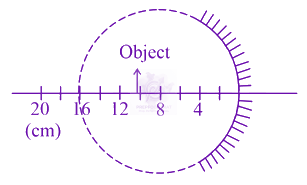
A point object in air is in front of the curved surface of a plano-convex lens. The radius of curvature of the curved surface is $30cm$ and the refractive index of the lens material is $1.5,$ then the focal length of the lens (in cm) is ___________.