Optics PYQ — Page 13
JEE Main Physics — Optics previous year questions with solutions.
All Optics Questions (489)
In a Young's double slit experiment, the slits are separated by $0.3\mathrm{mm}$ and the screen is $1.5m$ away from the plane of slits. Distance between fourth bright fringes on both sides of central bright fringe is $2.4\mathrm{cm}.$ The frequency of light used is $x\times {10}^{14}\mathrm{Hz}.$
An object is placed at the focus of concave lens having focal length $f.$ What is the magnification and distance of the image from the optical centre of the lens?
Two satellites revolve around a planet in coplanar circular orbits in anticlockwise direction. Their period of revolutions are $1$ hour and $8$ hours respectively. The radius of the orbit of nearer satellite is $2\times {10}^{3}\mathrm{km}.$ The angular speed of the farther satellite as observed from the nearer satellite at the instant when both the satellites are closest is $\frac{\pi }{x}rad{h}^{-1}$, where $x$ is $_______.$
The light waves from two coherent sources have same intensity ${I}_{1}={I}_{2}={I}_{0}.$ In interference pattern the intensity of light at minima is zero. What will be the intensity of light at maxima?
In a Young's double slit experiment, the width of the one of the slit is three times the other slit. The amplitude of the light coming from a slit is proportional to the slit-width. Find the ratio of the maximum to the minimum intensity in the interference pattern.
In Young's double slit arrangement, slits are separated by a gap of $0.5\mathrm{mm}$, and the screen is placed at a distance of $0.5m$ from them. The distance between the first and the third bright fringe formed when the slits are illuminated by a monochromatic light of $5890\overset{o}{A}$ is :-
A short straight object of height $100\mathrm{cm}$ lies before the central axis of a spherical mirror whose focal length has absolute value $|f|=40\mathrm{cm}$. The image of object produced by the mirror is of height $25\mathrm{cm}$ and has the same orientation of the object. One may conclude from the information:
Region $I$ and $\mathrm{II}$ are separated by a spherical surface of radius $25\mathrm{cm}$. An object is kept in region $I$ at a distance of $40\mathrm{cm}$ from the surface. The distance of the image from the surface is: 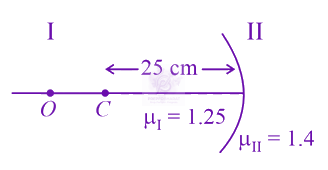
The difference in the number of waves when yellow light propagates through air and vacuum columns of the same thickness is one. The thickness of the air column is _____ $\mathrm{mm}$. [Refractive index of air $=1.0003$, the wavelength of yellow light in vacuum $=6000\overset{\circ }{A}]$
The same size images are formed by a convex lens when the object is placed at $20\mathrm{cm}$ or at $10\mathrm{cm}$ from the lens. The focal length of convex lens is
A fringe width of $6\mathrm{mm}$ was produced for two slits separated by $1\mathrm{mm}$ apart. The screen is placed $10m$ away. The wavelength of light used is $x$ $\mathrm{nm}$. The value of $x$ to the nearest integer is ______.
The angle of deviation through a prism is minimum when 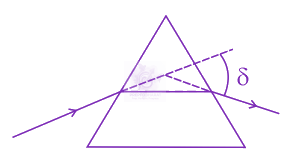 (A) Incident ray and emergent ray are symmetric to the prism (B) The refracted ray inside the prism becomes parallel to its base (C) Angle of incidence is equal to that of the angle of emergence (D) When angle of emergence is double the angle of incidence Choose the correct answer from the options given below :
An object is placed beyond the centre of curvature $C$ of the given concave mirror. If the distance of the object is ${d}_{1}$ from $C$ and the distance of the image formed is ${d}_{2}$ from $C,$ the radius of curvature of this mirror is:
A source of light is placed in front of a screen. The intensity of light on the screen is $I$. Two Polaroids ${P}_{1}$ and ${P}_{2}$ are so placed in between the source of light and screen that the intensity of light on the screen is $\frac{I}{2}$. Then the ${P}_{2}$, should be rotated by an angle of (degrees) so that the intensity of light on the screen becomes $\frac{3I}{8}$.
Your friend is having eye sight problem. She is not able to see clearly a distant uniform window mesh and it appears to her as nonuniform and distorted. The doctor diagnosed the problem as :
An object viewed from a near point distance of $25\mathrm{cm}$, using a microscopic lens with magnification $6,$ gives an unresolved image. A resolved image is observed at infinite distance with a total magnification double the earlier using an eyepiece along with the given lens and a tube of length $0.6m$, if the focal length of the eyepiece is equal to ____ $\mathrm{cm}.$
The refractive index of a converging lens is $1.4$. What will be the focal length of this lens if it is placed in a medium of same refractive index ? (Assume the radii of curvature of the faces of lens are ${R}_{1}$ and ${R}_{2}$ respectively)
The expected graphical representation of the variation of angle of deviation ' $\delta$ ' with angle of incidence 'i' in a prism is :
White light is passed through a double slit and interference is observed on a screen $1.5m$ away. The separation between the slits is $0.3\mathrm{mm}$. The first violet and red fringes are formed $2.0\mathrm{mm}$ and $3.5\mathrm{mm}$ away from the central white fringes. The difference in wavelengths of red and violet light is $(\text{in}\mathrm{nm}).$
Curved surfaces of a plano-convex lens of refractive index ${\mu }_{1}$ and a plano-concave lens of refractive index ${\mu }_{2}$ have equal radius of curvature as shown in figure. Find the ratio of radius of curvature to the focal length of the combined lenses 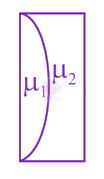
In the figure below, $P$ and $Q$ are two equally intense coherent sources emitting radiation of wavelength $20m.$ The separation between $P$ and $Q$ is $5m$ and the phase of $P$ is ahead of that of $Q$ by $90^{\circ}.A,B$ and C are three distinct point of observation, each equidistant from the midpoint of PQ. The intensities of radiation at $A,B,C$ will be in the ratio : 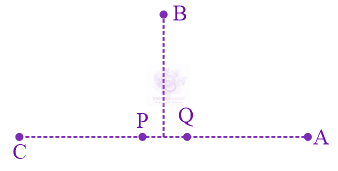
The refractive index of a medium where speed of light is 2 × 10⁸ m/s is:
In a Young's double slit experiment, light of $500\mathrm{nm}$ is used to produce and interference pattern. When the distance between the slits is $0.05\mathrm{mm},$ the angular width (in degree) of the fringes formed on the distance screen is close to :
Orange light of wavelength $6000\times {10}^{–10}m$ illuminates a single slit of width $0.6\times {10}^{–4}m$. The maximum possible number of diffraction minima produced on both sides of the central maximum is __________