Optics PYQ — Page 15
JEE Main Physics — Optics previous year questions with solutions.
All Optics Questions (489)
There is a small source of light at some depth below the surface of water (refractive index $=\frac{4}{3}$ ) in a tank of large cross sectional surface area. Neglecting any reflection from the bottom and absorption by water, percentage of light that emerges out of surface is (nearly): [Use the fact that surface area of a spherical cap of height $h$ and radius of curvature $r$ is $2\pi rh$ ]
The critical angle of a medium for a specific wavelength, if the medium has relative permittivity $3$ and relative permeability $\frac{4}{3}$ for this wavelength, will be:
In a double – slit experiment, at a certain point on the screen the path difference between the two interfering waves is $\frac{1}{8}th$ of a wavelength. The ratio of the intensity of light at that point to that at the center of a bright fringe is:
An observer can see through a small hole on the side of a jar (radius $15\mathrm{cm}$ ) at a point at height of $15\mathrm{cm}$ from the bottom (see figure). The hole is at a height of $45\mathrm{cm}$. When the jar is filled with a liquid up to a height of $30\mathrm{cm}$ the same observer can see the edge at the bottom of the jar. If the refractive index of the liquid is$\frac{N}{100},$ where $N$ is an integer, the value of $N$ is 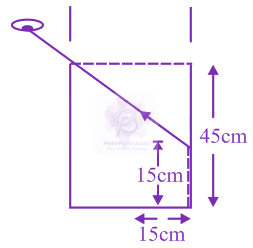
A light ray enters a solid glass sphere of refractive index $\mu =\sqrt{3}$ at an angle of incidence $60^{\circ}$. The ray is both reflected and refracted at the farther surface of the sphere. The angle (in degrees) between the reflected and refracted rays at this surface is _____________.
Two coherent sources of sound, ${S}_{1}$ and ${S}_{2},$ produce sound waves of the same wavelength $\lambda =1m$ are in phase. ${S}_{1}$ and ${S}_{2}$ are placed $1.5m$ apart (see fig). A listener, located at $L$, directly in front of ${S}_{2}$, finds that the intensity is at a minimum when he is $2m$ away from ${S}_{2}$. The listener moves away from ${S}_{1}$, keeping the distance from ${S}_{2}$ fixed. The adjacent maximum of intensity is observed when the listener is at a distance $d$ from ${S}_{1}$. Then $d$ is : 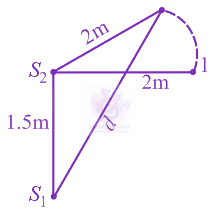
A point like object is placed at distance of $1m$ in front of a convex lens of focal length $0.5m$. A plane mirror is placed at a distance of $2m$ behind the lens. The position and nature of the image formed by the system is
When an object is kept at a distance of $30\mathrm{cm}$ from a concave mirror, the image is formed at a distance of $10\mathrm{cm}$from the mirror. If the object is moved with a speed of $9\mathrm{cm}{s}^{-1}$ , the speed (in $\mathrm{cm}{s}^{-1}$) with which image moves at that instant is
A point source of light, S is placed at a distance L in front of the center of plane mirror of width d which is hanging vertically on a wall. A man walks in front of the mirror along a line parallel to the mirror, at a distance 2L as shown below. The distance over which the man can see the image of the light source in the mirror is: 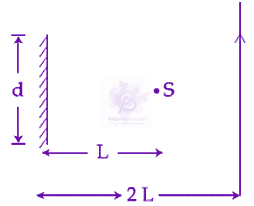
An object is at a distance of $20 \mathrm{~m}$ from a convex lens of focal length $0.3 \mathrm{~m}$. The lens forms an image of the object. If the object moves away from the lens at a speed of $5 \mathrm{~m} / \mathrm{s}$ the speed and direction of the image will be
A thin convex lens $L$ (refractive index $=1.5$ ) is placed on a plane mirror $M$. When a pin is placed at $A$, such that $OA=18 cm,$ its real inverted image is formed at $A$ itself, as shown in figure. When liquid of refractive index ${\mu }_{l}$ is put between the lens and the mirror, the pin has to be moved to ${A}^{'},$ such that $O{A}^{'}=27 cm,$ to get its inverted real image at $A'$ itself. The value of ${\mu }_{l}$ will be 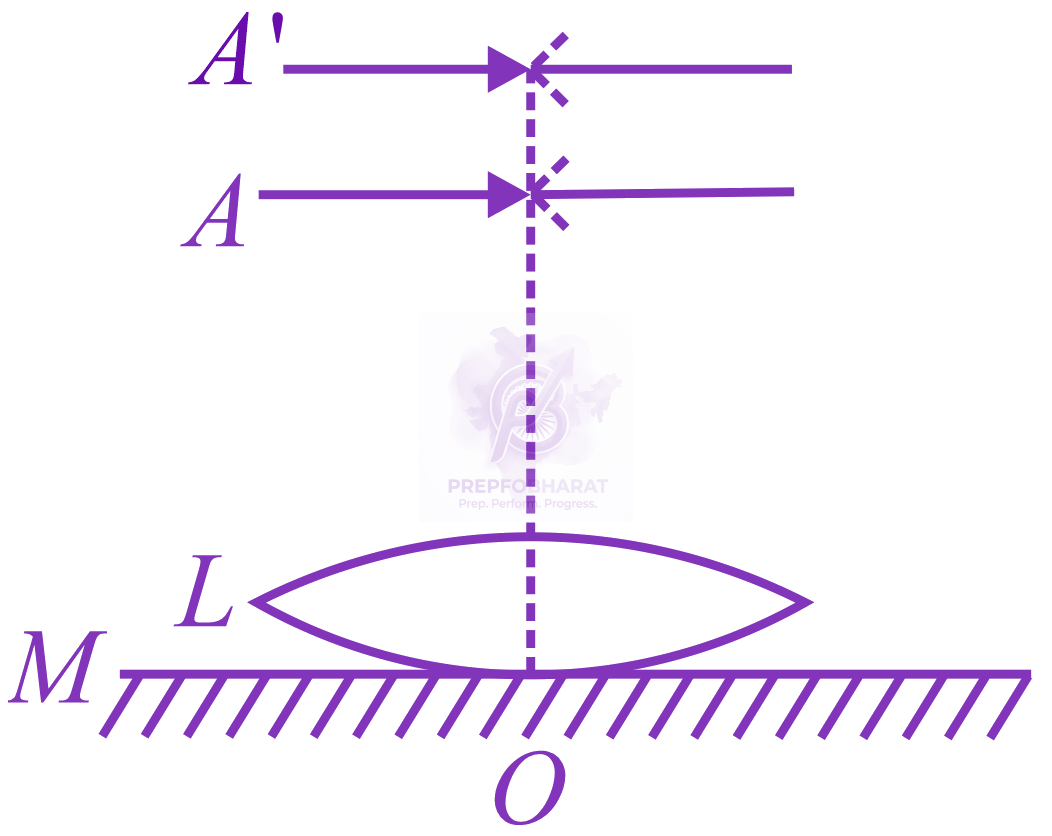
In a double slit experiment, when a thin film of thickness $t$ having refractive index $\mu$ is introuduced in front of one of the slits, the maximum at the centre of the fringe pattern shifts by one fringe width. The value of $t$ is $(\lambda$ is the wavelength of the light used):
A convex lens of focal length $20 cm$ produces images of the same magnification 2 when an object is kept at two distances ${x}_{1}$ and ${x}_{2}({x}_{1}>{x}_{2})$ from the lens. The ratio of ${x}_{1}$ and ${x}_{2}$ is:
What is the position and nature of image formed by lens combination shown in figure? ( ${f}_{1}, {f}_{2}$ are focal lengths) 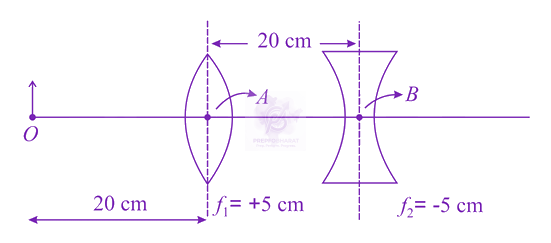
The variation of refractive index of a crown glass thin prism with wavelength of the incident light is shown. Which of the following graphs is the correct one, if $D_{m}$ is the angle of minimum deviation? 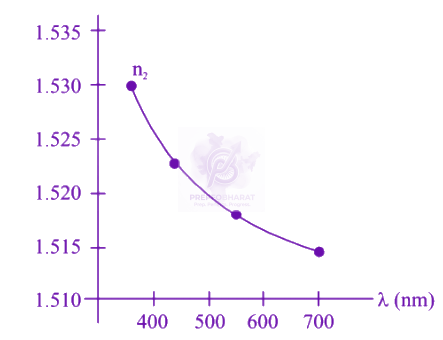
A convex lens is put $10 cm$ from a light source and it makes a sharp image on a screen, kept $10 cm$ from the lens. Now a glass block (refractive index 1.5) of $1.5 cm$ thickness is placed in between the light source and the lens. To get the sharp image again, the screen is shifted by a distance $d.$ Then $d$ is: 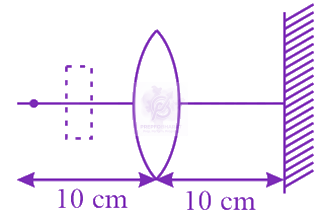
In a Young's double slit experiment slit separation $0.1 mm,$ one observes a bright fringe at angle $\frac{1}{40} rad$ by using light of wavelength ${\lambda }_{1}.$ When the light of wavelength ${\lambda }_{2}$ is used a bright fringe is seen at the same angle in the same set up. Given that ${\lambda }_{1}$ and ${\lambda }_{2}$ are in visible range $(380 nm to 740 nm),$ their values are:
The figure shows a Young's double slit experimental setup. It is observed that when a thin transparent sheet of thickness t and refractive index $\mu$ is put in front of one of the slits, the central maximum gets shifted by a distance equal to n fringe width. If the wavelength of light used is $\lambda$ then $t$ will be: 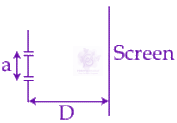
Two plane mirrors are inclined to each other such that a ray of light incident on the first mirror $({M}_{1})$ and parallel to the second mirror $({M}_{2})$ is finally reflected from the second mirror $({M}_{2})$ and parallel to the first mirror $({M}_{1}).$ The angle between the two mirrors will be:
A concave mirror for face viewing has a focal length of $0.4 m$. The distance at which you hold the mirror from your face in order to see your image upright with a magnification of $5$ is
In a double-slit experiment, green light $(5303 \mathrm{~A})$ falls on a double slit having a separation of $19.44 \mu \mathrm{m}$ and a width of $4.05 \mu \mathrm{m}$. The number of bright fringes between the first and the second diffraction minima is
Consider a tank made of glass (refractive index $1.5$ ) with a thick bottom. It is filled with a liquid of refractive index $\mu .$ A student finds that, irrespective of what the incident angle $i$ (see figure) is for a beam of light entering the liquid, the light reflected from the liquid glass interface is never completely polarized. For this to happen, the minimum value of $\mu$ is: 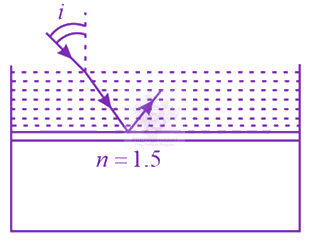
Formation of real image using a biconvex lens is shown below: 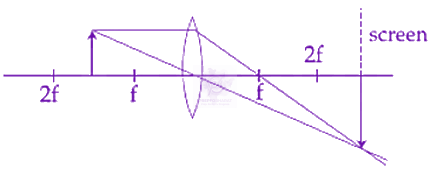 If the whole set up is immersed in water without disturbing the object and the screen positions, what will one observe on the screen?
Two coherent sources produce waves of different intensities which interfere. After interference, the ratio of the maximum intensity to the minimum intensity is $16.$ The intensity of the waves are in the ratio: