Optics PYQ — Page 16
JEE Main Physics — Optics previous year questions with solutions.
All Optics Questions (489)
In a Young's double slit experiment, the path difference, at a certain point on the screen, betwen two interfering waves is $\frac{1}{8}$ th of wavelength. The ratio of the intensity at this point to that at the centre of a bright fringe is close to:
A plano - convex lens (focal length ${f}_{2}$ , refractive index ${\mu }_{2},$ radius of curvature R) fits exactly into a plano - concave lens (focal length ${f}_{1},$ refractive index ${\mu }_{1},$ radius of curvature R). Their plane surfaces are parallel to each other. Then, the focal length of the combination will be:
In a young's double slit experiment, the slits are placed $0.320 mm$ apart. Light of wavelength $\lambda =500 nm$ is incident on the slits. The total number of bright fringes that are observed in the angular range $-{30}^{o}\leq \theta \leq {30}^{o}$ is:
A ray of light $AO$ in vacuum is incident on a glass slab at angle $60^{\circ}$ and refracted at angle $30^{\circ}$ along $OB$ as shown in the figure. The optical path length of light ray from $A$ to $B$ is: 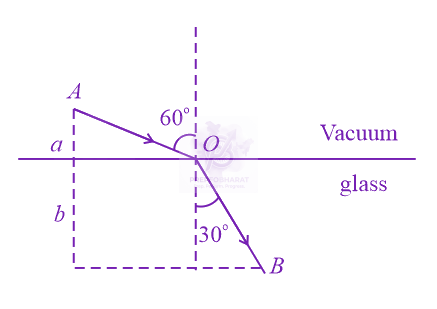
The graph shows how the magnification $m$ produced by a thin lens varies with image distance $v$. The focal length of the lens used is 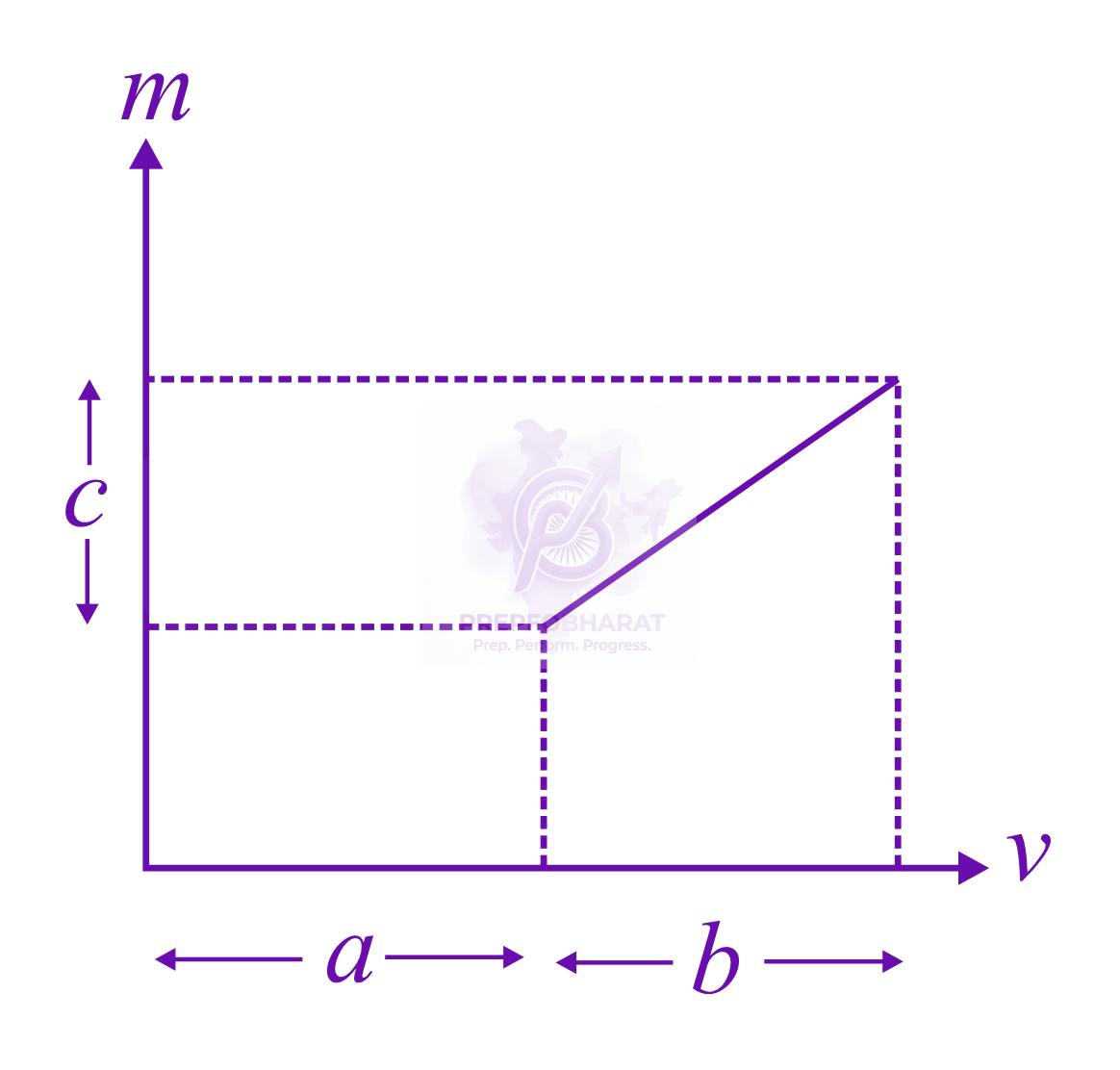
A plano-convex lens of refractive index ${\mu }_{1}$ and focal length ${f}_{1}$ is kept in contact with another plano-concave lens of refractive index ${\mu }_{2}$ and focal length ${f}_{2}.$ If the radius of curvature of their spherical faces is $R$ each and ${f}_{1}=2{f}_{2},$ the ${\mu }_{1}$ and ${\mu }_{2}$ are related as:
A convex lens (of focal length $20 cm$ ) and a concave mirror, having their principal axes along the same lines, are kept $80 cm$ apart from each other. The concave mirror is to the right of the convex lens. When an object is kept at a distance of $30 cm$ to the left of the convex lens, its image remains at the same position even if the concave mirror is removed. The maximum distance of the object for which this concave mirror, by itself would produce a virtual image would be:
A system of three polarizers ${P}_{1},{P}_{2},{P}_{3}$ is set up such that the pass axis of ${P}_{3}$ is crossed with respect to that of ${P}_{1}$ . The pass axis of ${P}_{2}$ is inclined at ${60}^{o}$ to the pass axis of ${P}_{3}.$ When a beam of unpolarized light of intensity ${I}_{o}$ is incident on ${P}_{1},$ the intensity of light transmitted by the three polarizers is $I$ . The ratio $({I}_{o}/I)$ equals (nearly):
A concave mirror has radius of curvature of $40 cm.$ It is at the bottom of a glass that has water filled up to $5 cm$ (see figure). If a small particle is floating on the surface of water, its image as seen, from directly above the glass, is at a distance $d$ from the surface of water. The value of $d$ is close to: (Refractive index of water $=1.33)$ 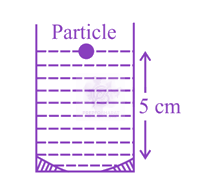
A transparent cube of side $d$, made of a material of refractive index ${\mu }_{2}$, is immersed in a liquid of refractive index ${\mu }_{1}({\mu }_{1}<{\mu }_{2})$. A ray is incident on the face $AB$ at an angle $\theta$ (shown in the figure). Total internal reflection takes place at the point $E$ on the face $BC.$ 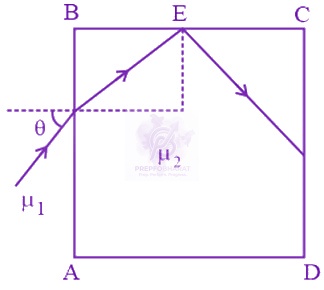 Then, $\theta$ must satisfy
One plano-convex and one plano-concave lens of the same radius of curvature $R$ but of different materials are joined side by side as shown in the figure. If the refractive index of the material of $1$ is ${\mu }_{1}$ and that of $2$ is${ \mu }_{2}$, then the focal length of the combination is: 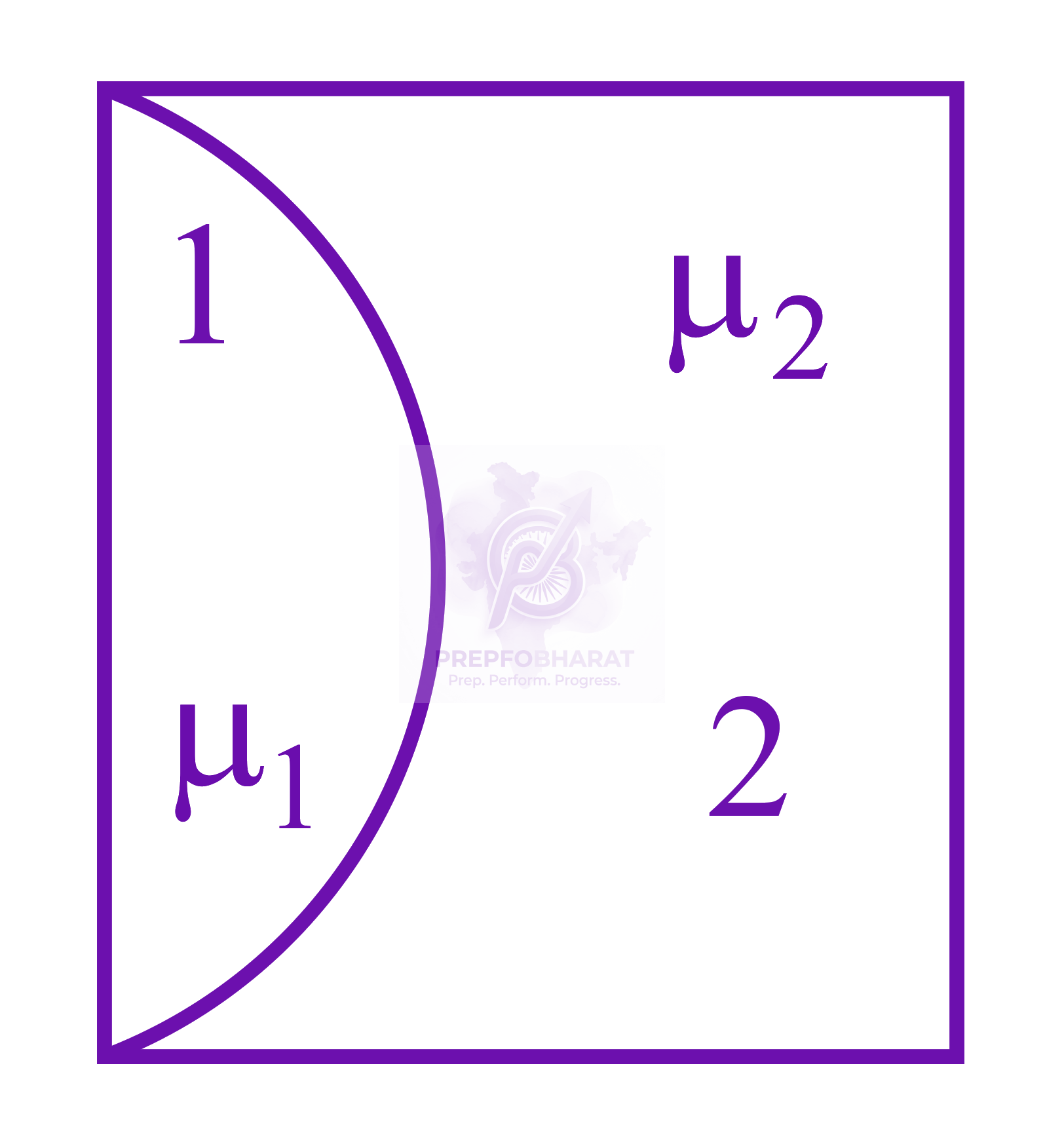
An upright object is placed at a distance of $40 cm$ in front of a convergent lens of focal length $20 cm.$ A convergent mirror of focal length $10 cm$ is placed at a distance of $60 cm$ on the other side of the lens. The position and size of the final image will be:
A monochromatic light is incident at a certain angle on an equilateral triangular prism and suffers minimum deviation. If the refractive index of the material of the prism is $\sqrt{3}$, then the angle of incidence is :
In a Young's double-slit experiment, the ratio of the slit's width is $4 :1$ . The ratio of the intensity of maxima to minima, close to the central fringe on the screen, will be
A light wave is incident normally on a glass slab of refractive index $1.5.$ If $4%$ of light gets reflected and the amplitude of the electric field of the incident light is $30\frac{V}{m},$ then the amplitude of the electric field for the wave propagating in the glass medium will be:
In an interference experiment the ratio of amplitudes of coherent waves is $\frac{{a}_{1}}{{a}_{2}}=\frac{1}{3}$ . The ratio of maximum and minimum intensities of fringes will be:
In figure, the optical fiber is $l=2 m$ long and has a diameter of $d=20 \mu m.$ If a ray of light is incident on one end of the fiber at angle ${\theta }_{1}=40^{\circ}$ , the number of reflections it makes before emerging from the other end is close to: (refractive index of fiber is $1.31$ , $sin 40^{\circ}=0.64$ and ${\mathrm{sin}}^{-1}0.49=30^{\circ}$ .) 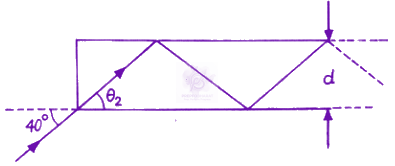
Consider a Young's double slit experiment as shown in figure. What should be the slit separation $d$ in terms of wavelength $\lambda$ such that the first minima occurs directly in front of the slit $({S}_{1})$ ? 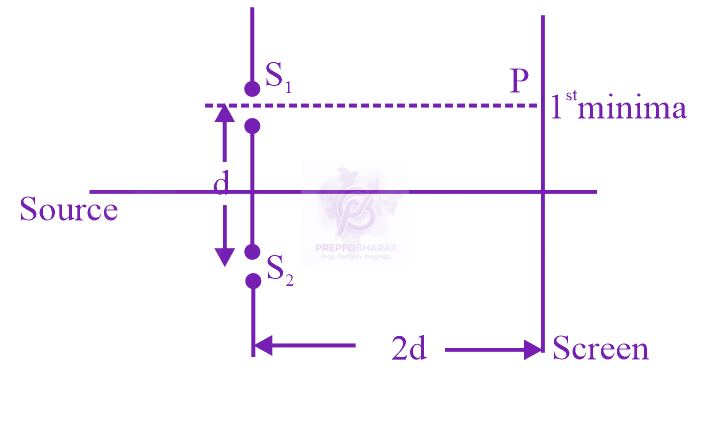
The eye can be regarded as a single refracting surface. The radius of curvature of this surface is equal to that of the cornea $(7.8 \mathrm{mm})$. This surface separates two media of refractive indices $1$ and $1.34$. Calculate the distance from the refracting surface at which a parallel beam of light will come to focus.
A plano-convex lens becomes an optical system of $28\mathrm{cm}$ focal length when its plane surface is silvered and illuminated from left to right as shown in fig$-A$ If the same lens is instead silvered on the curved surface and illuminated from another side as in fig-$B$, it acts as an optical system of focal length $10\mathrm{cm}$. The refractive index of the material of the lens is: 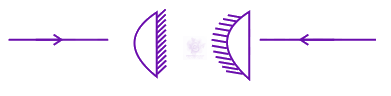
A particle is oscillating on the $\mathrm{X}$-axis with an amplitude $2 \mathrm{~cm}$ about the point $x_0=10 \mathrm{~cm}$ with a frequency $\omega$. A concave mirror of focal length 5 $\mathrm{cm}$ is placed at the origin (see figure) Identify the correct statements: (A) The image executes periodic motion (B) The image executes non-periodic motion (C) The turning points of the image are asymmetric w.r.t the image of the point at $x$ $=10 \mathrm{~cm}$ (D) The distance between the turning points of the oscillation of the image is $\frac{100}{21}$ 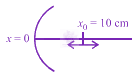
A particle is oscillating on the $x$-axis with an amplitude $2\mathrm{cm}$ about the point ${x}_{0}=10 \mathrm{cm}$ with a frequency. A concave mirror of focal length $5\mathrm{cm}$ is placed at the origin (see figure). 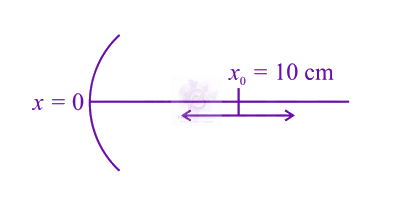 Identify the correct statements? (i) The image executes periodic motion. (ii) The image executes non-periodic motion. (iii) The turning points of the image are asymmetric with respect to the image of the point at $X=10 \mathrm{cm}$. (iv) The distance between the turning points of the oscillation of the image is $\frac{100}{21} \mathrm{cm}$.
Light of wavelength $550 \mathrm{~nm}$ falls normally on a slit of width $22.0 \times 10^{-5} \mathrm{~cm}$. The angular position of the second minima from the central maximum will be (in radians)
A ray of light is incident at an angle of ${ 60}^{\circ }$ on one face of a prism of angle ${ 30}^{\circ }$. The emergent ray of light makes an angle of ${ 30}^{\circ }$ with incident ray. The angle made by the emergent ray with second face of prism will be: