JEE Main Physics — Mechanics previous year questions with solutions.
A sphere of radius $a$ and mass $m$ rolls along a horizontal plane with constant speed ${v}_{0}$. It encounters an inclined plane at angle $\theta$ and climbs upward. Assuming that it rolls without slipping, how far up the sphere will travel? 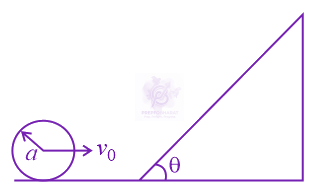
The radius in kilometer to which the present radius of earth $(R=6400\mathrm{km})$ to be compressed so that the escape velocity is increased $10$ time is _______.
A hydraulic press can lift $100\mathrm{kg}$ when a mass $m$ is placed on the smaller piston. It can lift kg when the diameter of the larger piston is increased by $4$ times and that of the smaller piston is decreased by $4$ times keeping the same mass $m$ on the smaller piston.
The boxes of masses $2\mathrm{kg}$ and $8\mathrm{kg}$ are connected by a massless string passing over smooth pulleys. Calculate the time taken by box of mass $8\mathrm{kg}$ to strike the ground starting from rest. $(g=10m{s}^{-2})$ 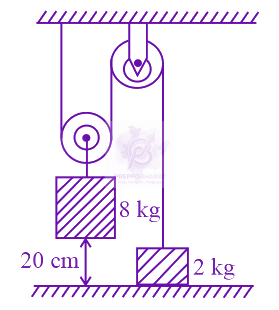
Water droplets are coming from an open tap at a particular rate. The spacing between a droplet observed at ${4}^{\mathrm{th}}$ second after its fall to the next droplet is $34.3m$. At what rate the droplets are coming from the tap ? (Take $g=9.8m{s}^{-2}$)
When two soap bubbles of radii $a$ and $b$$(b>a)$ coalesce, the radius of curvature of common surface is:
A solid disc of radius $20\mathrm{cm}$ and mass $10\mathrm{kg}$ is rotating with an angular velocity of $600\mathrm{rpm}$, about an axis normal to its circular plane and passing through its centre of mass. The retarding torque required to bring the disc at rest in $10s$ is _________$\pi \times {10}^{-1}Nm$
Two bodies, a ring and a solid cylinder of same material are rolling down without slipping an inclined plane. The radii of the bodies are same. The ratio of velocity of the centre of mass at the bottom of the inclined plane of the ring to that of the cylinder is $\frac{\sqrt{x}}{2}.$ Then, the value of $x$ is
The value of tension in a long thin metal wire has been changed from ${T}_{1}$ to ${T}_{2}$. The lengths of the metal wire at two different values of tension ${T}_{1}$ and ${T}_{2}$ are ${\ell }_{1}$ and ${\ell }_{2}$, respectively. The actual length of the metal wire is:
A body of mass $2\mathrm{kg}$ moving with a speed of $4m{s}^{-1}$ makes an elastic collision with another body at rest and continues to move in the original direction but with one fourth of its initial speed. The speed of the two body centre of mass is $x/10$. Find the value of x.
The disc of mass $M$ with uniform surface mass density $\sigma$ is shown in the figure. The center of mass of the quarter disc (the shaded area) is at the position $(\frac{xa}{3\pi },\frac{xa}{3\pi })$ where $x$ is _______ . (Round off to the Nearest Integer) [$a$ is an area as shown in the figure] 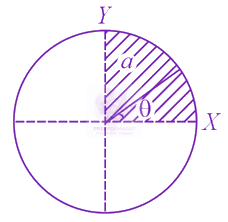
A scooter accelerates from rest for time ${t}_{1}$ at constant rate ${a}_{1}$ and then retards at constant rate ${a}_{2}$ for time ${t}_{2}$ and comes to rest. The correct value of $\frac{{t}_{1}}{{t}_{2}}$ will be :
Two particles having masses $4g$ and $16g$ respectively are moving with equal kinetic energies. The ratio of the magnitudes of their linear momentum is $n:2$. The value of $n$ will be ___.
A small bob tied at one end of a thin string of length $1m$ is describing a vertical circle so that the maximum and minimum tension in the string is in the ratio $5:1$. The velocity of the bob at the highest position is ______ $m{s}^{-1}$. (Take $g=10m{s}^{-2}$)
The solid cylinder of length $80\mathrm{cm}$ and mass $M$ has a radius of $20\mathrm{cm}.$ Calculate the density of the material used if the moment of inertia of the cylinder about an axis $CD$ parallel to $AB$ as shown in figure is $2.7\mathrm{kg}{m}^{2}$. 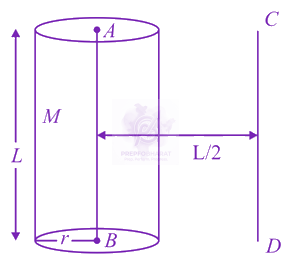
A circular hole of radius $(\frac{a}{2})$ is cut out of a circular disc of radius $a$ as shown in figure. The centroid of the remaining circular portion with respect to point $O$ will be: 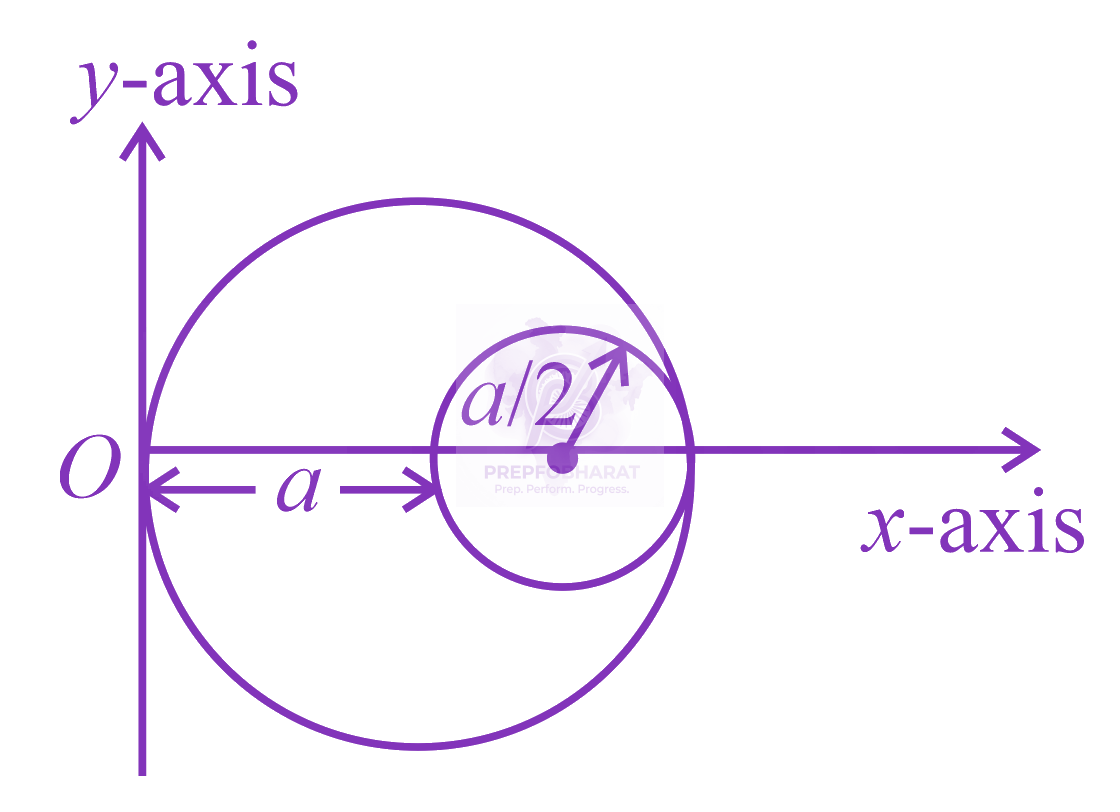
Consider a situation in which a ring, a solid cylinder and a solid sphere roll down on the same inclined plane without slipping. Assume that they start rolling from rest and having identical diameter. The correct statement for this situation is
A thin circular ring of mass $M$ and radius $r$ is rotating about its axis with an angular speed $\omega .$ Two particles having mass $m$ each are now attached at diametrically opposite points. The angular speed of the ring will become:
A ball of mass $10\mathrm{kg}$ moving with a velocity $10\sqrt{3}{ms}^{-1}$ along $X$-axis, hits another ball of mass $20\mathrm{kg}$ which is at rest. After the collision, the first ball comes to rest and the second one disintegrates into two equal pieces. One of the pieces starts moving along $Y$-axis at a speed of $10m{s}^{-1}$. The second piece starts moving at a speed of $20m{s}^{-1}$ at an angle $\theta$ (degree) with respect to the $X$-axis. The configuration of pieces after the collision is shown in the figure. The value of $\theta$ to the nearest integer is _________. 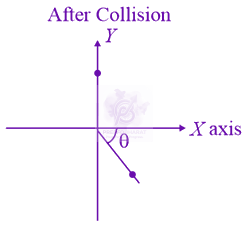
A soap bubble of the radius $3\mathrm{cm}$ is formed inside another soap bubble of radius, $6\mathrm{cm}$. The radius of an equivalent soap bubble that has the same excess pressure as inside the smaller bubble with respect to the atmospheric pressure is____$\mathrm{cm}.$
Consider a planet in some solar system that has a mass double the mass of earth and density equal to the average density of the earth. If the weight of an object on earth is $W$, the weight of the same object on that planet will be:
The angular momentum of a planet of mass $M$ moving around the sun in an elliptical orbit is $\vec{L}$. The magnitude of the areal velocity of the planet is :
Two stars of masses $m$ and $2m$ at a distance $d$ rotate about their common centre of mass in free space. The period of revolution is
Four identical particles of equal masses $1\mathrm{kg}$ made to move along the circumference of a circle of radius $1m$ under the action of their own mutual gravitational attraction. The speed of each particle will be: