JEE Main Physics — Mechanics previous year questions with solutions.
The height of victoria's falls is $63m$. What is the difference in the temperature of water at the top and at the bottom of the fall? [Given $1\mathrm{cal}=4.2J$ and specific heat of water $=1\mathrm{cal}{g}^{-1}{C\circ }^{-1}]$
If $\vec{A}$ and $\vec{B}$ are two vectors satisfying the relation $\vec{A}\cdot \vec{B}=|\vec{A}\times \vec{B}|$. Then the value of $|\vec{A}-\vec{B}|$ will be:
Student $A$ and student $B$ used two screw gauges of equal pitch and $100$ equal circular divisions to measure the radius of a given wire. The actual value of the radius of the wire is $0.322\mathrm{cm}$. The absolute value of the difference between the final circular scale readings observed by the students $A$ and $B$ is _______. [Figure shows position of reference $O$ when jaws of screw gauge are closed] Given pitch $=0.1\mathrm{cm}$. 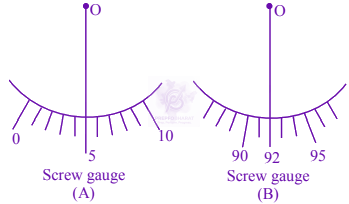
The resistance $R=\frac{V}{I}$, where $V=(50\pm 2)V$ and $I=(20\pm 0.2)A$. The percentage error in $R$ is $x$ $%$. The value of $x$ to the nearest integer is ________.
The resultant of these forces $\vec{OP},\vec{OQ},\vec{OR},\vec{OS}$ and $\vec{OT}$ is approximately ______$N.$ [Take $\sqrt{3}=1.7,\sqrt{2}=1.4$ Given $\hat{i}$ and $\hat{j}$ unit vectors along $x,y$ axis] 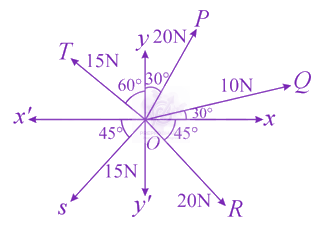
A block of mass $m$ slides along a floor while a force of magnitude $F$ is applied to it at an angle $\theta$ as shown in figure. The coefficient of kinetic friction is ${\mu }_{K}$. Then, the block's acceleration $a$ is given by : ($g$ is acceleration due to gravity) 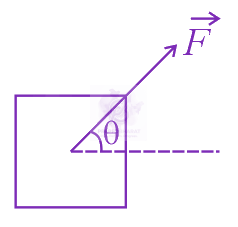
A student determined Young's Modulus of elasticity using the formula $Y=\frac{Mg{L}^{3}}{4{\mathrm{bd}}^{3}\delta }.$ The value of $g$ is taken to be $9.8m{s}^{-2}$ without any significant error, his observations are as following. <table class="pyq-table"><tbody><tr><td>Physical Quantity</td><td>Least count of the Equipment used for measurement</td><td>Observed Value</td></tr><tr><td>Mass $(M)$</td><td>$1g$</td><td>$2\mathrm{kg}$</td></tr><tr><td>Length of bar $(L)$</td><td>$1\mathrm{mm}$</td><td>$1m$</td></tr><tr><td>Breadth of bar $(b)$</td><td>$0.1\mathrm{mm}$</td><td>$4\mathrm{cm}$</td></tr><tr><td>Thickness of bar $(d)$</td><td>$0.01\mathrm{mm}$</td><td>$0.4\mathrm{cm}$</td></tr><tr><td>Depression $(\delta )$</td><td>$0.01\mathrm{mm}$</td><td>$5\mathrm{mm}$</td></tr></tbody></table>Then the fractional error in the measurement of $Y$ is :
A body rolls down an inclined plane without slipping. The kinetic energy of rotation is $50%$ of its translational kinetic energy. The body is:
The resistance $R=\frac{V}{I}$, where $V=(50\pm 2)V$ and $I=(20\pm 0.2)A$. The percentage error in $R$ is $x$ $%$. The value of $x$ to the nearest integer is ________.
If the length of the pendulum in pendulum clock increases by $0.1%$, then the error in time per day is:
Consider a frame that is made up of two thin massless rods $AB$ and $AC$ as shown in the figure. A vertical force $\vec{P}$ of magnitude $100N$ is applied at point $A$ of the frame. 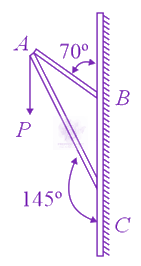 Suppose the force is $\vec{P}$ resolved parallel to the arms $AB$ and $AC$ of the frame. The magnitude of the resolved component along the arm $AC$ is $xN$. The value of $x$, to the nearest integer, is ________. [Given : $\mathrm{sin}(35^{\circ})=0.573,\mathrm{cos}(35^{\circ})=0.819,\mathrm{sin}(110^{\circ})=0.939,\mathrm{cos}(110^{\circ})=-0.342$]
A particle of mass $m$ is moving in time $t$ on a trajectory given by, $\vec{r}=10\alpha {t}^{2}\hat{i}+5\beta (t-5)\hat{j}$ where $\alpha$ and $\beta$ are dimensional constants. The angular momentum of the particle becomes the same as it was for $t=0$ at time $t=$_____ seconds.
Two blocks ($m=0.5\mathrm{kg}$ and $M=4.5\mathrm{kg}$) are arranged on a horizontal frictionless table as shown in the figure. The coefficient of static friction between the two blocks is $\frac{3}{7}.$ Then the maximum horizontal force that can be applied on the larger block so that the blocks move together is $N.$ (Round off to the Nearest Integer) [Take $g$ as $9.8m{s}^{-2}$] 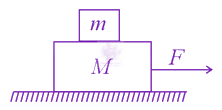
In order to determine the Young's Modulus of a wire of radius $0.2\mathrm{cm}$ (measured using a scale of least count $=0.001\mathrm{cm}$) and length $1m$ (measured using a scale of least count $=1\mathrm{mm}$), a weight of mass $1\mathrm{kg}$ (measured using a scale of least count $=1g$ ) was hanged to get the elongation of $0.5\mathrm{cm}$ (measured using a scale of least count $0.001\mathrm{cm}$). What will be the fractional error in the value of Young's Modulus determined by this experiment?
Consider two satellites ${S}_{1}$ and ${S}_{2}$ with periods of revolution $1\mathrm{hr}$ and $8\mathrm{hr}$ respectively revolving around a planet in circular orbits. The ratio of angular velocity of satellite ${S}_{1}$ to the angular velocity of satellite ${S}_{2}$ is:
If $\vec{A}$ and $\vec{B}$ are two vectors satisfying the relation $\vec{A}\cdot \vec{B}=|\vec{A}\times \vec{B}|$. Then the value of $|\vec{A}-\vec{B}|$ will be:
If force (F), length (L) and time (T) are taken as the fundamental quantities. Then what will be the dimension of density:
A large block of wood of mass $M=5.99\mathrm{kg}$ is hanging from two long massless cords. A bullet of mass $m=10g$ is fired into the block and gets embedded in it. The (block $+$ bullet) then swing upwards, their center of mass rising a vertical distance $h=9.8\mathrm{cm}$ before the (block $+$ bullet) pendulum comes momentarily to rest at the end of its arc. The speed of the bullet just before the collision is: (Take $g=9.8{ms}^{-2}$) 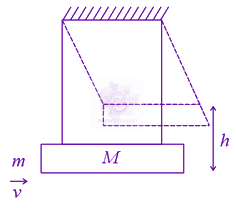
Match List I with List II. <table class="pyq-table"><tbody><tr><td colspan="2" rowspan="1">List I</td><td colspan="2" rowspan="1">List II</td></tr><tr><td>(a)</td><td>$\vec{C}-\vec{A}-\vec{B}=0$</td><td>(i)</td><td><img src="https://prepforbharat.s3.ap-south-1.amazonaws.com/exam/615f0e999476412f48314daf/Physics/images/Mathematics_in_Physics/648b5a6a417cc3fb48d67301/question_1__q_648b5a6a417cc3fb48d67301__cdn-question-pool.getmarks.app__b6c349fb-53c1-4e10-b1fe-828e32653b15-image__3b91df2772_final_ppt_sync.png" alt="JEE Main 2021 Physics, Mathematics in Physics — question figure 1"></td></tr><tr><td>(b)</td><td>$\vec{A}-\vec{C}-\vec{B}=0$</td><td>(ii)</td><td><img src="https://prepforbharat.s3.ap-south-1.amazonaws.com/exam/615f0e999476412f48314daf/Physics/images/Mathematics_in_Physics/648b5a6a417cc3fb48d67301/question_2__q_648b5a6a417cc3fb48d67301__cdn-question-pool.getmarks.app__8dcfe9df-eb9f-48ba-8cc4-cfd2b2c16819-image__2f6e4b06d3_final_ppt_sync.png" alt="JEE Main 2021 Physics, Mathematics in Physics — question figure 2"></td></tr><tr><td>(c)</td><td>$\vec{B}-\vec{A}-\vec{C}=0$</td><td>(iii)</td><td><img src="https://prepforbharat.s3.ap-south-1.amazonaws.com/exam/615f0e999476412f48314daf/Physics/images/Mathematics_in_Physics/648b5a6a417cc3fb48d67301/question_3__q_648b5a6a417cc3fb48d67301__cdn-question-pool.getmarks.app__e1726169-6520-4d6a-92bb-b0147017581e-image__8def3f0e02_final_ppt_sync.png" alt="JEE Main 2021 Physics, Mathematics in Physics — question figure 3"></td></tr><tr><td>(d)</td><td>$\vec{A}+\vec{B}=-\vec{C}$</td><td>(iv)</td><td><img src="https://prepforbharat.s3.ap-south-1.amazonaws.com/exam/615f0e999476412f48314daf/Physics/images/Mathematics_in_Physics/648b5a6a417cc3fb48d67301/question_4__q_648b5a6a417cc3fb48d67301__cdn-question-pool.getmarks.app__1019a326-88c2-4ad4-8b38-ec52abb6bdc9-image__957699a43d_final_ppt_sync.png" alt="JEE Main 2021 Physics, Mathematics in Physics — question figure 4"></td></tr></tbody></table>Choose the correct answer from the options given below:
When a rubber ball is taken to a depth of _______ $m$ in deep sea, its volume decreases by $0.5%$ (The bulk modulus of rubber $=9.8\times {10}^{8}N{m}^{-2}$ Density of sea water $={10}^{3}\mathrm{kg}{m}^{-3}$,$g=9.8m{s}^{-2}$)
The acceleration due to gravity is found up to an accuracy of $4%$ on a planet. The energy supplied to a simple pendulum of known mass $m$ to undertake oscillations of time period $T$ is being estimated. If time period is measured to an accuracy of $3%$, the accuracy to which $E$ is known as ________$%$
A student determined Young's Modulus of elasticity using the formula $Y=\frac{Mg{L}^{3}}{4{\mathrm{bd}}^{3}\delta }.$ The value of $g$ is taken to be $9.8m{s}^{-2}$ without any significant error, his observations are as following.<br><table class="pyq-table"><tbody><tr><td>Physical Quantity</td><td>Least count of the Equipment used for measurement</td><td>Observed Value</td></tr><tr><td>Mass $(M)$</td><td>$1g$</td><td>$2\mathrm{kg}$</td></tr><tr><td>Length of bar $(L)$</td><td>$1\mathrm{mm}$</td><td>$1m$</td></tr><tr><td>Breadth of bar $(b)$</td><td>$0.1\mathrm{mm}$</td><td>$4\mathrm{cm}$</td></tr><tr><td>Thickness of bar $(d)$</td><td>$0.01\mathrm{mm}$</td><td>$0.4\mathrm{cm}$</td></tr><tr><td>Depression $(\delta )$</td><td>$0.01\mathrm{mm}$</td><td>$5\mathrm{mm}$</td></tr></tbody></table>Then the fractional error in the measurement of $Y$ is :
The acceleration due to gravity is found up to an accuracy of $4%$ on a planet. The energy supplied to a simple pendulum of known mass $m$ to undertake oscillations of time period $T$ is being estimated. If time period is measured to an accuracy of $3%$, the accuracy to which $E$ is known as ________$%$
If $Y,K$ and $\eta$ are the values of Young's modulus, bulk modulus and modulus of rigidity of any material respectively. Choose the correct relation for these parameters.