Coordinate Geometry PYQ — Page 16
JEE Main Mathematics — Coordinate Geometry previous year questions with solutions.
All Coordinate Geometry Questions (615)
If the curves, $\frac{{x}^{2}}{a}+\frac{{y}^{2}}{b}=1$ and $\frac{{x}^{2}}{c}+\frac{{y}^{2}}{d}=1$ intersect each other at an angle of ${90}^{^{\circ}},$ then which of the following relations is TRUE?
Choose the incorrect statement about the two circles whose equations are given below: ${x}^{2}+{y}^{2}-10x-10y+41=0$ and ${x}^{2}+{y}^{2}-16x-10y+80=0$
The intersection of three lines $x-y=0,x+2y=3$ and $2x+y=6$ is a/an
The line $2x-y+1=0$ is a tangent to the circle at the point $(2,5)$ and the centre of the circle lies on $x-2y=4.$ Then, the radius of the circle is:
Two sides of a parallelogram are along the lines $4x+5y=0$ and $7x+2y=0.$ If the equation of one of the diagonals of the parallelogram is $11x+7y=9,$ then other diagonal passes through the point:
Let $P$ be a variable point on the parabola $y=4{x}^{2}+1.$ Then, the locus of the mid-point of the point $P$ and the foot of the perpendicular drawn from the point $P$ to the line $y=x$ is:
For the four circles $M,N,O$ and $P,$ following four equations are given: Circle $M:{x}^{2}+{y}^{2}=1$ Circle $N:{x}^{2}+{y}^{2}-2x=0$ Circle $O:{x}^{2}+{y}^{2}-2x-2y+1=0$ Circle $P:{x}^{2}+{y}^{2}-2y=0$ If the centre of circle $M$ is joined with centre of the circle $N,$ further centre of circle $N$ is joined with centre of the circle $O,$ centre of circle $O$ is joined with the centre of circle $P$ and lastly, centre of circle $P$ is joined with centre of circle $M,$ then these lines form the sides of a
Let $P$ and $Q$ be two distinct points on a circle which has center at $C(2,3)$ and which passes through origin $O.$ If $OC$ is perpendicular to both the line segments $CP$ and $CQ,$ then the set ${P,Q}$ is equal to
Let ${E}_{1}:\frac{{x}^{2}}{{a}^{2}}+\frac{{y}^{2}}{{b}^{2}}=1,a>b.$ Let ${E}_{2}$ be another ellipse such that it touches the end points of major axis of ${E}_{1}$ and the foci of ${E}_{2}$ are the end points of minor axis of ${E}_{1}.$ If ${E}_{1}$ and ${E}_{2}$ have same eccentricities, then its value is:
The length of the latus rectum of a parabola, whose vertex and focus are on the positive $x$-axis at a distance $R$ and $S(>R)$ respectively from the origin, is :
If one of the diameters of the circle ${x}^{2}+{y}^{2}-2x-6y+6=0$ is a chord of another circle $C''$, whose center is at $(2,1)$, then its radius is_____.
The locus of mid-points of the line segments joining $(-3,-5)$ and the points on the ellipse $\frac{{x}^{2}}{4}+\frac{{y}^{2}}{9}=1$ is :
Let the equation ${x}^{2}+{y}^{2}+px+(1-p)y+5=0$ represent circles of varying radius $r\in (0,5].$ Then the number of elements in the set $S=${$q:q={p}^{2}$ and $q$ is an integer} is ___________
The equation of one of the straight lines which passes through the point $(1,3)$ and makes an angles ${\mathrm{tan}}^{-1}(\sqrt{2})$ with the straight line, $y+1=3\sqrt{2}x$ is
Let $A$ be a fixed point $(0,6)$ and $B$ be a moving point $(2t,0).$ Let $M$ be the mid-point of $AB$ and the perpendicular bisector of $AB$ meets the $y-$axis at $C.$ The locus of the mid-point $P$ of $\mathrm{MC}$ is
In a triangle $PQR,$ the co-ordinates of the points $P$ and $Q$ are $(-2,4)$ and $(4,-2)$ respectively. If the equation of the perpendicular bisector of $PR$ is $2x-y+2=0,$ then the centre of the circumcircle of the $\Delta PQR$ is:
A square $ABCD$ has all its vertices on the curve ${x}^{2}{y}^{2}=1.$ The midpoints of its sides also lie on the same curve. Then, the square of area of $ABCD$ is
Let an ellipse $E:\frac{{x}^{2}}{{a}^{2}}+\frac{{y}^{2}}{{b}^{2}}=1,{a}^{2}>{b}^{2}$, passes through $(\sqrt{\frac{3}{2}},1)$ and has eccentricity $\frac{1}{\sqrt{3}}$. If a circle, centered at focus $F(\alpha ,0),\alpha >0$, of $E$ and radius $\frac{2}{\sqrt{3}}$, intersects $E$ at two points $P$ and $Q$, then $P{Q}^{2}$ is equal to :
Let $A(-1,1),B(3,4)$ and $C(2,0)$ be given three points. A line $y=mx,m>0$ , intersects lines $AC$ and $BC$ at point $P$ and $Q$ respectively. Let ${A}_{1}$ and ${A}_{2}$ be the areas of $\Delta ABC$ and $\Delta PQC$ respectively, such that ${A}_{1}=3{A}_{2}$, then the value of $m$ is equal to :
In the circle given below, let $OA=1$ unit, $OB=13$ unit and $PQ\perp OB$. Then, the area of the triangle $PQB$ (in square units) is :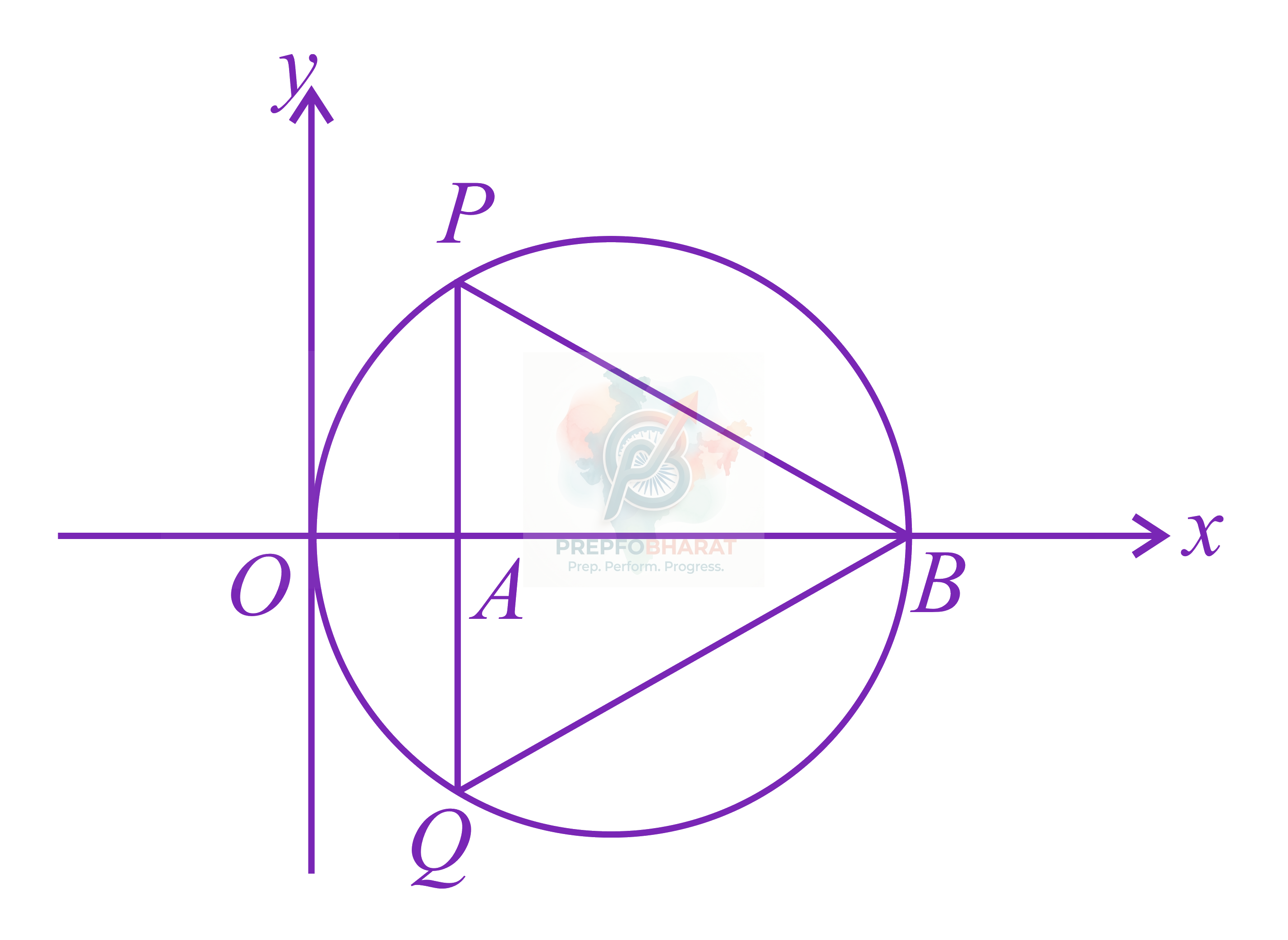
Let ${S}_{1}:{x}^{2}+{y}^{2}=9$ and ${S}_{2}:(x-2{)}^{2}+{y}^{2}=1$. Then the locus of center of a variable circle $S$ which touches ${S}_{1}$ internally and ${S}_{2}$ externally always passes through the points :
Let $A(1,4)$ and $B(1,-5)$ be two points. Let $P$ be a point on the circle ${((x-1))}^{2}+{(y-1)}^{2}=1$, such that ${(PA)}^{2}+{(PB)}^{2}$ have maximum value, then the points, $P,A$ and $B$ lie on
Let $B$ be the centre of the circle ${x}^{2}+{y}^{2}-2x+4y+1=0.$ Let the tangents at two points $P$ and $Q$ on the circle intersect at the point $A(3,1).$ Then $8(\frac{\mathrm{area}\Delta \mathrm{APQ}}{\mathrm{area}\Delta \mathrm{BPQ}})$ is equal to .
Let the lengths of intercepts on $x$ -axis and $y$ -axis made by the circle ${x}^{2}+{y}^{2}+ax+2ay+c=0,$ $(a<0)$ be $2\sqrt{2}$ and $2\sqrt{5}$, respectively. Then the shortest distance from origin to a tangent to this circle which is perpendicular to the line $x+2y=0,$ is equal to :