Organic Chemistry PYQ — Page 26
JEE Main Chemistry — Organic Chemistry previous year questions with solutions.
All Organic Chemistry Questions (1783)
$2-$Methyl propyl bromide reacts with ${C}_{2}{H}_{5}{O}^{-}$and gives $‘A’$ whereas on reaction with ${C}_{2}{H}_{5}\mathrm{OH}$ it gives $‘B’.$ The mechanism followed in these reactions and the products $‘A’$ and $‘B’$ respectively are:
The major product formed in the following reaction is  A. 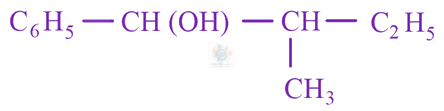 B. 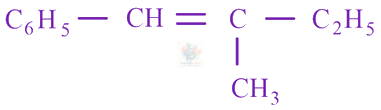 C. 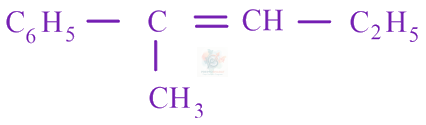 D. 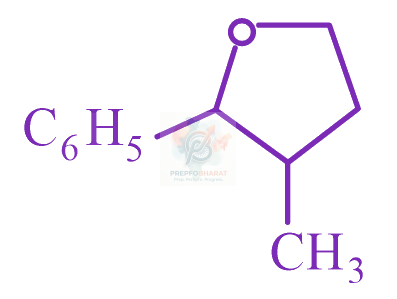 choose the correct answer from the options Given below:
The major product formed in the Friedel-Craft acylation of chlorobenzene is
$D-(+)-$Glyceraldehyde$\rightarrow _{\underset{\mathrm{iii}){\mathrm{HNO}}_{3}}{\mathrm{ii}){H}_{2}O/{H}^{+}}}^{i)\mathrm{HCN}}$ The products formed in the above reaction are
An organic compound $[A]({C}_{4}{H}_{11}N)$, shows optical activity and gives ${N}_{2}$ gas on treatment with ${\mathrm{HNO}}_{2}$. The compound $[A]$ reacts with ${\mathrm{PhSO}}_{2}\mathrm{Cl}$ producing a compound which is soluble in $\mathrm{KOH}$. The structure of $A$ is :
In Carius tube, an organic compound ' $X$ ' is treated with sodium peroxide to form a mineral acid ' $Y$ '. The solution of ${\mathrm{BaCl}}_{2}$ is added to ' $Y$ ' to form a precipitate ' $Z$ '. ' $Z$ ' is used for the quantitative estimation of an extra element. ' $X$ ' could be
Thin layer chromatography of a mixture shows the following observation: 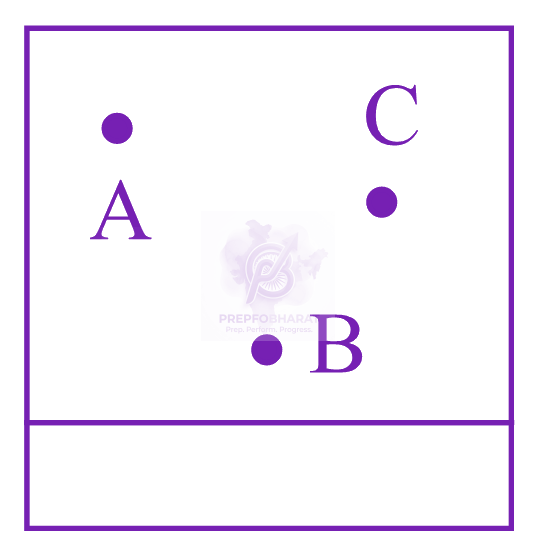 The correct order of elution in the silica gel column chromatography is
For the given reaction 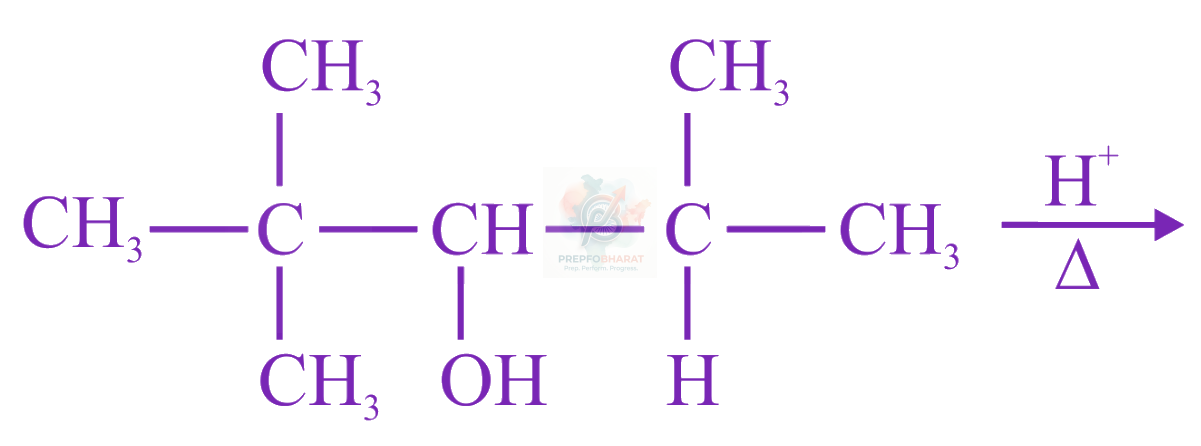 The, total number of possible products formed by tertiary carbocation of $A$ is$_______.$
What is the correct order of acidity of the protons marked $A–D$ in the given compounds? 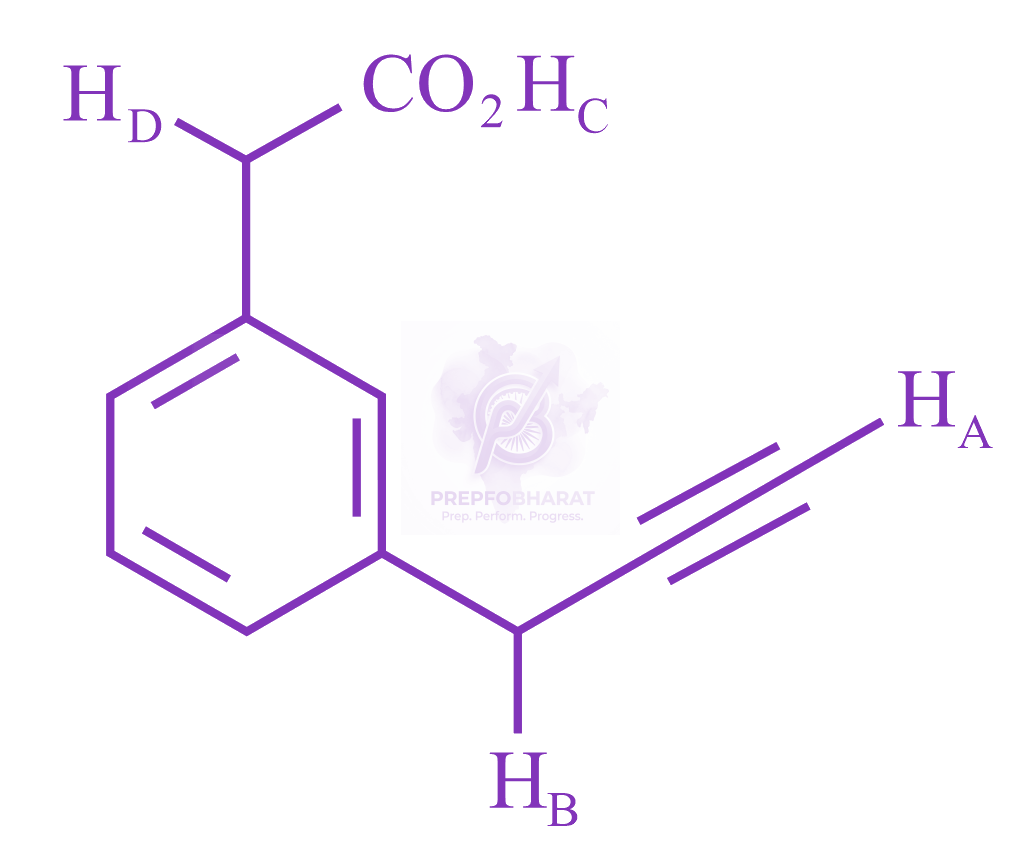
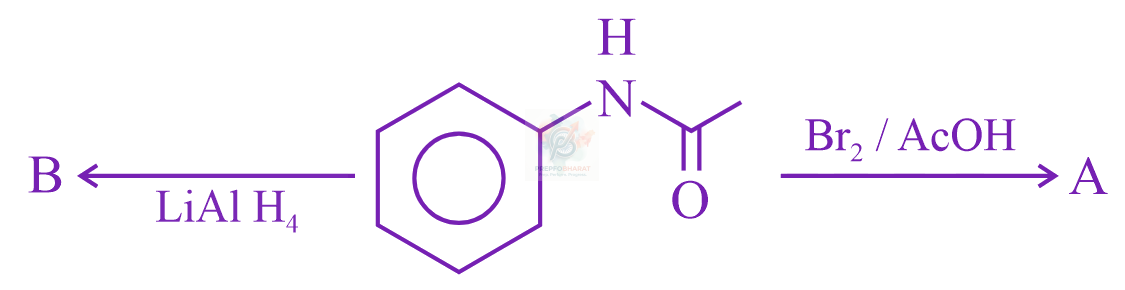
The structures of major products $A,B$ and $C$ in the following reaction are sequence. 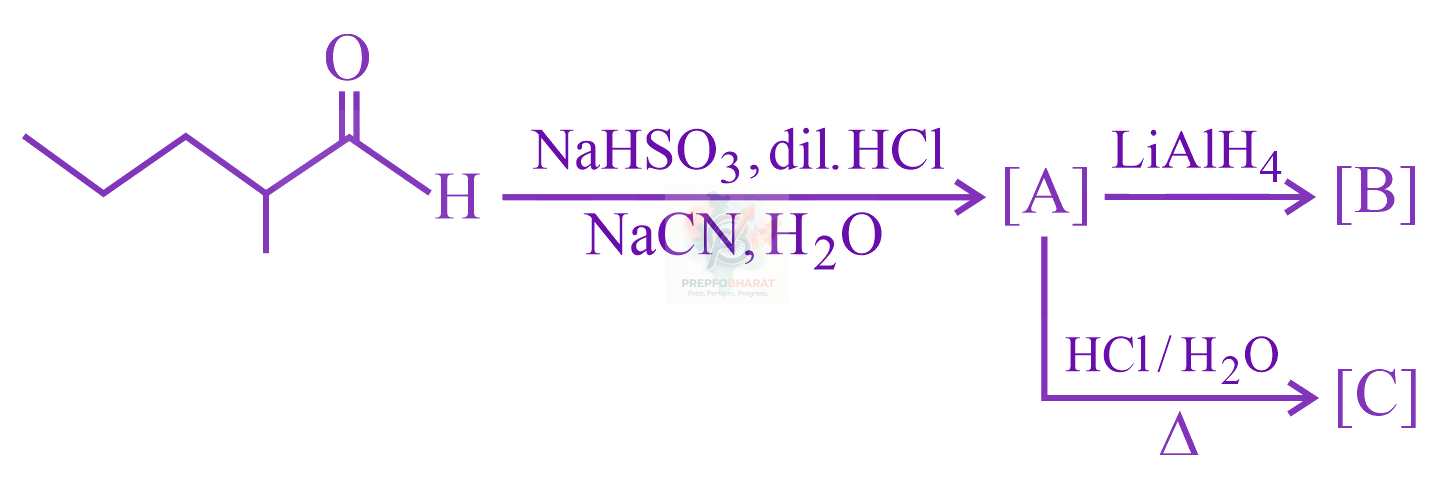
Given below are two statements, one is labelled as Assertion A and the other is labelled as Reason R Assertion A:- Butylated hydroxyl anisole when added to butter increases its shelf life. Reason R:- Butylated hydroxyl anisole is more reactive towards oxygen than food. In the light of the above statements, choose the most appropriate answer from the options given below:-
Which of the following is the IUPAC name of CH₃-CH=CH-CHO?
The decreasing order of hydride affinity for following carbocations is: (a) 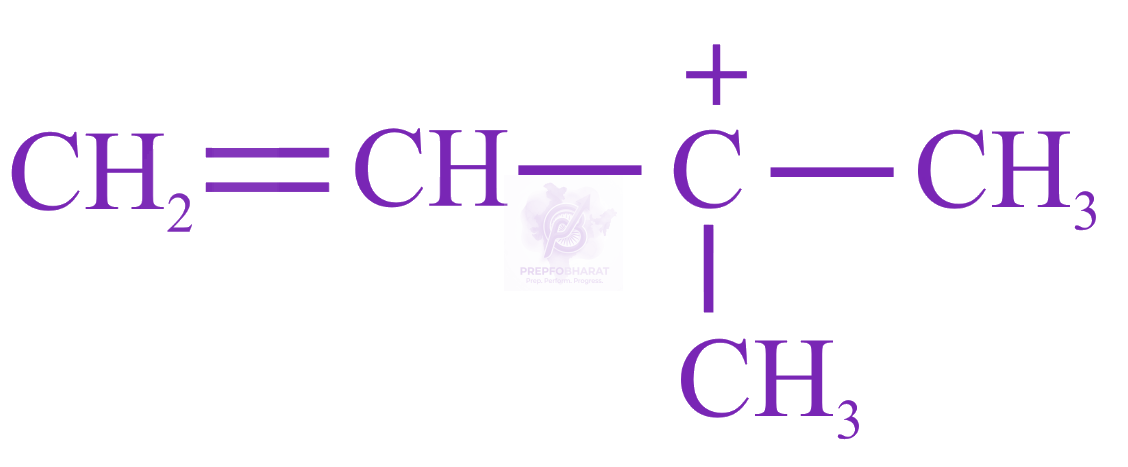 (2) 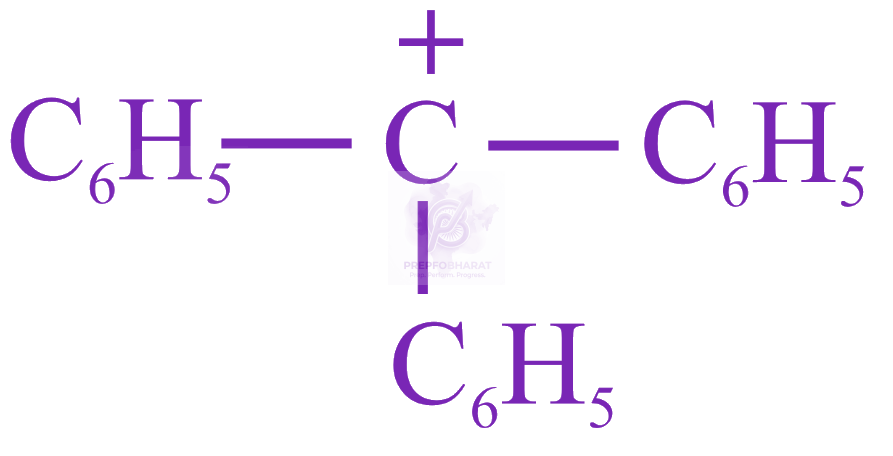 (3) 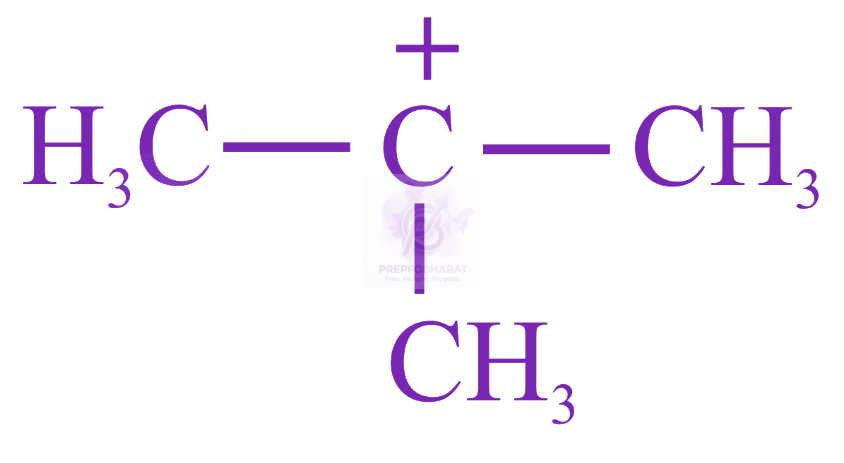 (4) 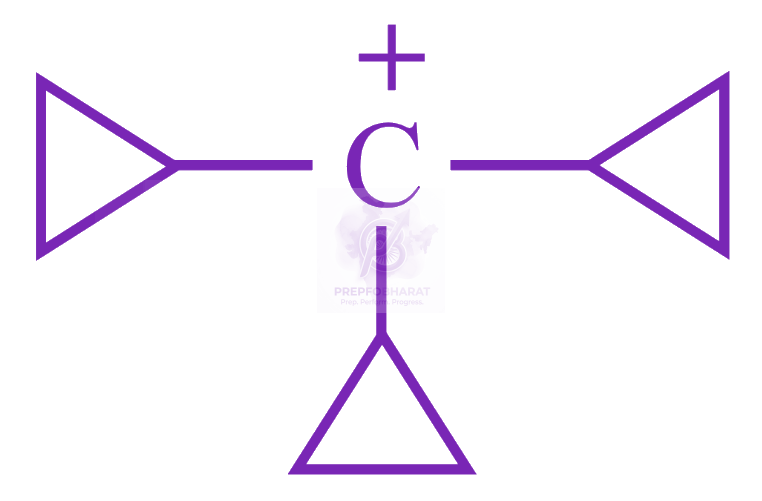 Choose the correct answer from the options given below:
Testosterone, which is a steroidal hormone, has the following structure. 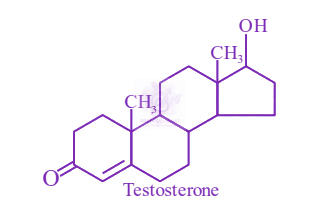 The total number of asymmetric carbon atom/s in testosterone is ____________.
Benzyl isocyanide can be obtained by: (A) 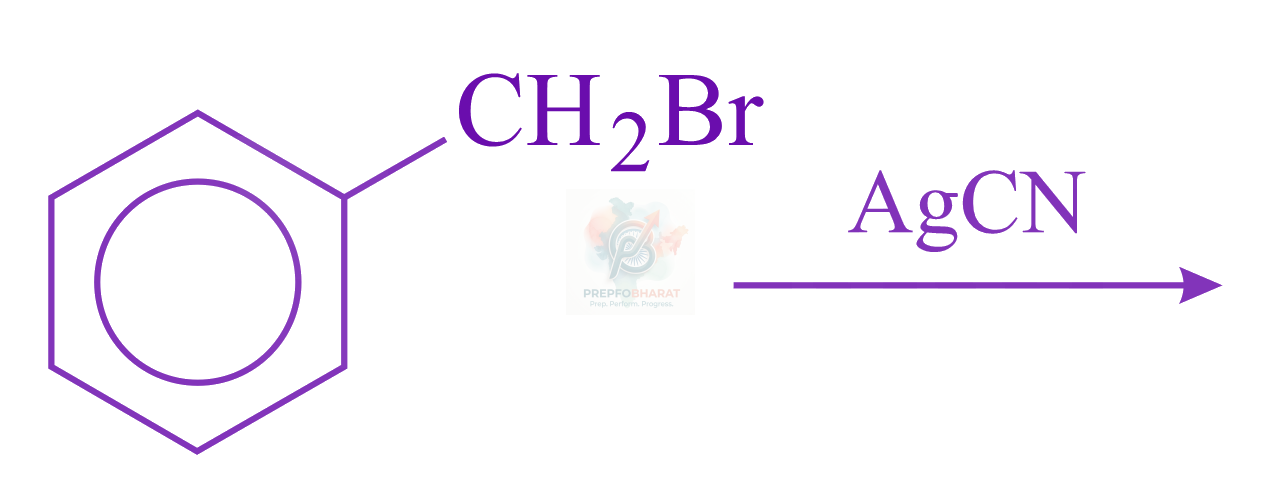 (B) 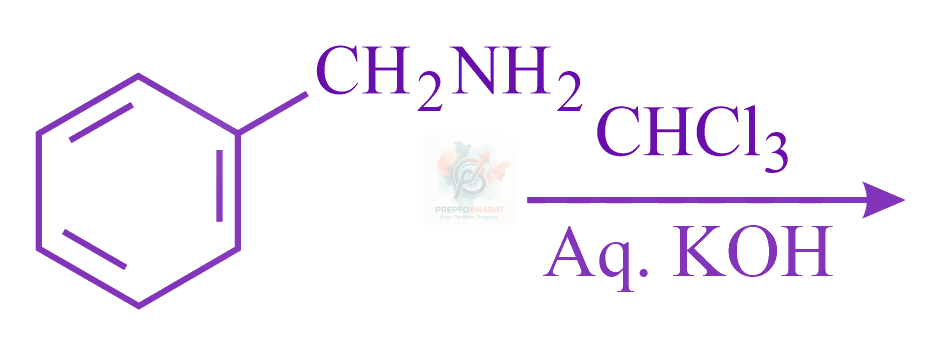 (C) 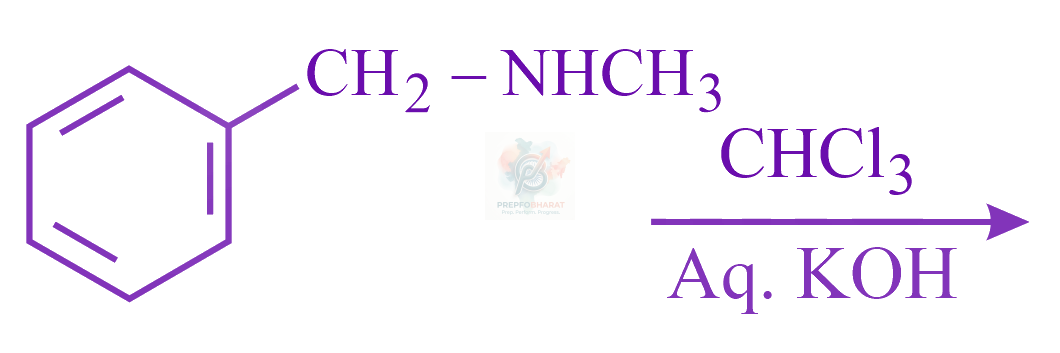 (D) 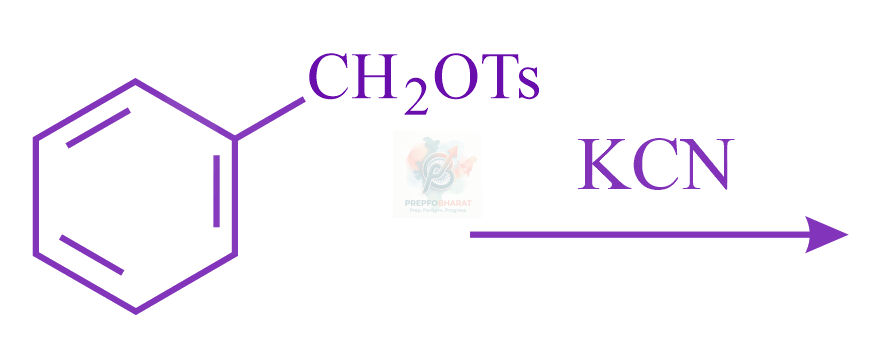 Choose the correct answer from the options given below:
Compound $(X)$ undergoes following sequence of reactions to give the Lactone $(Y)$. 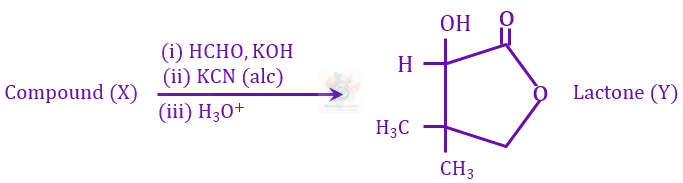
$17\mathrm{mg}$ of a hydrocarbon (M.F. ${C}_{10}{H}_{16}$) takes up $8.40\mathrm{mL}$ of the ${H}_{2}$ gas measured at $0^{\circ}C$ and $760\mathrm{mm}$ of $\mathrm{Hg}$. Ozonolysis of the same hydrocarbon yields ${\mathrm{CH}}_{3}-\underset{\underset{O}{||}}{C}-{\mathrm{CH}}_{3},H-\underset{\underset{O}{||}}{C}-H,H-\underset{\underset{O}{||}}{C}-{\mathrm{CH}}_{2}-{\mathrm{CH}}_{2}-\underset{\underset{O}{||}}{C}-\underset{\underset{O}{||}}{C}-H$ The number of double bond/s present in the hydrocarbon is
Increasing order of stability of the resonance structure is: 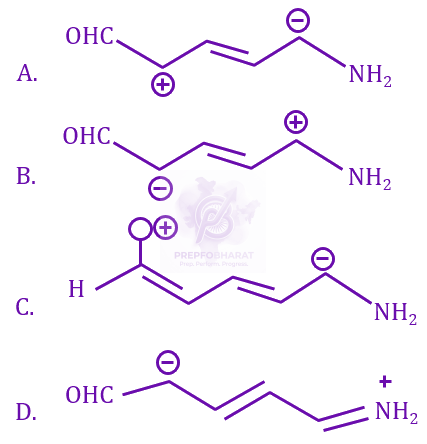
Match List I with List II : 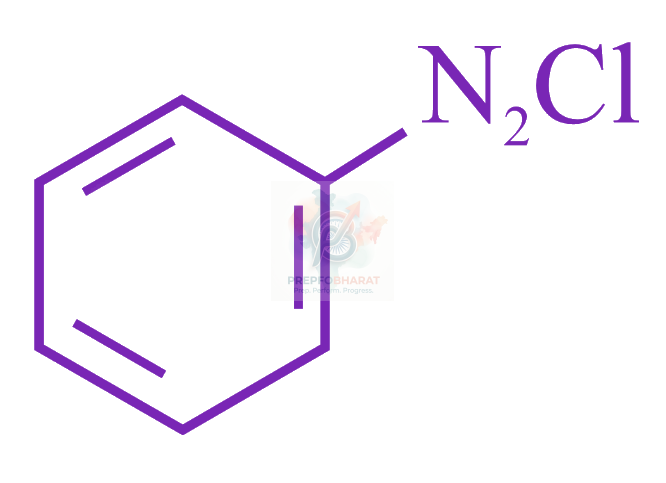 s reacted with reagents in List I to form products in List II products in List II. <table class="pyq-table"><tbody><tr><td colspan="4">List I (Reagent) List II (Product)</td></tr><tr><td>A.</td><td><img src="https://prepforbharat.s3.ap-south-1.amazonaws.com/exam/615f0e999476412f48314daf/Chemistry/images/Amines/648b5a70417cc3fb48d683fa/question_2__q_648b5a70417cc3fb48d683fa__cdn-question-pool.getmarks.app__e9b7ca1e-a08c-463c-befd-bad3cae01260__3bf765b91b_final_ppt_sync.png" alt="JEE Main 2023 Chemistry, Amines — question figure 2"></td><td>I.</td><td><img src="https://prepforbharat.s3.ap-south-1.amazonaws.com/exam/615f0e999476412f48314daf/Chemistry/images/Amines/648b5a70417cc3fb48d683fa/question_3__q_648b5a70417cc3fb48d683fa__cdn-question-pool.getmarks.app__ab91210b-b62c-4fa2-8d6c-44f929671b1d__9cdf92b4f8_final_ppt_sync.png" alt="JEE Main 2023 Chemistry, Amines — question figure 3"></td></tr><tr><td>B.</td><td>${\mathrm{HBF}}_{4,\Delta }$</td><td>II.</td><td><img src="https://prepforbharat.s3.ap-south-1.amazonaws.com/exam/615f0e999476412f48314daf/Chemistry/images/Amines/648b5a70417cc3fb48d683fa/question_4__q_648b5a70417cc3fb48d683fa__cdn-question-pool.getmarks.app__52eff05c-a27b-44e0-ac32-0c0af363c271__24e09a08c1_final_ppt_sync.png" alt="JEE Main 2023 Chemistry, Amines — question figure 4"></td></tr><tr><td>C.</td><td>Cu, HCl</td><td>III.</td><td><img src="https://prepforbharat.s3.ap-south-1.amazonaws.com/exam/615f0e999476412f48314daf/Chemistry/images/Amines/648b5a70417cc3fb48d683fa/question_5__q_648b5a70417cc3fb48d683fa__cdn-question-pool.getmarks.app__ebd6b0d7-3841-4ec9-a265-fb22ce59a5e8__5db116195d_final_ppt_sync.png" alt="JEE Main 2023 Chemistry, Amines — question figure 5"></td></tr><tr><td>D.</td><td>CuCN/KCN</td><td>IV.</td><td><img src="https://prepforbharat.s3.ap-south-1.amazonaws.com/exam/615f0e999476412f48314daf/Chemistry/images/Amines/648b5a70417cc3fb48d683fa/question_6__q_648b5a70417cc3fb48d683fa__cdn-question-pool.getmarks.app__ff994660-4747-4109-9052-2ad0fdc4d27c__3d0c8ce825_final_ppt_sync.png" alt="JEE Main 2023 Chemistry, Amines — question figure 6"></td></tr></tbody></table>Choose the correct answer from the options given below:
The major product formed in the following reaction is 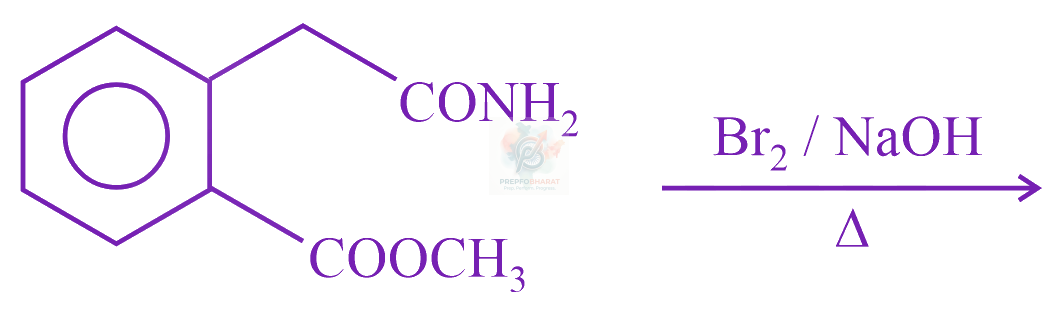
In the following reaction 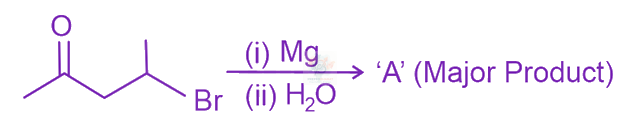
Identify the product formed ($A$ and $E$) 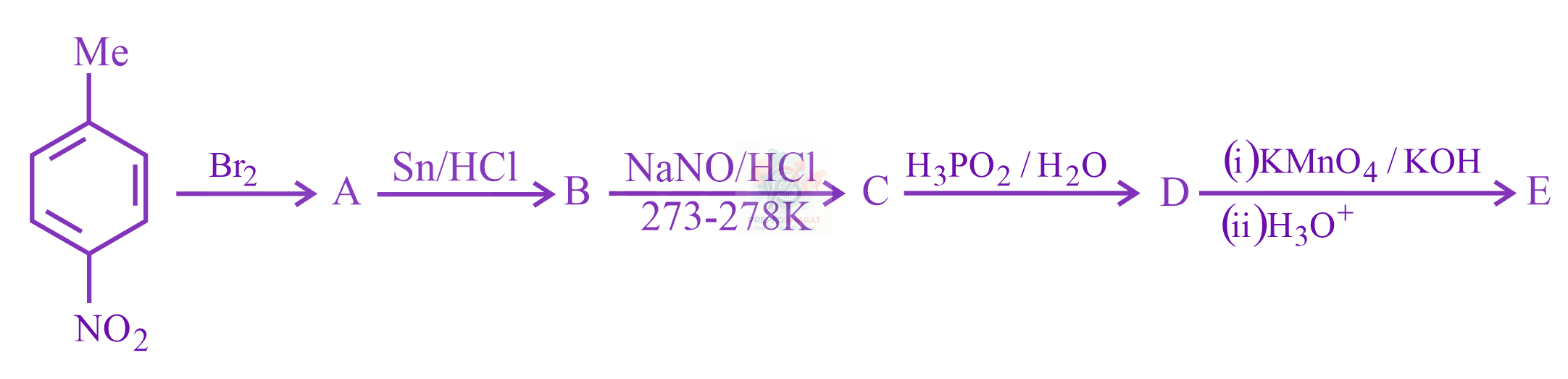
Identify the correct order of reactivity for the following pairs towards the respective mechanism (A) 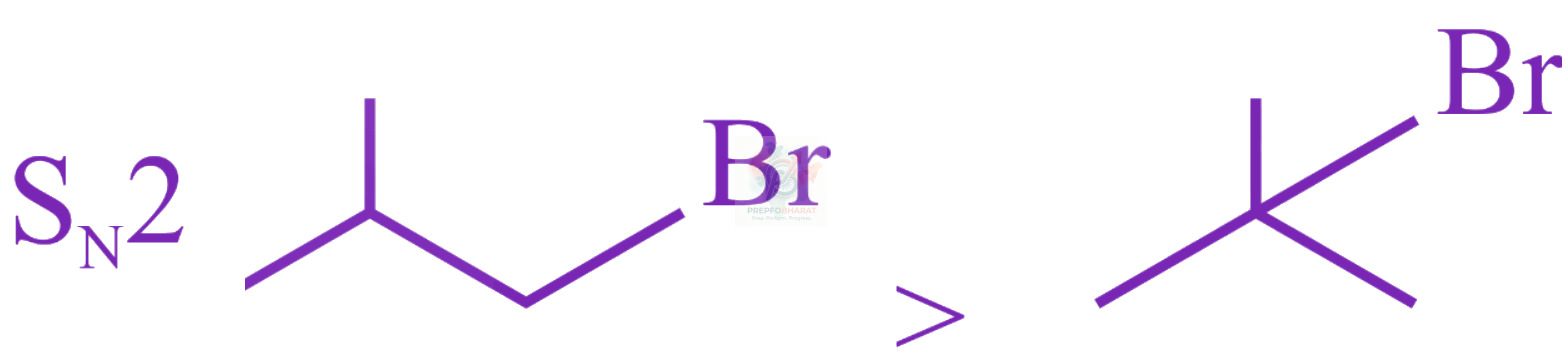 (B) 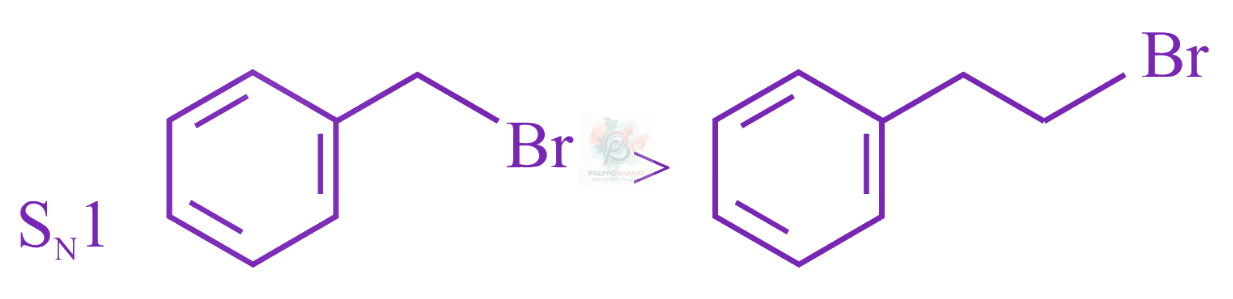 (C) Electrophilic substitution 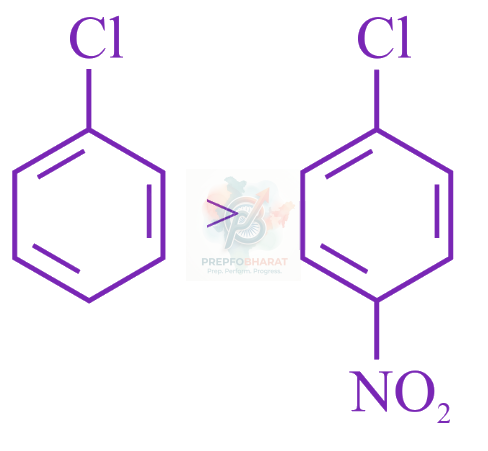 (D) Nucleophilic substitution 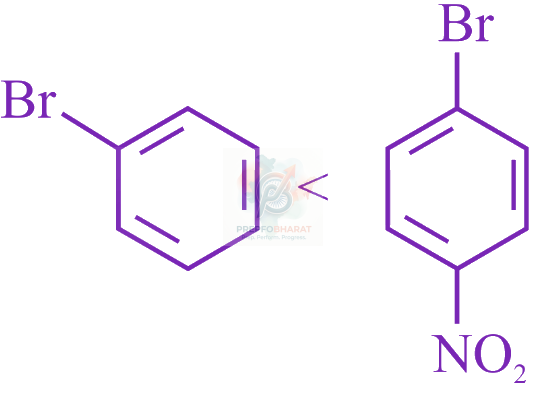 Choose the correction answer from the options given below:
The major products A and B from the following reactions are :