Organic Chemistry PYQ — Page 27
JEE Main Chemistry — Organic Chemistry previous year questions with solutions.
All Organic Chemistry Questions (1783)
Find out the major products from the following reaction sequence. 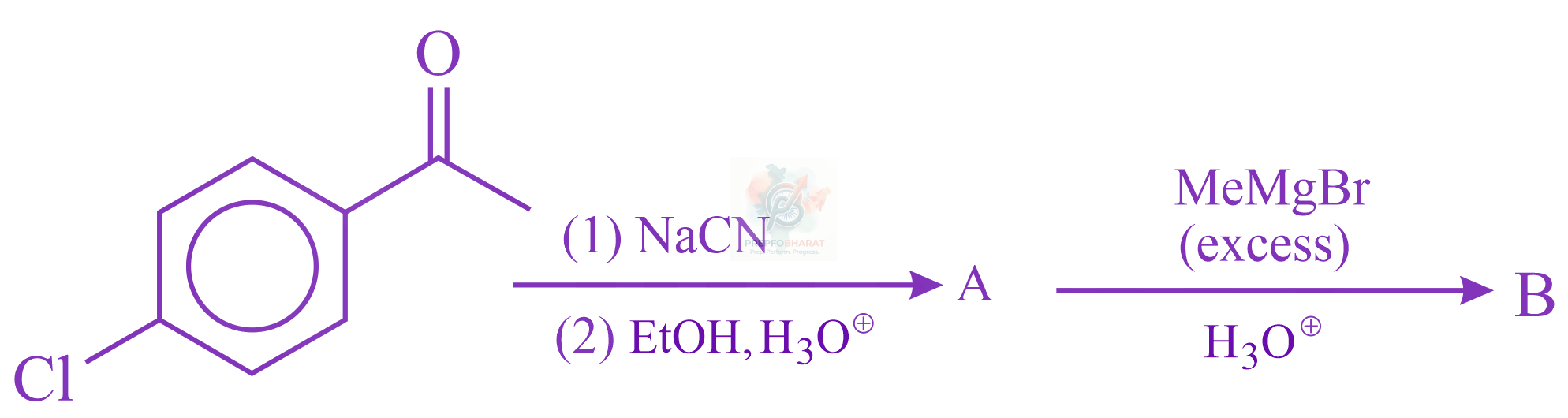
Suitable reaction condition for preparation of Methyl phenyl ether is
Given below are two statements: One is labelled as Assertion A and the other is labelled as Reason R. Assertion A: 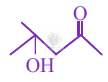 can be easily reduced using $\mathrm{Zn}-\mathrm{Hg}/\mathrm{HCl}$ to 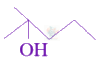 Reason R: $\mathrm{Zn}-\mathrm{Hg}/\mathrm{HCl}$ is used to reduce carbonyl group to –${\mathrm{CH}}_{2}$ – group. In the light of the above statements, choose the correct answer from the options given below:
Which of the following statement is correct for paper chromatography?
Number of compounds from the following which will not produce orange red precipitate with Benedict solution is........ Glucose, maltose, sucrose, ribose,$2$-deoxyribose, amylose, lactose
In the following reaction $‘X’$ is ${\mathrm{CH}}_{3}{({\mathrm{CH}}_{2})}_{4}{\mathrm{CH}}_{3}\rightarrow _{\underset{\triangle }{\mathrm{HCl}}}^{\mathrm{Anhy}.{\mathrm{AlCl}}_{3}}\underset{\mathrm{major}\mathrm{product}}{X}$
L-isomer of tetrose $X({C}_{4}{H}_{8}{O}_{4})$ gives positive Schiff’s test and has two chiral carbons. On acetylation ‘X’ yields triacetate. ‘X’ also undergoes following reactions. 
$A$' and '$B$' formed in the following set of reactions are: 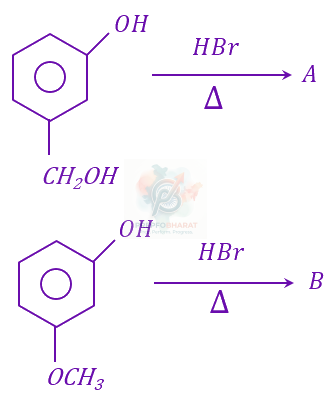
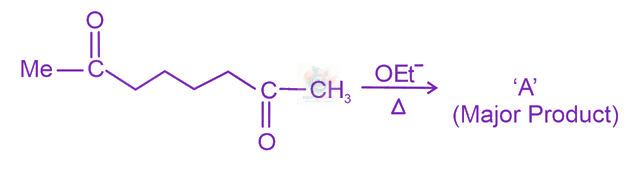 $A$ in the above reaction is :
Number of isomeric compounds with molecular formula ${C}_{9}{H}_{10}O$ which (i) do not dissolve in $\mathrm{NaOH}$ (ii) do not dissolve in $\mathrm{HCl}$. (iii) do not give orange precipitate with $2,4$ - DNP (iv) on hydrogenation give identical compound with molecular formula ${C}_{9}{H}_{12}O$ is
Given below are two statements: Statement I: Sulphanilic acid gives esterification test for carboxyl group. Statement II: Sulphanilic acid gives red colour in Lassigne’s test for extra element detection. In the light of the above statements, choose the most appropriate answer from the options given below:
In Dumas method for the estimation of ${N}_{2}$, the sample is heated with copper oxide and the gas evolved is passed over:
The descending order of acidity for the following carboxylic acid is- (A) ${\mathrm{CH}}_{3}\mathrm{COOH}$ (B) ${F}_{3}C-\mathrm{COOH}$ (C) ${\mathrm{ClCH}}_{2}-\mathrm{COOH}$ (D) ${\mathrm{FCH}}_{2}-\mathrm{COOH}$ (E) ${\mathrm{BrCH}}_{2}-\mathrm{COOH}$ Choose the correct answer from the options given below:
Correct statements for the given reaction are: 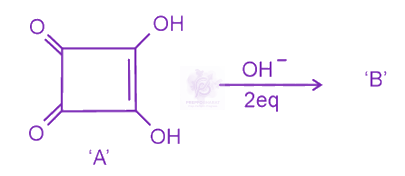 A. Compound ‘$B$’ is aromatic B. The completion of above reaction is very slow C. ‘$A$’ shows tautomerism D. The bond lengths of $C-C$ in compound $B$ are found to be same Choose the correct answer from the options given below.
The strongest acid from the following is
 The correct sequence of reagents for the preparation of $Q$ and $R$ is:
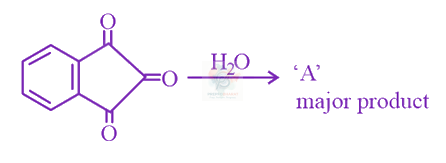 ‘$A$’ formed in the above reaction is
Find out the major product from the following reaction. 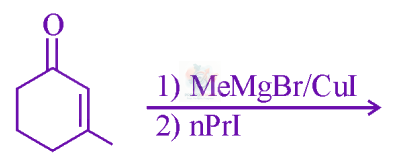
A compound $'X'$ when treated with phthalic anhydride in presence of concentrated ${H}_{2}{\mathrm{SO}}_{4}$ yields $'Y'$. $'Y'$ is used as an acid/base indicator. $'X'$ and $'Y'$ are respectively
The isomeric deuterated bromide with molecular formula ${C}_{4}{H}_{8}\mathrm{DBr}$ having two chiral carbon atoms is
Given below are two statements, one is labelled as Assertion A and the other is labelled as Reason R. Assertion A : Order of acidic nature of the following compounds is $A>B>C$. 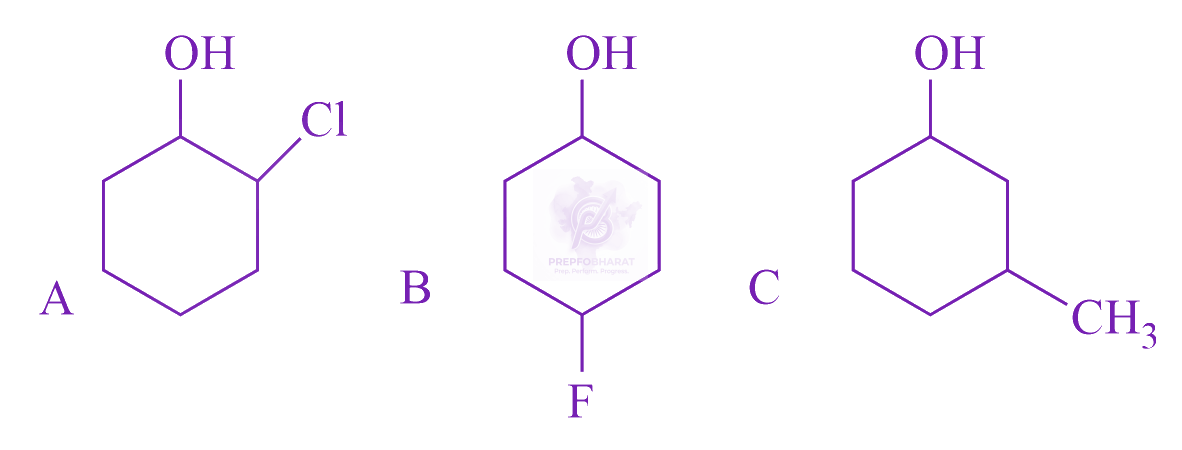 Reason R: Fluoro is a stronger electron withdrawing group than Chloro group. In the light of the above statements, choose the correct answer from the options given below :
Given below are two statements, one is labelled as Assertion A and the other is labelled as Reason R. Assertion A : Benzene is more stable than hypothetical cyclohexatriene. Reason R : The delocalized $\pi$ electron cloud is attracted more strongly by nuclei of carbon atoms. In the light of the above statements, choose the correct answer from the options given below:
Resonance in carbonate ion $({\mathrm{CO}}_{3}^{2-})$ is 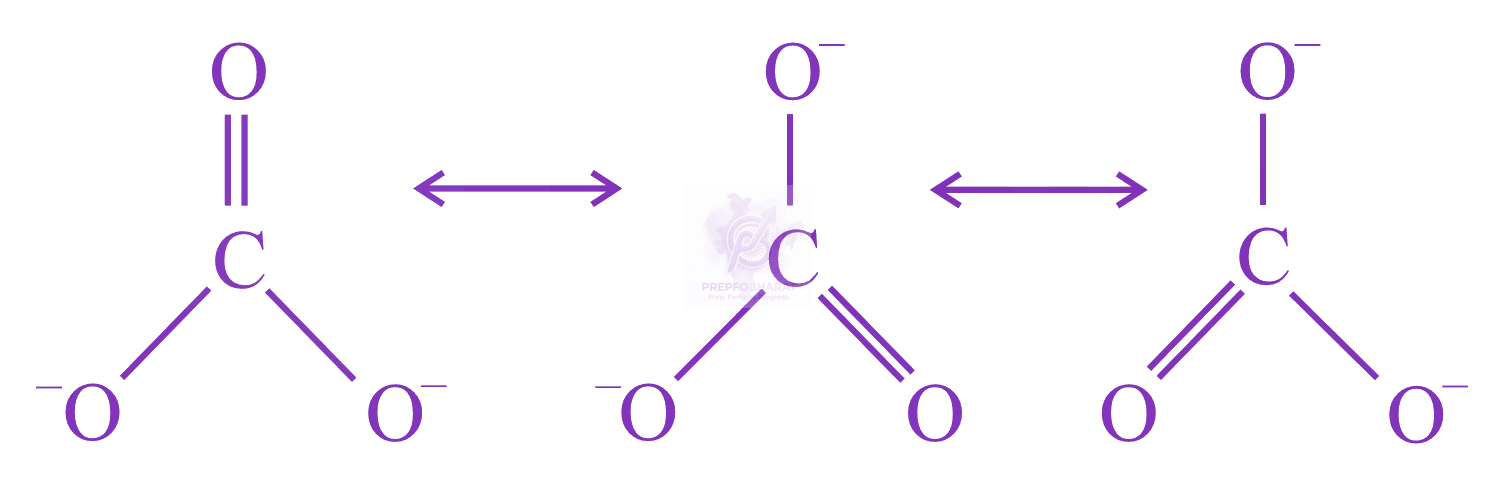 Which of the following is true?
Match List-I with List-II. <table class="pyq-table"><tbody><tr><td colspan="2" rowspan="1">List-I Element detected</td><td colspan="2" rowspan="1">List-II Reagent used/Product formed</td></tr><tr><td>$A$</td><td>Nitrogen</td><td>$I$</td><td>${\mathrm{Na}}_{2}[\mathrm{Fe}{(\mathrm{CN})}_{5}\mathrm{NO}]$</td></tr><tr><td>$B$</td><td>Sulphur</td><td>$\mathrm{II}$</td><td>${\mathrm{AgNO}}_{3}$</td></tr><tr><td>$C$</td><td>Phosphorus</td><td>$\mathrm{III}$</td><td>${\mathrm{Fe}}_{4}{[\mathrm{Fe}{(\mathrm{CN})}_{6}]}_{3}$</td></tr><tr><td>$D$</td><td>Halogen</td><td>$\mathrm{IV}$</td><td>${({\mathrm{NH}}_{4})}_{2}{\mathrm{MoO}}_{4}$</td></tr></tbody></table>Choose the correct answer from the options given below: