Organic Chemistry PYQ — Page 28
JEE Main Chemistry — Organic Chemistry previous year questions with solutions.
All Organic Chemistry Questions (1783)
Match List I with List II. Choose the correct answer from the options given below :- <table class="pyq-table"><tbody><tr><td></td><td>List I Isomeric pairs</td><td></td><td>List II Type of isomers</td></tr><tr><td>A</td><td>Propanamine and N- Methylethanamine</td><td>I</td><td>Metamers</td></tr><tr><td>B</td><td>Hexan-2-one Hexan-3-one</td><td>II</td><td>Positional isomers</td></tr><tr><td>C</td><td>Ethanamide and Hydroxyethanimine</td><td>III</td><td>Functional isomers</td></tr><tr><td>D</td><td>o-nitrophenol and pnitrophenol</td><td>IV</td><td>Tautomers</td></tr></tbody></table>
The correct order of reactivity of following haloarenes towards nucleophilic substitution with aqueous $\mathrm{NaOH}$ is: 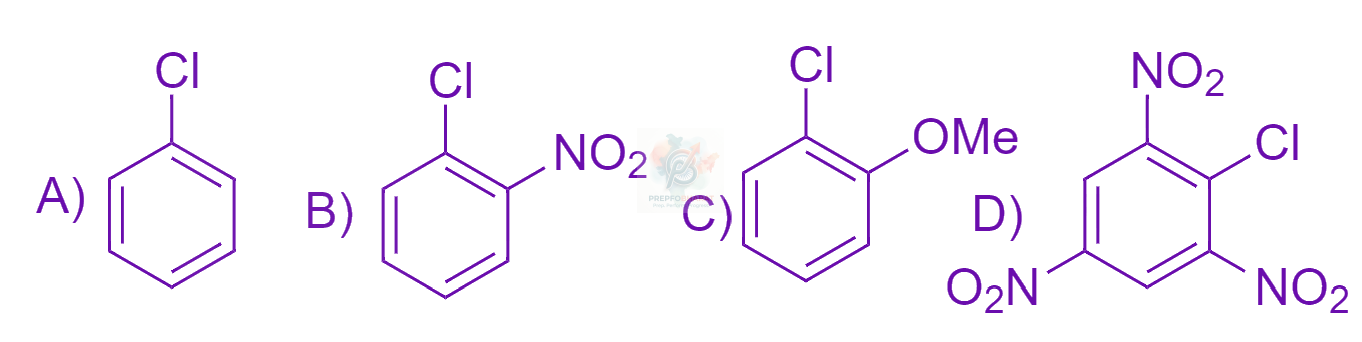 Choose the correct answer from the options given below:
Using column chromatography, mixture of two compounds ‘$A$’ and ‘$B$’ was separated. ‘$A$’ eluted first, this indicates ‘$B$’ has
The correct order for acidity of the following hydroxyl compound is (A) ${\mathrm{CH}}_{3}\mathrm{OH}$ (B) ${({\mathrm{CH}}_{3})}_{3}\mathrm{COH}$ (C) 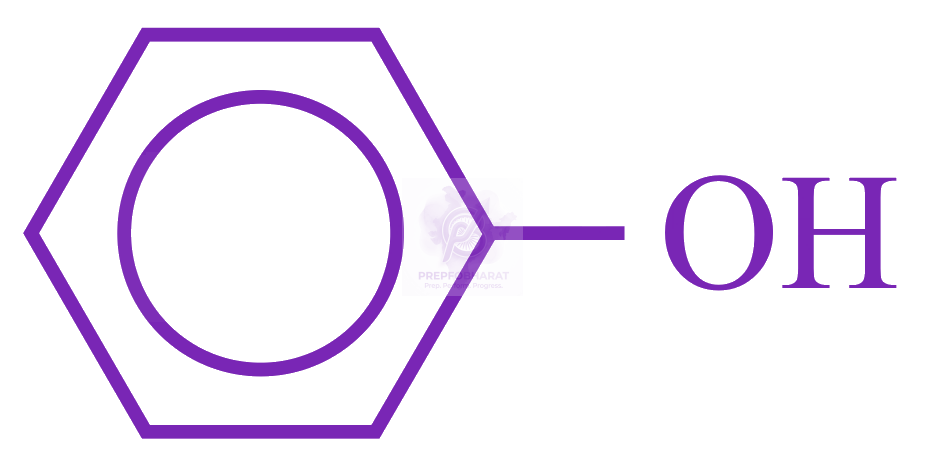 (D) 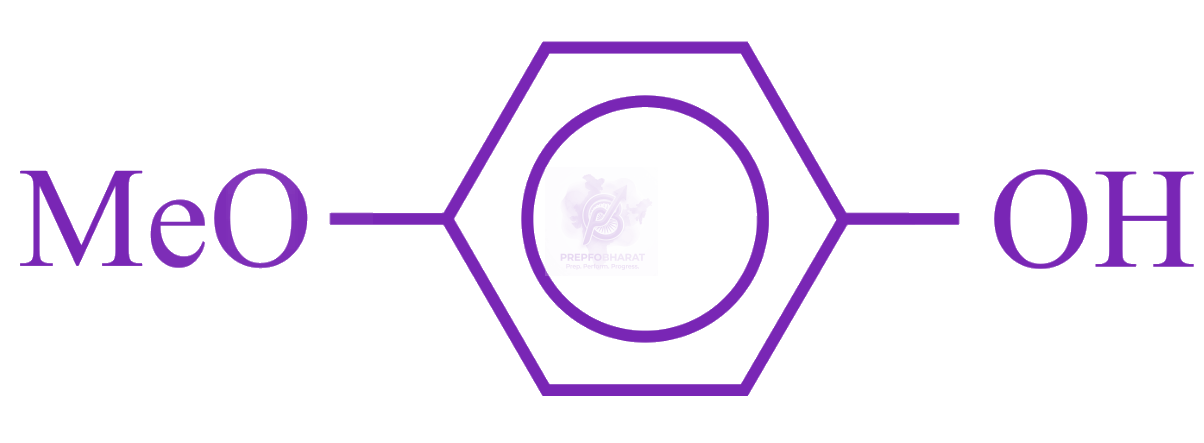 (E) 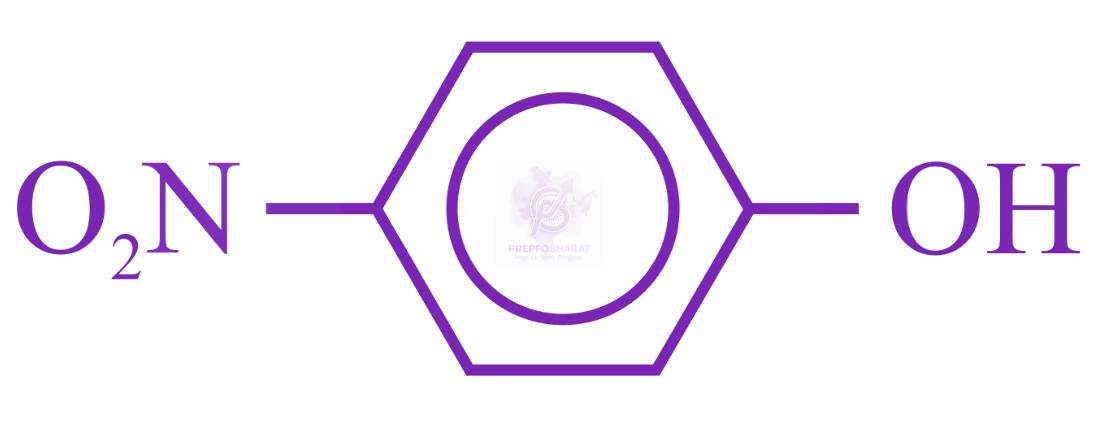 Choose the correct answer from the options given below:
Match items of column I and II <table class="pyq-table"><tbody><tr><td>Column I (Mixture of compounds)</td><td>Column II (Separation Technique)</td></tr><tr><td>A. ${H}_{2}O/{\mathrm{CH}}_{2}{\mathrm{Cl}}_{2}$</td><td>i. Crystallization</td></tr><tr><td>B. <img src="https://prepforbharat.s3.ap-south-1.amazonaws.com/exam/615f0e999476412f48314daf/Chemistry/images/General_Organic_Chemistry/648b5a70417cc3fb48d682a2/question_1__q_648b5a70417cc3fb48d682a2__cdn-question-pool.getmarks.app__5e082b5c-afbf-4440-b682-999f3a210bc5-9896029__4fbc32c1e9_final_ppt_sync.png" alt="JEE Main 2023 Chemistry, General Organic Chemistry — question figure"></td><td>ii. Differential solvent extraction</td></tr><tr><td>C. Kerosene/Naphthalene</td><td>iii. Column chromatography</td></tr><tr><td>D. ${C}_{6}{H}_{12}{O}_{6}/\mathrm{NaCl}$</td><td>iv. Fractional Distillation</td></tr></tbody></table>
Which will undergo deprotonation most readily in basic medium? 
Given below are two statements: one is labelled as Assertion (A) and the other is labelled as Reason (R). Assertion (A): Ketoses give Seliwanoff’s test faster than Aldoses. Reason (R): Ketoses undergo $\beta$-elimination followed by formation of furfural. In the light of the above statements, choose the correct answer from the options given below:
Among the following the number of compounds which will give positive iodoform reaction is _____. (a) $1$-Phenylbutan-$2$-one (b) $2$-Methylbutan-$2$-ol (c) $3$-Methylbutan-$2$-ol (d) $1$-Phenylethanol (e) $3,3$-dimethylbutan-$2$-one (f) $1$-Phenylpropan-$2$-ol
In the following reaction, ‘$A$’ is 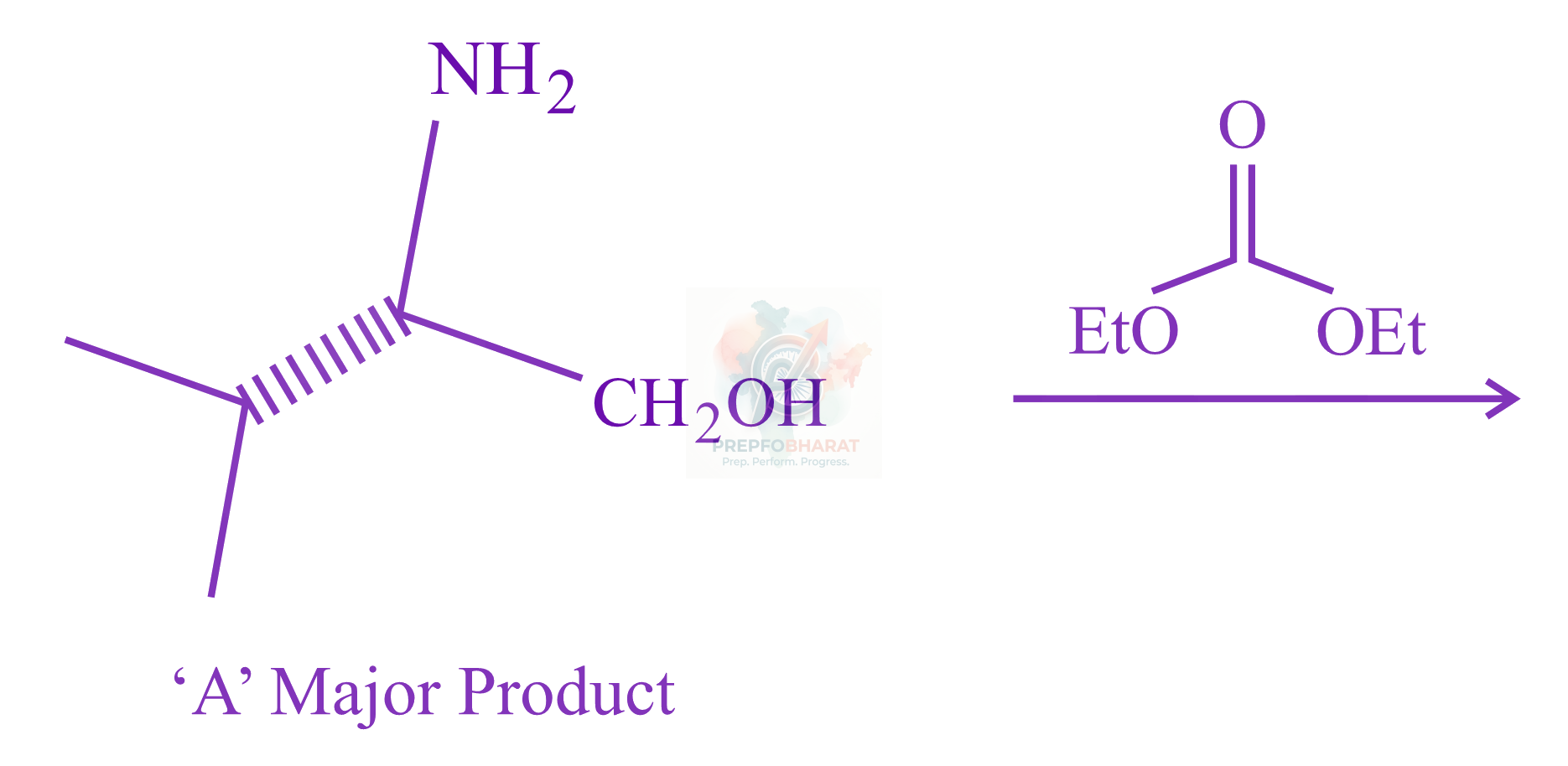
A short peptide on complete hydrolysis produces $3$ moles of glycine $(G)$, two moles of leucine $(L)$ and two moles of valine $(V)$ per mole of peptide. The number of peptide linkages in it are _____ .
The increasing order of ${\mathrm{pK}}_{a}$ for the following phenols is (A) 2,4-Dinitrophenol (B) 4-Nitrophenol (C) 2,4,5-Trimethylphenol (D) Phenol (E) 3-Chlorophenol Choose the correct answer from the option given below :
In SN2 reactions, the rate of reaction depends on:
How many of the transformation given below would result in aromatic amines? 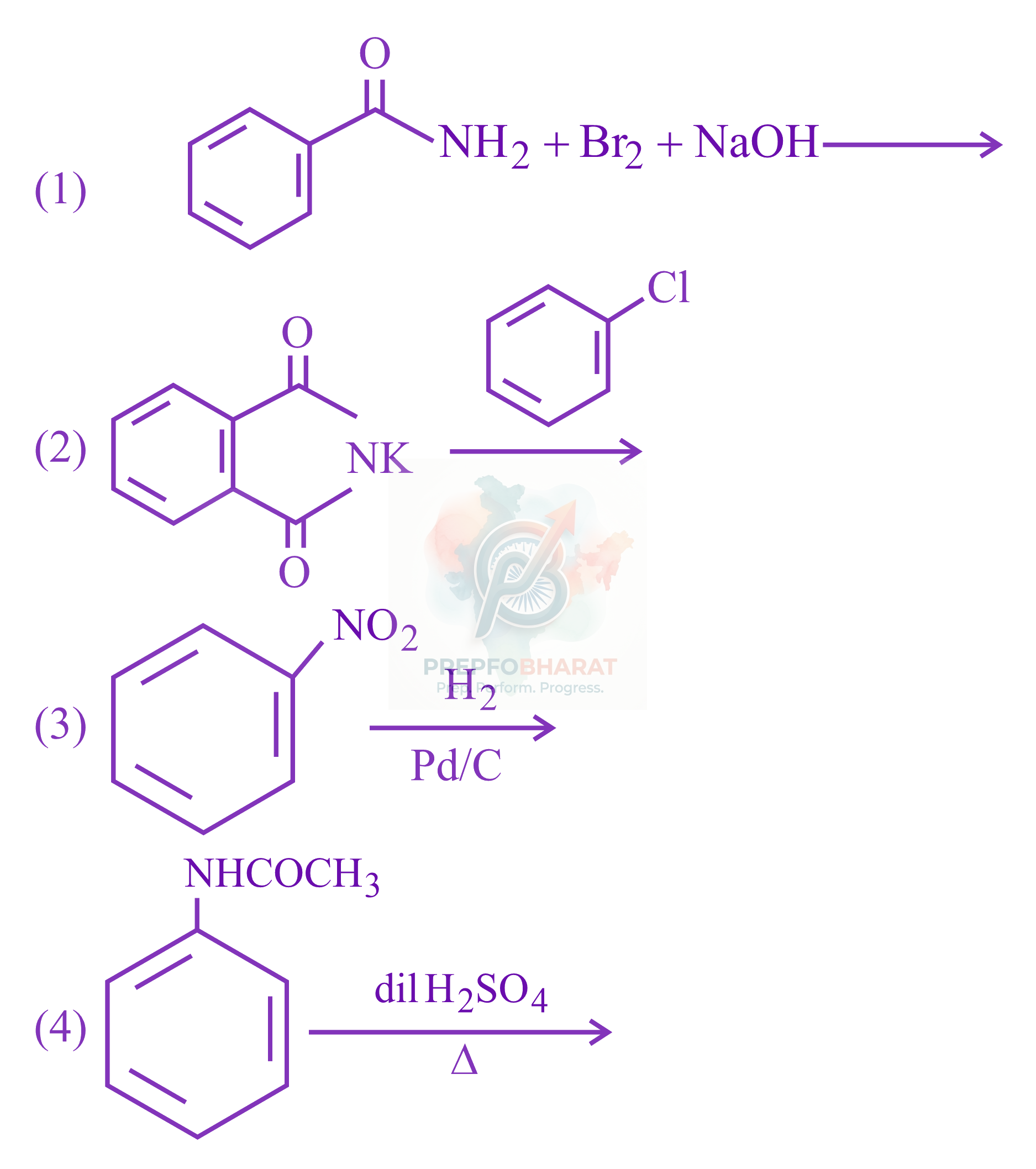
The naturally occurring amino acid that contains only one basic functional group in its chemical structure is
Which of the following compounds would give the following set of qualitative analysis? (i) Fehling’s Test: Positive (ii) $\mathrm{Na}$ fusion extract upon treatment with sodium nitroprusside gives a blood red colour but not prussian blue.
Match List I with List II<table class="pyq-table"><tbody><tr><td></td><td>List I Natural amino acid</td><td></td><td>List II One Letter Code</td></tr><tr><td>(A)</td><td>Glutamic acid</td><td>(I)</td><td>$Q$</td></tr><tr><td>(B)</td><td>Glutamine</td><td>(II)</td><td>$W$</td></tr><tr><td>(C)</td><td>Tyrosine</td><td>(III)</td><td>$E$</td></tr><tr><td>(D)</td><td>Tryptophan</td><td>(IV)</td><td>$Y$</td></tr></tbody></table> Choose the correct answer from the options given below:
The one giving maximum number of isomeric alkenes on dehydrohalogenation reaction is (excluding rearrangement)
In sulphur estimation. $0.471g$ of an organic compound gave $1.4439g$ of barium sulphate. The percentage of sulphur in the compound is _______(Nearest Integer) (Given: Atomic mass Ba: $137u:S:32u,O:16u$ )
In the following halogenated organic compounds the one with maximum number of chlorine atoms in its structure is:
The functional group in aldehydes is
Match List I with List II. <table class="pyq-table"><tbody><tr><td colspan="2" rowspan="1">List I</td><td colspan="2" rowspan="1">List II</td></tr><tr><td colspan="2" rowspan="1">Reaction</td><td colspan="2" rowspan="1">Reagents</td></tr><tr><td>(A)</td><td>Hoffmann Degradation</td><td>(I)</td><td>Conc.$\mathrm{KOH},\Delta$</td></tr><tr><td>(B)</td><td>Clemmensen reduction</td><td>(II)</td><td>${\mathrm{CHCl}}_{3},\mathrm{NaOH}/{H}_{3}{O}^{+}$</td></tr><tr><td>(C)</td><td>Cannizzaro reaction</td><td>(III)</td><td>${\mathrm{Br}}_{2},\mathrm{NaOH}$</td></tr><tr><td>(D)</td><td>Reimer-Tiemann reaction</td><td>(IV)</td><td>$\mathrm{Zn}-\mathrm{Hg}/\mathrm{HCl}$</td></tr></tbody></table>
The major product ‘$P$’ formed in the following sequence of reactions is 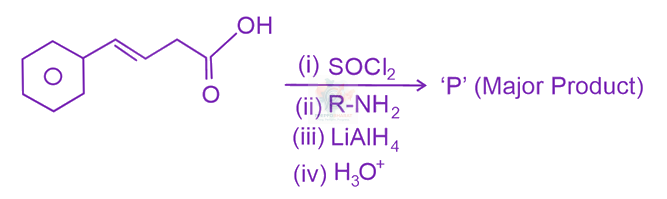
The major product formed in the following reaction is 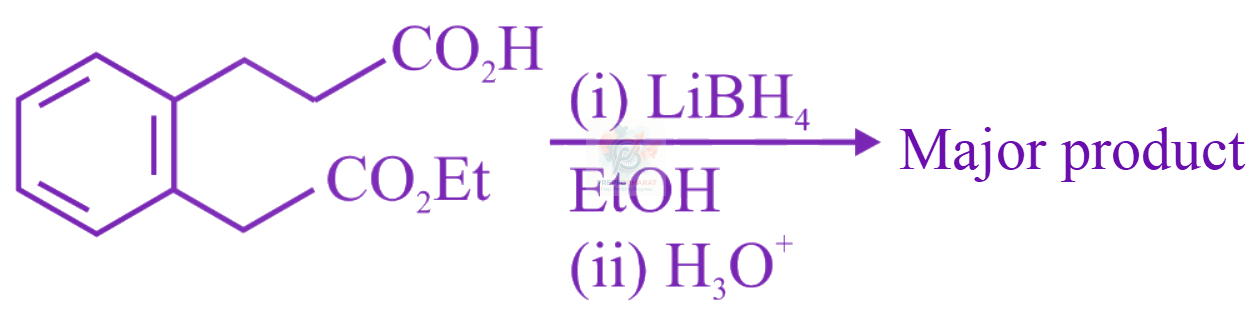
A trisubstituted compound '$A$', ${C}_{10}{H}_{12}{O}_{2}$ gives neutral ${\mathrm{FeCl}}_{3}$ test positive. Treatment of compound '$A$' with $\mathrm{NaOH}$ and ${\mathrm{CH}}_{3}\mathrm{Br}$ gives ${C}_{11}{H}_{14}{O}_{2}$, with hydroiodic acid gives methyl iodide and with hot conc. $\mathrm{NaOH}$ gives a compound $B$, ${C}_{10}{H}_{12}{O}_{2}$. Compound '$A$' also decolorises alkaline ${\mathrm{KMnO}}_{4}$. The number of $\pi$ bond/s present in the compound '$A$' is _____ .