Organic Chemistry PYQ — Page 29
JEE Main Chemistry — Organic Chemistry previous year questions with solutions.
All Organic Chemistry Questions (1783)
Incorrect method of preparation for alcohols from the following is:
The number of possible isomeric products formed when $3$-chloro-$1$-butene reacts with $\mathrm{HCl}$ through carbocation formation is.........
Match List I and List II <table class="pyq-table"><tbody><tr><td colspan="2" rowspan="1">List I Vitamin</td><td colspan="2" rowspan="1">List II Deficiency disease</td></tr><tr><td>$A$</td><td>Vitamin A</td><td>$I$</td><td>Beri-Beri</td></tr><tr><td>$B$</td><td>Thiamine</td><td>$\mathrm{II}$</td><td>Cheilosis</td></tr><tr><td>$C$</td><td>Ascorbic acid</td><td>$\mathrm{III}$</td><td>Xerophthalmia</td></tr><tr><td>$D$</td><td>Riboflavin</td><td>$\mathrm{IV}$</td><td>Scurvy</td></tr></tbody></table>Choose the correct answer from the options given below
Identify the correct order for the given property for following compounds 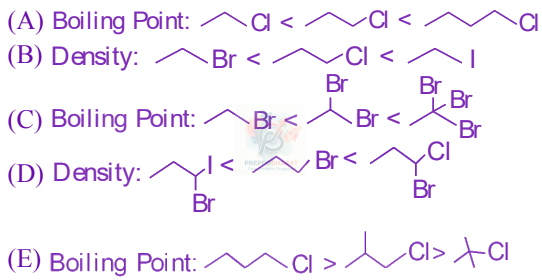 Choose the correct answer from the option given below :-
Number of bromo derivatives obtained on treating ethane with excess of ${\mathrm{Br}}_{2}$ in diffused sunlight is $_________$
Given below are two statements: one is labelled as Assertion (A) and the other is labelled as Reason (R). Assertion (A): $\alpha$-halocarboxylic acid on reaction with dil. ${\mathrm{NH}}_{3}$ gives good yield of $\alpha$-amino carboxylic acid whereas the yield of amines is very low when prepared from alkyl halides. Reason (R): Amino acids exist in zwitter ion form in aqueous medium. In the light of the above statements, choose the correct answer from the options given below :
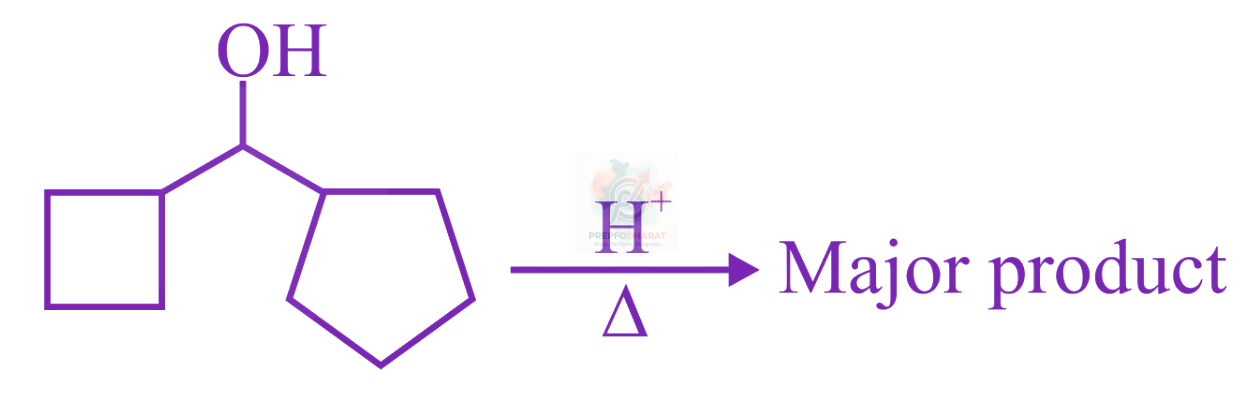 In the above reaction, left hand side and right hand side rings are named as $‘A’$ and $‘B’$ respectively. They undergo ring expansion. The correct statement for this process is:
An athlete is given $100g$ of glucose $({C}_{6}{H}_{12}{O}_{6})$ for energy. This is equivalent to $1800\mathrm{kJ}$ of energy. The $50%$ of this energy gained is utilized by the athlete for sports activities at the event. In order to avoid storage of energy, the weight of extra water he would need to perspire is $_____g$ (Nearest integer) Assume that there is no other way of consuming stored energy. Given : The enthalpy of evaporation of water is $45\mathrm{kJ}{\mathrm{mol}}^{-1}$ Molar mass of $C,H&O$ are $12.1$ and $16g{\mathrm{mol}}^{-1}$.
Given below are two statements : Statement I : Pure Aniline and other arylamines are usually colourless. Statement II : Arylamines get coloured on storage due to atmospheric reduction. In the light of the above statements, choose the most appropriate answer from the options given below :
Cyclohexylamine when treated with nitrous acid yields (P). On treating (P) with PCC results in (Q). When (Q) is heated with dil. $\mathrm{NaOH}$ we get (R) The final product (R) is:
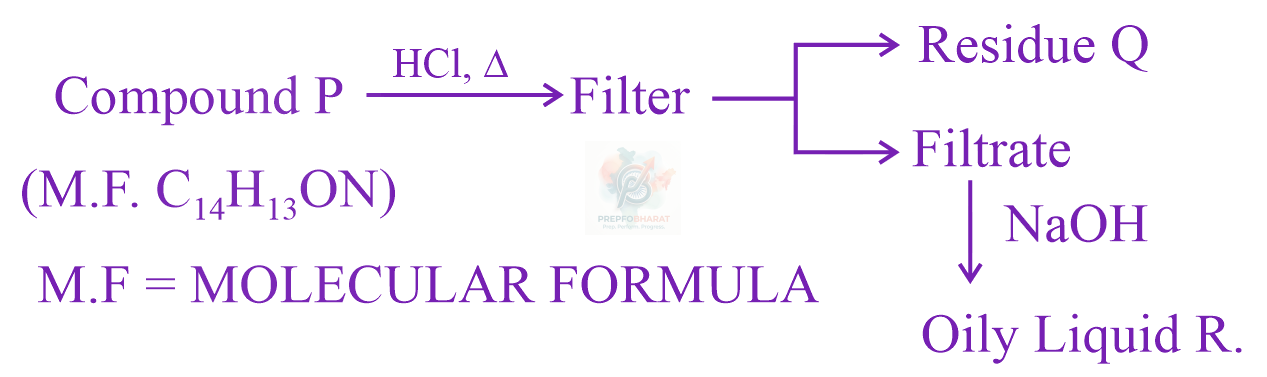 Compound $P$ is neutral, $Q$ gives effervescence with ${\mathrm{NaHCO}}_{3}$ while $R$ reacts with Hinsberg’s reagent to give solid soluble in $\mathrm{NaOH}.$ Compound $P$ is
'$R$' formed in the following sequence of reaction is: 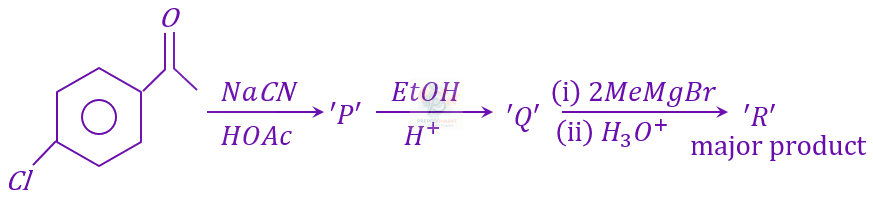
Sulphur (S) containing amino acids from the following are: (a) isoleucine (b) cysteine (c) lysine (d) methionine (e) glutamic acid
When $0.01\mathrm{mol}$ of an organic compound containing $60%$ carbon was burnt completely, $4.4g$ of ${\mathrm{CO}}_{2}$ was produced. The molar mass of compound is _____ ${\mathrm{gmol}}^{-1}$ (Nearest integer)
Total number of tripeptides possible by mixing of valine and proline is ________ .
Match List I with List II: <table class="pyq-table"><tbody><tr><td></td><td>List I (Mixture)</td><td></td><td>List II (Separation Technique)</td></tr><tr><td>(A)</td><td>${\mathrm{CHCl}}_{3}+{C}_{6}{H}_{5}{\mathrm{NH}}_{2}$</td><td>I</td><td>Steam distillation</td></tr><tr><td>(B)</td><td>${C}_{6}{H}_{14}+{C}_{5}{H}_{12}$</td><td>II</td><td>Differential extraction</td></tr><tr><td>(C)</td><td>${C}_{6}{H}_{5}{\mathrm{NH}}_{2}+{H}_{2}O$</td><td>III</td><td>Distillation</td></tr><tr><td>(D)</td><td>Organic compound in ${H}_{2}O$</td><td>IV</td><td>Fractional distillation</td></tr></tbody></table>
Reaction of propanamide with ${\mathrm{Br}}_{2}/\mathrm{KOH}$ (aq) produces:
For the reaction ${\mathrm{RCH}}_{2}\mathrm{Br}+{I}^{-}\overset{\text{ Acetone }}{\longrightarrow }\underset{\text{ major }}{{\mathrm{RCH}}_{2}I}+{\mathrm{Br}}^{-}$ The correct statement is
Identify the incorrect option from the following:
Match List I with List II <table class="pyq-table"><tbody><tr><td colspan="2" rowspan="1">List I</td><td colspan="2" rowspan="1">List II</td></tr><tr><td>A</td><td><img src="https://prepforbharat.s3.ap-south-1.amazonaws.com/exam/615f0e999476412f48314daf/Chemistry/images/Haloalkanes_and_Haloarenes/648b5a6f417cc3fb48d681e0/question_1__q_648b5a6f417cc3fb48d681e0__cdn-question-pool.getmarks.app__0330938c-4009-4fcf-abce-975bc19ab9bf-9895888_A__d7deb547ef_final_ppt_sync.png" alt="JEE Main 2023 Chemistry, Haloalkanes and Haloarenes — question figure 1"></td><td>I</td><td>Fittig reaction</td></tr><tr><td>B</td><td><img src="https://prepforbharat.s3.ap-south-1.amazonaws.com/exam/615f0e999476412f48314daf/Chemistry/images/Haloalkanes_and_Haloarenes/648b5a6f417cc3fb48d681e0/question_2__q_648b5a6f417cc3fb48d681e0__cdn-question-pool.getmarks.app__92db8cc8-1059-496b-a315-7fdb7fb6f3d6-9895888_B__40dfbebf2c_final_ppt_sync.png" alt="JEE Main 2023 Chemistry, Haloalkanes and Haloarenes — question figure 2"></td><td>II</td><td>Wurtz Fittig reaction</td></tr><tr><td>C</td><td><img src="https://prepforbharat.s3.ap-south-1.amazonaws.com/exam/615f0e999476412f48314daf/Chemistry/images/Haloalkanes_and_Haloarenes/648b5a6f417cc3fb48d681e0/question_3__q_648b5a6f417cc3fb48d681e0__cdn-question-pool.getmarks.app__0624c322-bc4b-4992-97ec-168d19f0034c-9895888_C__2a80acb97b_final_ppt_sync.png" alt="JEE Main 2023 Chemistry, Haloalkanes and Haloarenes — question figure 3"></td><td>III</td><td>Finkelstein reaction</td></tr><tr><td>D</td><td>${C}_{2}{H}_{5}\mathrm{Cl}+\mathrm{NaI}\rightarrow {C}_{2}{H}_{5}I+\mathrm{Nacl}$</td><td>IV</td><td>Sandmeyer reaction</td></tr></tbody></table>
Number of compounds from the following which will not dissolve in cold ${\mathrm{NaHCO}}_{3}$ and $\mathrm{NaOH}$ solutions but will dissolve in hot $\mathrm{NaOH}$ solution is _____ . 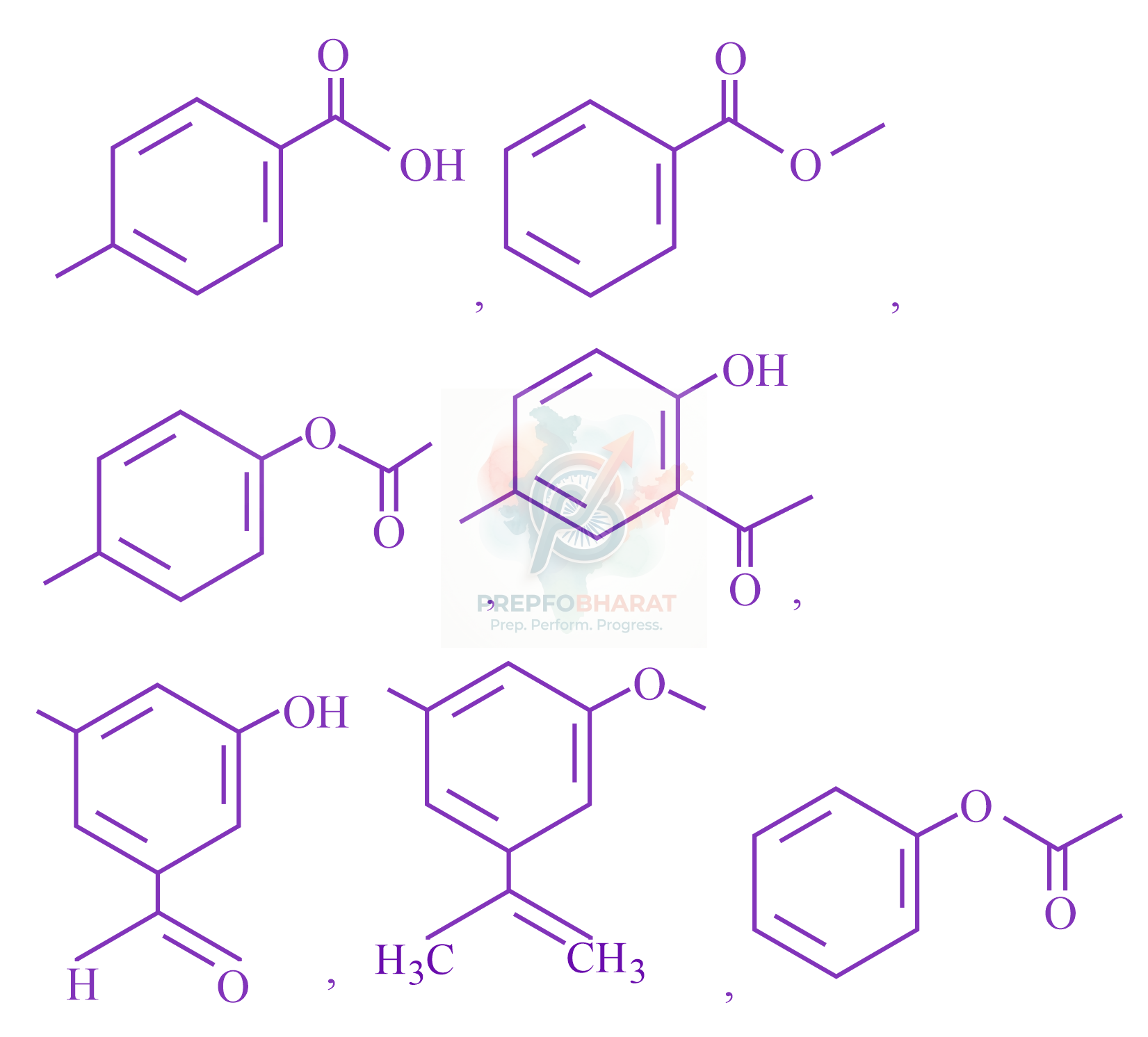
Decreasing order of dehydration of the following alcohols is 
Find out the major product from the following reaction. 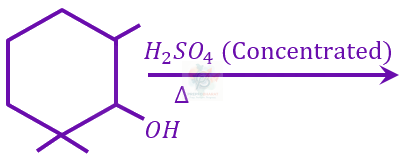
Find out the major product for the following reaction