Organic Chemistry PYQ — Page 30
JEE Main Chemistry — Organic Chemistry previous year questions with solutions.
All Organic Chemistry Questions (1783)
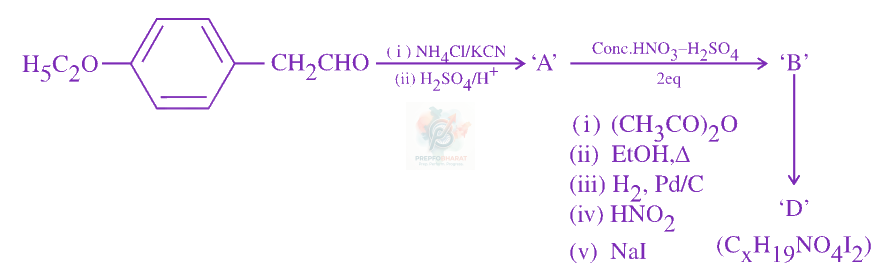 The value of $x$ in compound ‘$D$’ is _____
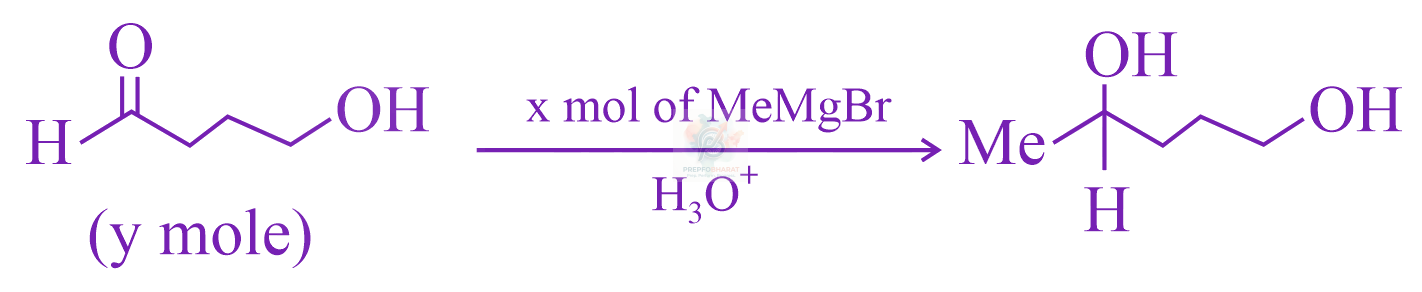 The ratio x/y on completion of the above reaction is ______ .
Given below are two statements: one is labelled as Assertion A and the other is labelled as Reason R: Assertion A: Acetal/Ketal is stable in basic medium. Reason R: The high leaving tendency of alkoxide ion gives the stability to acetal/ketal in basic medium. In the light of the above statements, choose the correct answer from the options given below:
Consider the following sequence of reactions  The product ‘$B$’ is
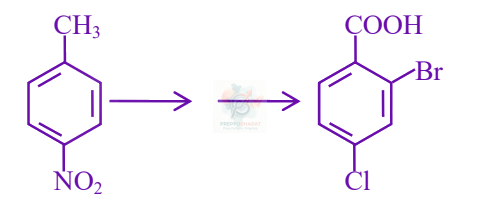 In the above conversion the correct sequence of reagents to be added is
Compound A from the following reaction sequence is : 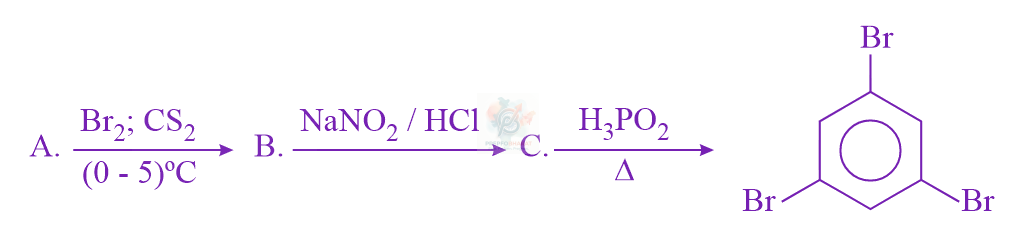
The product $(P)$ formed from the following multistep reaction is: 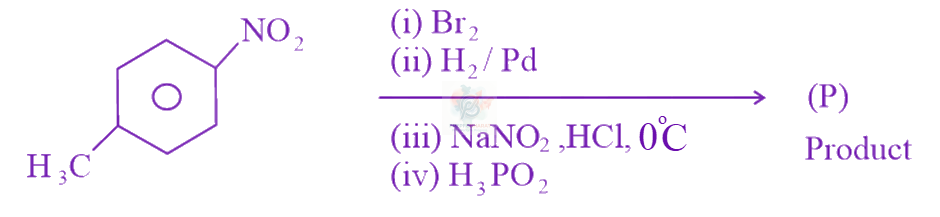
The correct order in aqueous medium of basic strength in case of methyl substituted amines is:
Match List I with List II <table class="pyq-table"><tbody><tr><td colspan="2" rowspan="1">List I (Amines)</td><td colspan="2" rowspan="1">List II $(\mathrm{pKb})$</td></tr><tr><td>A.</td><td>Aniline</td><td>I.</td><td>$3.25$</td></tr><tr><td>B.</td><td>Ethanamine</td><td>II.</td><td>$3.00$</td></tr><tr><td>C.</td><td>N-Ethylethanamine</td><td>III.</td><td>$9.38$</td></tr><tr><td>D.</td><td>N, N-Diethylethanamine</td><td>IV.</td><td>$3.29$</td></tr></tbody></table>Choose the correct answer from the options given below:-
Choose the correct colour of the product for the following reaction. 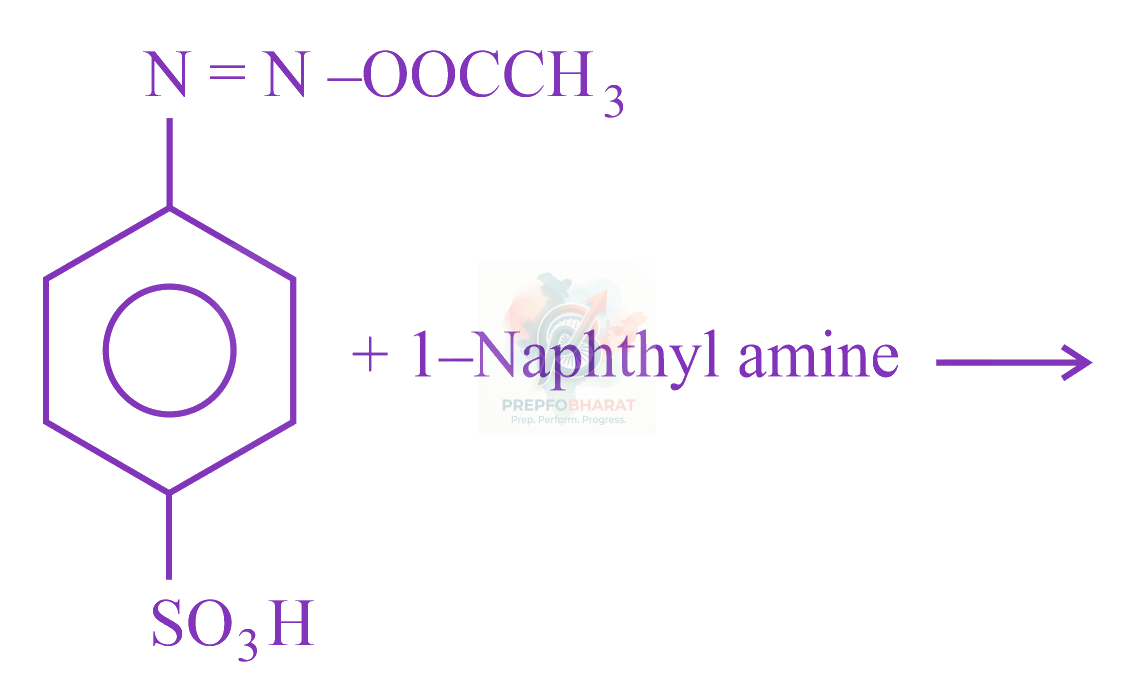
Match List-I with List-II. <table class="pyq-table"><tbody><tr><td></td><td>List-I Natural Amino acid</td><td></td><td>List-II One Letter Code</td></tr><tr><td>(A)</td><td>Arginine</td><td>(I)</td><td>$D$</td></tr><tr><td>(B)</td><td>Aspartic acid</td><td>(II)</td><td>$N$</td></tr><tr><td>(C)</td><td>Asparagine</td><td>(III)</td><td>$A$</td></tr><tr><td>(D)</td><td>Alanine</td><td>(IV)</td><td>$R$</td></tr></tbody></table>Choose the correct answer from the options given below:
Following tetrapeptide can be represented as 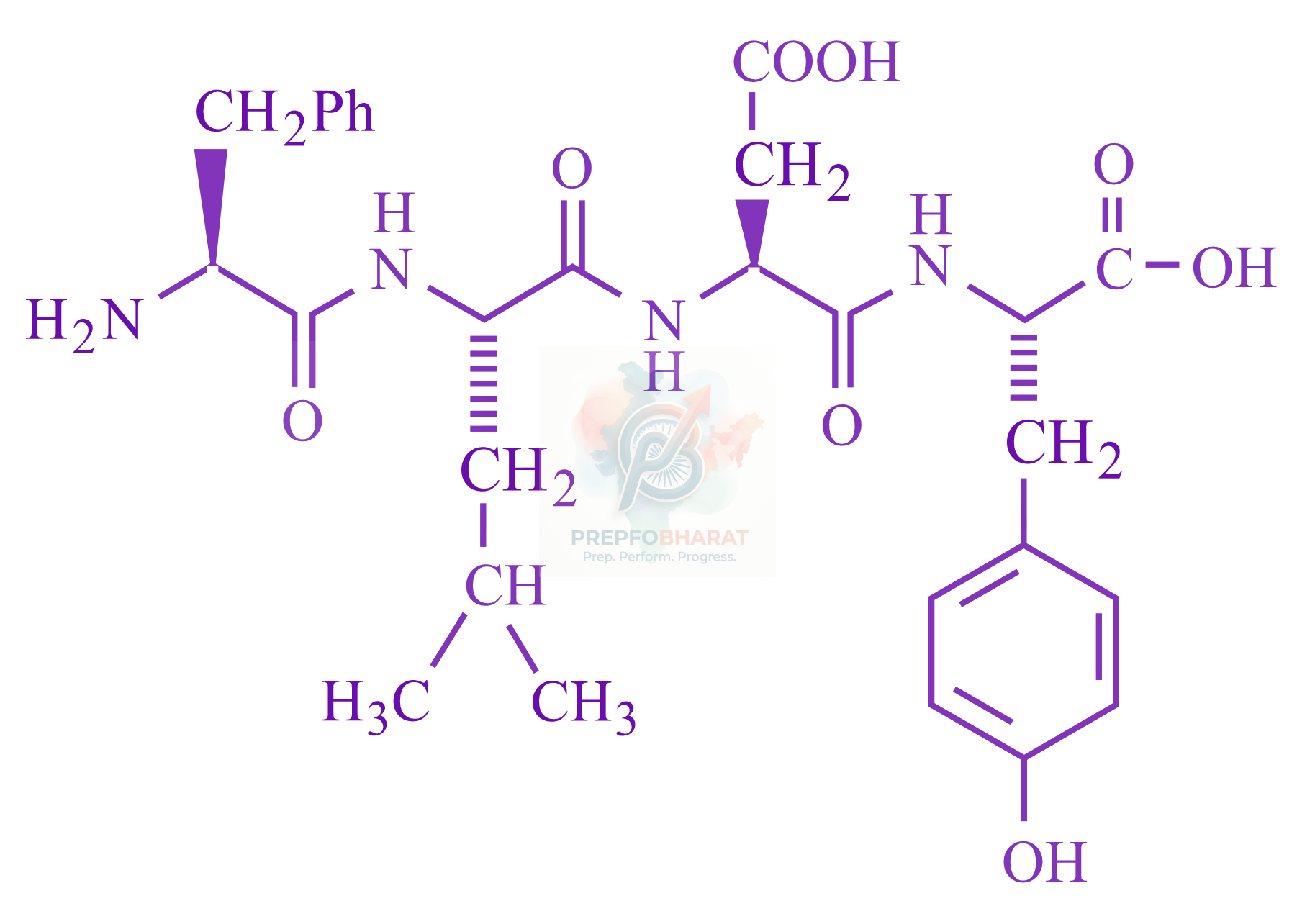 ($F,L,D,Y,I,Q,P$ are one letter codes for amino acids)
Number of cyclic tripeptides formed with $2$ amino acids $A$ and $B$ is:
Uracil is base present in $\mathrm{RNA}$ with the following structure. $%\mathrm{of}N$ in uracil is _______. 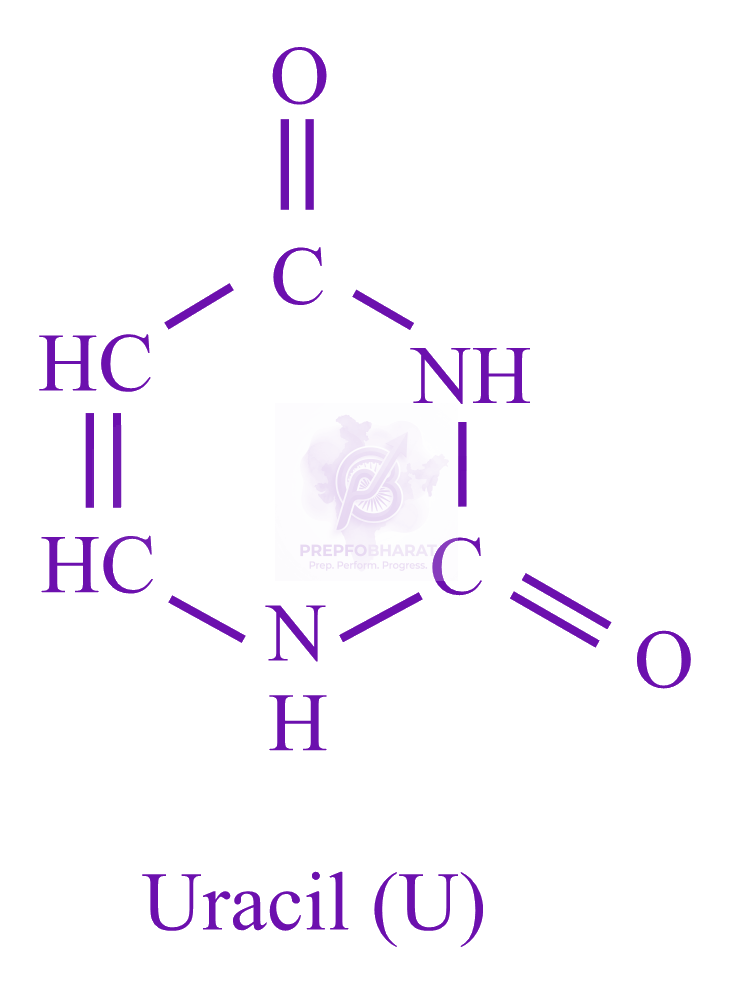
In the following given reaction '$A$' is 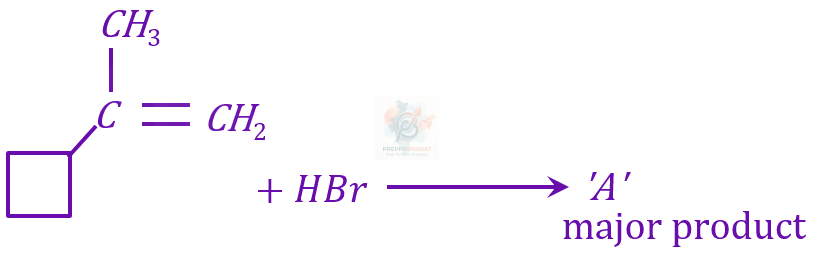
Consider the following reaction $\mathrm{Propanal}+\mathrm{Methanal}=\rightarrow _{(\mathrm{ii})\Delta (\mathrm{iii})\mathrm{NaCN} (\mathrm{iv}){H}_{3}{O}^{+}}^{(i)\mathrm{dil}.\mathrm{NaOH}}P\underset{({C}_{5}{H}_{8}{O}_{3})}{\mathrm{roduct}B}$ The correct statement for product $B$ is. It is
. Match List I with List II : <table class="pyq-table"><tbody><tr><td colspan="2" rowspan="1">List I (Reagents used)</td><td colspan="2" rowspan="1">List II (Compound with Functional group detected)</td></tr><tr><td>A.</td><td>Alkaline solution of copper sulphate and sodium citrate</td><td>I.</td><td><img src="https://prepforbharat.s3.ap-south-1.amazonaws.com/exam/615f0e999476412f48314daf/Chemistry/images/Aldehydes_and_Ketones/648b5a70417cc3fb48d68402/question_1__q_648b5a70417cc3fb48d68402__cdn-question-pool.getmarks.app__d3130153-0692-4959-b528-b5b6fa417b45__e9b2522ab3_final_ppt_sync.png" alt="JEE Main 2023 Chemistry, Aldehydes and Ketones — question figure 1"></td></tr><tr><td>B.</td><td>Neutral ${\mathrm{FeCl}}_{3}$ solution</td><td>II.</td><td><img src="https://prepforbharat.s3.ap-south-1.amazonaws.com/exam/615f0e999476412f48314daf/Chemistry/images/Aldehydes_and_Ketones/648b5a70417cc3fb48d68402/question_2__q_648b5a70417cc3fb48d68402__cdn-question-pool.getmarks.app__500acecd-e89e-4bc5-b5a5-2fc8c85b569e__2173145188_final_ppt_sync.png" alt="JEE Main 2023 Chemistry, Aldehydes and Ketones — question figure 2"></td></tr><tr><td>C.</td><td>Alkaline chloroform solution</td><td>III.</td><td><img src="https://prepforbharat.s3.ap-south-1.amazonaws.com/exam/615f0e999476412f48314daf/Chemistry/images/Aldehydes_and_Ketones/648b5a70417cc3fb48d68402/question_3__q_648b5a70417cc3fb48d68402__cdn-question-pool.getmarks.app__62dd3115-cd71-4c0d-9119-b371a81d5690__be682f3272_final_ppt_sync.png" alt="JEE Main 2023 Chemistry, Aldehydes and Ketones — question figure 3"></td></tr><tr><td>D.</td><td>Potassium iodide and sodium hypochloride</td><td>IV</td><td><img src="https://prepforbharat.s3.ap-south-1.amazonaws.com/exam/615f0e999476412f48314daf/Chemistry/images/Aldehydes_and_Ketones/648b5a70417cc3fb48d68402/question_4__q_648b5a70417cc3fb48d68402__cdn-question-pool.getmarks.app__5801308d-075f-4405-818a-0811629d2710__04d2cf7a55_final_ppt_sync.png" alt="JEE Main 2023 Chemistry, Aldehydes and Ketones — question figure 4"></td></tr></tbody></table>Choose the correct answer from the options given below :
The product formed in the following multistep reaction is: 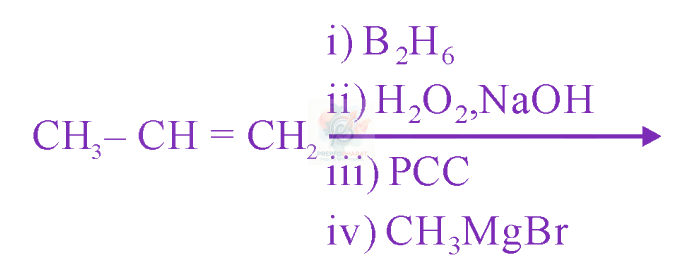
But-$2$-yne is reacted separately with one mole of Hydrogen as shown below: $\underset{¯}{B}\leftarrow _{\mathrm{liq}{\mathrm{NH}}_{3}}^{\mathrm{Na}}{\mathrm{CH}}_{3}-\underset{+{H}_{2}}{C\equiv }C-{\mathrm{CH}}_{3}\rightarrow _{\Delta }^{\mathrm{Pd}/C}\underset{¯}{A}$ Identify the incorrect statements from the options given below: A. A is more soluble than $B$. B. The boiling point & melting point of $A$are higher and lower than $B$ respectively. C. A is more polar than $B$ because dipole moment of $A$ is zero. D. ${\mathrm{Br}}_{2}$ adds easily to $B$ than $A$.
Match List-I with List-II. 1-Bromopropane is reacted with reagents in List-I to give product in List-II <table class="pyq-table"><tbody><tr><td></td><td>List-I Reagent</td><td></td><td>List-II Product</td></tr><tr><td>A.</td><td>KOH (alc)</td><td>I.</td><td>Nitrile</td></tr><tr><td>B.</td><td>KCN (alc)</td><td>II.</td><td>Ester</td></tr><tr><td>C.</td><td>AgNO$_{2}$</td><td>III.</td><td>Alkene</td></tr><tr><td>D</td><td>H$_{3}$CCOOAg</td><td>IV.</td><td>Nitroalkane</td></tr></tbody></table>Choose the correct answer from the options given below
In the reaction given below 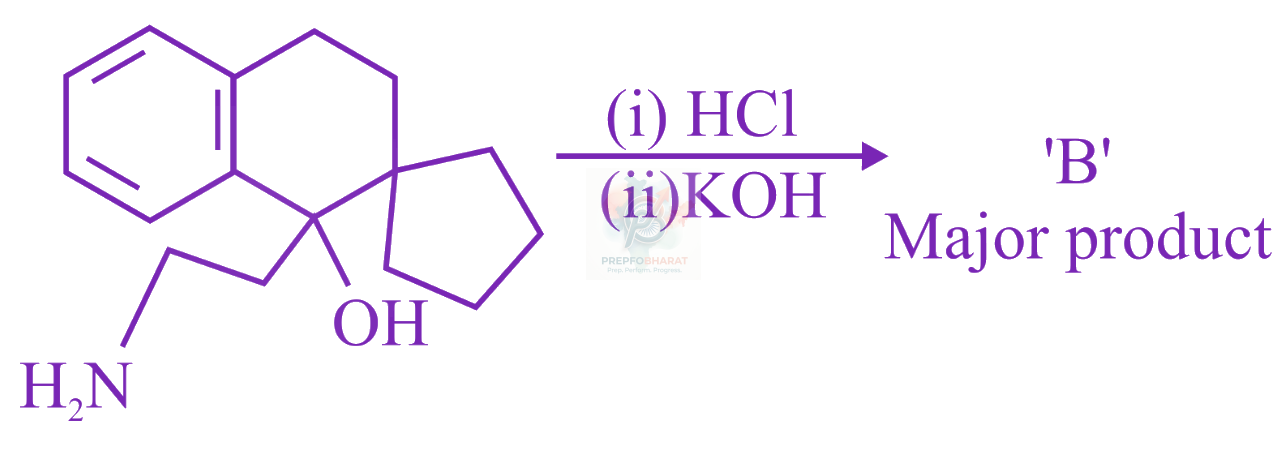 $'B'$ is:
Number of moles of $\mathrm{AgCl}$ formed in the following reaction is _____ . 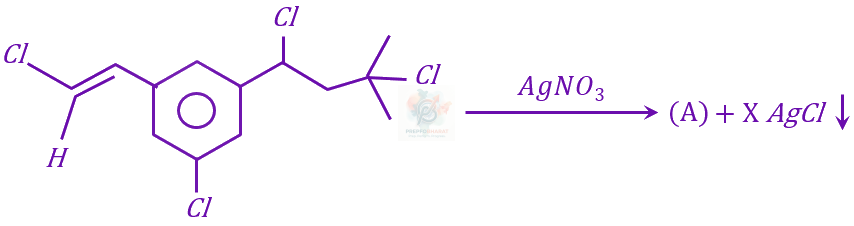
Three organic compounds $A,B$ and $C$ were allowed to run in thin layer chromatography using hexane and gave the following result (see figure). The ${R}_{f}$ value of the most polar compound is _____ $\times {10}^{–2}$ 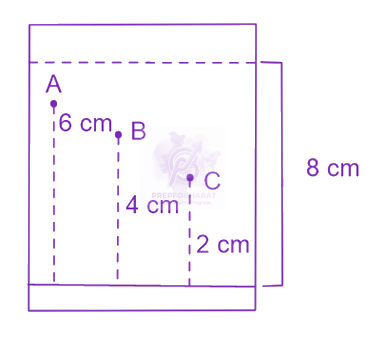
‘$X$’ is: