Cretinism refers to severe hypothyroidism in an infant or child as a result of maternal iodine deficiency. Cystic fibrosis is an inherited disorder that causes severe damage to the lungs, digestive system and other organs in the body. Thalassemia is an genetic disease caused by mutations in the DNA of RBCs and hampers the haemoglobin production in the body. Haemophilia is a genetic condition, that is characterized by a deficiency in blood clotting. Related Theory There are two major kinds of haemophilia: hemophilia A, which is a factor VIII deficiency; and hemophilia B, which is a factor IX deficiency. People with hemophilia may bruise and bleed easily, and they may bleed a lot or for a long time after an injury.
Which of the following is not a hereditary disease?
NEET UG 2005 — Zoology Principles of Inheritance and Variation
2005mcqmedium
Which of the following is not a hereditary disease?
Official previous-year question
Held on 30 Apr 2005 · Verified 9 Jul 2026.
Options
- A
cystic fibrosis
- B
thalassemia
- C
haemophilia
- D
cretinism.
Did you get this right?
Sign in to track your attempts and accuracy.
Your note
Sign in to keep a private note on this question. Nothing you write is ever public.
NEET UG Principles of Inheritance and Variation in other years
Principles of Inheritance and Variation 2025Principles of Inheritance and Variation 2024Principles of Inheritance and Variation 2023Principles of Inheritance and Variation 2022Principles of Inheritance and Variation 2021Principles of Inheritance and Variation 2020Principles of Inheritance and Variation 2019Principles of Inheritance and Variation 2018Principles of Inheritance and Variation 2017Principles of Inheritance and Variation 2016Principles of Inheritance and Variation 2015Principles of Inheritance and Variation 2014
More NEET UG Principles of Inheritance and Variation questions
What is the pattern of inheritance for polygenic trait?
2025easy
With the help of given pedigree, find out the probability for the birth of a child having no disease and being a carrier (has the disease mutation in one allele of the gene) in $F_3$ generation. 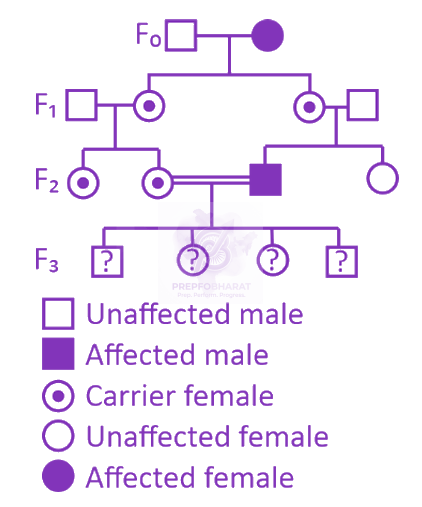
2025hard
Genes $R$ and $Y$ follow independent assortment. If RRYY produce round yellow seeds and rryy produce wrinkled green seeds, what will be the phenotypic ratio of the F2 generation?
2025medium
When a tall pea plant with round seeds was selfed, it produced the progeny of : (a) Tall plants with round seeds and (b) Tall plants with wrinkled seeds. Identify the genotype of the parent plant.
2024hard
Given below are two statements: Statement I: Failure of segregation of chromatids during cell cycle resulting in the gain or loss of whole set of chromosome in an organism is known as aneuploidy. Statement II: Failure of cytokinesis after anaphase stage of cell division results in the gain or loss of a chromosome is called polyploidy. In the light of the above statements, choose the correct answer from the options given below:
2024medium
Other Zoology topics for NEET UG
Keep practicing Principles of Inheritance and Variation
Work through every NEET UG Principles of Inheritance and Variation PYQ, year by year.