Colour change in chameleon and melanism in moths are examples of camouflage in animals adapted to prevent predation from prey. As a defence mechanism puffers have the ability to inflate rapidly, filling their extremely elastic stomach with water (or air) until they are almost spherical. This prevents them from being identified by the predator. But poison fangs in snakes are a method adopted for preying and not escaping predation. Related Theory Prey species have defense adaptations that help them escape predation. These defenses may be mechanical, chemical, physical, or behavioural. Camouflage is the ability of an organism to blend in with its surroundings. It can be as simple as being the predominant colour of surrounding vegetation, or it can define an organism's complete morphology, like this walking stick. It is considered as a great defensive strategy, as evidenced by its widespread use in nature.
Animals have the innate ability to escape from predation. Examples for the same are given below. Select the incorrect example.
NEET UG 2005 — Zoology Organisms and Populations
Animals have the innate ability to escape from predation. Examples for the same are given below. Select the incorrect example.
Held on 30 Apr 2005 · Verified 9 Jul 2026.
Options
- A
colour change in chameleon
- B
enlargement of body size by swallowing air in puffer fish
- C
poison fangs in snakes
- D
melanism in moths.
Did you get this right?
Sign in to track your attempts and accuracy.
Your note
Sign in to keep a private note on this question. Nothing you write is ever public.
NEET UG Organisms and Populations in other years
More NEET UG Organisms and Populations questions
Epiphytes that are growing on a mango branch is an example of which of the following?
Given below are two statements : Statement I : Fig fruit is a non-vegetarian fruit as it has enclosed fig wasps in it. Statement II : Fig wasp and fig tree exhibit mutual relationship as fig wasp completes its life cycle in fig fruit and fig fruit gets pollinated by fig wasp. In the light of the above statements, choose the most appropriate answer from the options given below :
Which one of the following equations represents the Verhulst-Pearl Logistic Growth of population?
Who is known as the father of Ecology in India?
What do 'a' and 'b' represent in the following population growth curve? 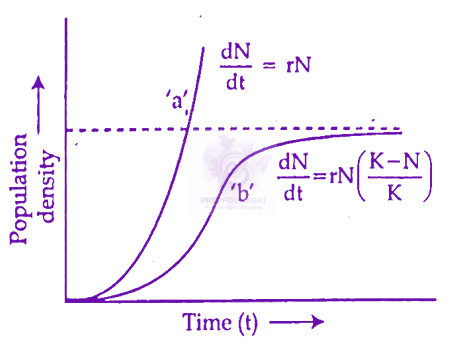
Other Zoology topics for NEET UG
Keep practicing Organisms and Populations
Work through every NEET UG Organisms and Populations PYQ, year by year.