A-Adrenal gland, B-Renal pelvis, CMedulla, D-Cortex.
Figure shows human urinary system with structures labelled A to D. Select option, which correctly identifies them and gives their characteristics…
NEET UG 2013 — Zoology Excretory Products and their Elimination
2013mcqmedium
Figure shows human urinary system with structures labelled A to D. Select option, which correctly identifies them and gives their characteristics and/of functions 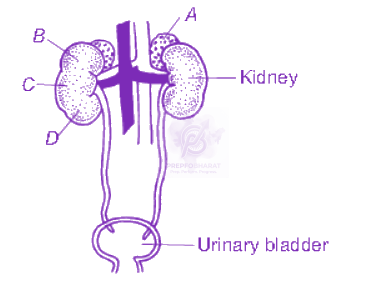
Official previous-year question
Held on 30 Apr 2013 · Verified 9 Jul 2026.
Options
- A
A-adrenal gland-located at the anterior part of kidney. Secrete catecholamines, which stimulate glycogen breakdown
- B
B-pelvis-broad funnel shaped space inner to hilum, directly connected to loops of Henle
- C
C-mediulla-inner zone of kidney and contains complete nephrons
- D
D-cortex-outer part of kidney and do not contain any part of nephrons
Did you get this right?
Sign in to track your attempts and accuracy.
Your note
Sign in to keep a private note on this question. Nothing you write is ever public.
NEET UG Excretory Products and their Elimination in other years
Excretory Products and their Elimination 2025Excretory Products and their Elimination 2024Excretory Products and their Elimination 2023Excretory Products and their Elimination 2022Excretory Products and their Elimination 2021Excretory Products and their Elimination 2020Excretory Products and their Elimination 2019Excretory Products and their Elimination 2018Excretory Products and their Elimination 2017Excretory Products and their Elimination 2016Excretory Products and their Elimination 2015Excretory Products and their Elimination 2014
More NEET UG Excretory Products and their Elimination questions
Which of the following diagrams is correct with regard to the proximal $(P)$ and distal (D) tubule of the Nephron.
2025medium
Choose the correct statement given below regarding juxta medullary nephron.
2024medium
Given below are two statements : Statement I : In the nephron, the descending limb of loop of Henle is impermeable to water and permeable to electrolytes. Statement II : The proximal convoluted tubule is lined by simple columnar brush border epithelium and increases the surface area for reabsorption. In the light of the above statements, choose the correct answer from the option given below :
2024medium
Given below are two statements: Statements I: Concentrated urine is formed due to counter current mechanism in nephron. Statement II: Counter current mechanism helps to maintain osmotic gradient in the medullary interstitium. In the light of the above statements, choose the most appropriate answer from the options given below.
2024medium
Diuresis is prevented by:
2024medium
Other Zoology topics for NEET UG
Keep practicing Excretory Products and their Elimination
Work through every NEET UG Excretory Products and their Elimination PYQ, year by year.