Our tissue are able to utilize only 25% of O2 carried by arterial blood. The venous blood is still 75% saturated with O2. This O2 acts as a reserve during muscular exercise.
A large proportion of oxygen is left unsused in the human blood even after its uptake by the body tissues. This O_2
NEET UG 2011 — Zoology Breathing and Exchange of Gases
2011mcqmedium
A large proportion of oxygen is left unsused in the human blood even after its uptake by the body tissues. This O2
Official previous-year question
Held on 30 Apr 2011 · Verified 9 Jul 2026.
Options
- A
raises the pCO2 of blood to 75 mm of Hg
- B
is enough to keep oxyhaemoglobin
- C
helps in relasing more O2 to the epithelial tissues
- D
acts as a reserve during muscular exercise
Did you get this right?
Sign in to track your attempts and accuracy.
Your note
Sign in to keep a private note on this question. Nothing you write is ever public.
NEET UG Breathing and Exchange of Gases in other years
Breathing and Exchange of Gases 2025Breathing and Exchange of Gases 2024Breathing and Exchange of Gases 2023Breathing and Exchange of Gases 2022Breathing and Exchange of Gases 2021Breathing and Exchange of Gases 2020Breathing and Exchange of Gases 2019Breathing and Exchange of Gases 2018Breathing and Exchange of Gases 2017Breathing and Exchange of Gases 2016Breathing and Exchange of Gases 2015Breathing and Exchange of Gases 2014
More NEET UG Breathing and Exchange of Gases questions
Frogs respire in water by skin and buccal cavity and on land by skin, buccal cavity and lungs. Choose the correct answer from the following :
2025easy
Match List-I with List-II. $\begin{array}{|l|l|l|l|}\hline & \text{List - I} & & \text{List - II} \\\hline \text{A}. & \text{Emphysema} & \text{(i)} & \text{Rapid spasms in muscle due to low } \mathrm{Ca}^{++} \text{ in body fluid} \\\hline \text{B.} & \text{Angina pectoris} & \text{(ii)} & \text{Damaged alveolar walls and decreased respiratory surface} \\\hline \text{C.} & \text{Glomerulonephritis} & \text{(iii)} & \text{Acute chest pain when not enough oxygen is reaching to heart muscle} \\\hline \text{D.} & \text{Tetany} & \text{(iv)} & \text{Inflammation of glomeruli of kidney} \\\hline\end{array}$ Choose the correct answer from the options given below :
2025medium
Match List-I with List-II: $\begin{array}{|l|l|r|l|}\hline & \text{List-I} & & \text{List-II} \\ \hline A. & \text{Residual Volume} & I. & \begin{array}{l} \text{Maximum volume of air that can be breathed in after forced} \\ \text{expiration} \end{array} \\ \hline B. & \text{Vital Capacity} & II. & \text{Volume of air inspired or expired during normal respiration} \\ \hline C. & \text{Expiratory Capacity} & III. & \text{Volume of air remaining in lungs after forcible expiration} \\ \hline D. & \text{Tidal Volume} & IV. & \text{Total volume of air expired after normal inspiration} \\ \hline \end{array}$ Choose the correct answer from the options given below:
2024medium
Given below are two statements: One is labelled as Assertion A and the other is labelled as Reason R. Assertion A: During the transportation of gases, about $20-25$ percent of $\mathrm{CO}_2$ is carried by Haemoglobin as carbamino-haemoglobin. Reason R: This binding is related to high $\mathrm{pCO}_2$ and low $\mathrm{pO}_2$ in tissues. In the light of the above statements, choose the correct answer from the options given below.
2024medium
Match List I with List II : 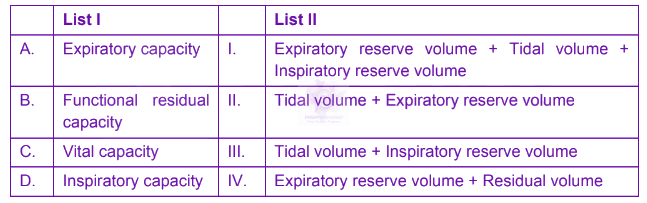 Choose the correct answer from the options given below :
2024medium
Other Zoology topics for NEET UG
Keep practicing Breathing and Exchange of Gases
Work through every NEET UG Breathing and Exchange of Gases PYQ, year by year.