Breathing and Exchange of Gases PYQ
NEET UG Zoology — Breathing and Exchange of Gases previous year questions with solutions.
Browse by Year
Breathing and Exchange of Gases at a glance
Questions per year
50 across 19 yearsDifficulty mix
50 total- easy27 · 54%
- medium21 · 42%
- hard2 · 4%
All Breathing and Exchange of Gases Questions (50)
Match List-I with List-II. $\begin{array}{|l|l|l|l|}\hline & \text{List - I} & & \text{List - II} \\\hline \text{A}. & \text{Emphysema} & \text{(i)} & \text{Rapid spasms in muscle due to low } \mathrm{Ca}^{++} \text{ in body fluid} \\\hline \text{B.} & \text{Angina pectoris} & \text{(ii)} & \text{Damaged alveolar walls and decreased respiratory surface} \\\hline \text{C.} & \text{Glomerulonephritis} & \text{(iii)} & \text{Acute chest pain when not enough oxygen is reaching to heart muscle} \\\hline \text{D.} & \text{Tetany} & \text{(iv)} & \text{Inflammation of glomeruli of kidney} \\\hline\end{array}$ Choose the correct answer from the options given below :
Frogs respire in water by skin and buccal cavity and on land by skin, buccal cavity and lungs. Choose the correct answer from the following :
Match List-I with List-II: $\begin{array}{|l|l|r|l|}\hline & \text{List-I} & & \text{List-II} \\ \hline A. & \text{Residual Volume} & I. & \begin{array}{l} \text{Maximum volume of air that can be breathed in after forced} \\ \text{expiration} \end{array} \\ \hline B. & \text{Vital Capacity} & II. & \text{Volume of air inspired or expired during normal respiration} \\ \hline C. & \text{Expiratory Capacity} & III. & \text{Volume of air remaining in lungs after forcible expiration} \\ \hline D. & \text{Tidal Volume} & IV. & \text{Total volume of air expired after normal inspiration} \\ \hline \end{array}$ Choose the correct answer from the options given below:
Given below are two statements: One is labelled as Assertion A and the other is labelled as Reason R. Assertion A: During the transportation of gases, about $20-25$ percent of $\mathrm{CO}_2$ is carried by Haemoglobin as carbamino-haemoglobin. Reason R: This binding is related to high $\mathrm{pCO}_2$ and low $\mathrm{pO}_2$ in tissues. In the light of the above statements, choose the correct answer from the options given below.
Match List I with List II : 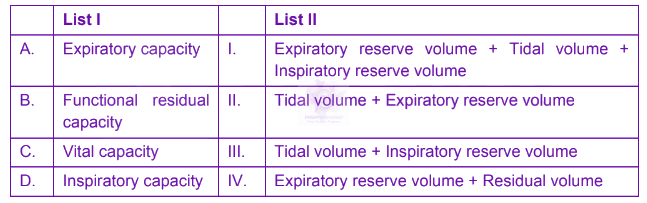 Choose the correct answer from the options given below :
Which of the following factors are favourable for the formation of oxyhaemoglobin in alveoli?
Vital capacity of lung is ______ .
Select the sequence of steps in Respiration. (A) Diffusion of gases $\left(\mathrm{O}_2\right.$ and $\left.\mathrm{CO}_2\right)$ across alveolar membrane. (B) Diffusion of $\mathrm{O}_2$ and $\mathrm{CO}_2$ between blood and tissues. (C) Transport of gases by the blood. (D) Pulmonary ventilation by which atmospheric air is drawn in and $\mathrm{CO}_2$ rich alveolar air is released out. (E) Utilisation of $\mathrm{O}_2$ by the cells for catabolic reactions and resultant release of $\mathrm{CO}_2$. Choose the correct answer from the options given below :
Which of the following statements are correct with respect to vital capacity? (a) It includes ERV, TV and IRV (b) Total volume of air a person can inspire after a normal expiration (c) The maximum volume of air a person can breathe in after forced expiration (d) It includes ERV, RV and IRV. (e) The maximum volume of air a person can breath out after a forced inspiration. Choose the most appropriate answer from the options given below:
Under normal physiological conditions in human being every $100\mathrm{ml}$ of oxygenated blood can deliver ___________ $\mathrm{ml}$ of ${O}_{2}$ to the tissues.
Identify the region of human brain which has pneumotaxic centre that alters respiratory rate by reducing the duration of inspiration.
Which of the following is not the function of conducting part of respiratory system?
The partial pressures (in $\mathrm{mmHg}$) of oxygen $({O}_{2})$ and carbon dioxide $({\mathrm{CO}}_{2})$ at alveoli (the site of diffusion) are:
Select the favourable conditions required for the formation of oxyhaemoglobin at the alveoli.
Match the following columns and select the correct option:- <table class="pyq-table"><tbody><tr><td colspan="2" rowspan="1">Column-I</td><td colspan="2" rowspan="1">Column-II</td></tr><tr><td>(a)</td><td>Pneumotaxic centre</td><td>(i)</td><td>Alveoli</td></tr><tr><td>(b)</td><td>${O}_{2}$ Dissociation curve</td><td>(ii)</td><td>Pons region of brain</td></tr><tr><td>(c)</td><td>Carbonic anhydrase</td><td>(iii)</td><td>Haemoglobin</td></tr><tr><td>(d)</td><td>Primary site of exchange of gases</td><td>(iv)</td><td>$R.B.C.$</td></tr></tbody></table>
Identify the wrong statement with reference to transport of oxygen.
The Total Lung Capacity$(\mathrm{TLC})$ is the total volume of air accomodated in the lungs at the end of a forced inspiration. This includes:
Select the correct events that occur during inspiration. (a) Contraction of diaphragm (b) Contraction of external intercostal muscles (c) Pulmonary volume decreases (d) Intrapulmonary pressure increases
The maximum volume of air a person can breathe in after a forced expiration is known as
Select the correct statement.
Tidal Volume and Expiratory Reserve Volume of an athlete is 500 mL and 1000 mL respectively. What will be his Expiratory Capacity if the Residual Volume is 1200 mL?
Match the items given in Column I with those in Column II and select the correct option given below: <table class="pyq-table"><tbody><tr><td></td><td>Column - I</td><td></td><td>Column - II</td></tr><tr><td>a.</td><td>Tidal volume</td><td>i.</td><td>2500 - 3000 mL</td></tr><tr><td>b.</td><td>Inspiratory Reserve volume</td><td>ii.</td><td>1100 - 1200 mL</td></tr><tr><td>c.</td><td>Expiratory Reserve volume</td><td>iii,</td><td>500 - 550 mL</td></tr><tr><td>d.</td><td>Residual volume</td><td>iv.</td><td>1000 - 1100 mL</td></tr></tbody></table>
Which of the following options correctly represents the lung conditions in asthma and emphysema, respectively?
Which of the following is an occupational respiratory disorder?