Breathing and Exchange of Gases PYQ — Page 2
NEET UG Zoology — Breathing and Exchange of Gases previous year questions with solutions.
All Breathing and Exchange of Gases Questions (50)
Lungs are made up of air-filled sacs the alveoli. They do not collapse even after forceful expiration, because of:
After forceful inspiration, the amount of air that can be breathed out with maximum forced expiration is equal to
Reduction in pH of blood will:
Lungs does not collapse between breaths and some amount of air will always remain in the lungs which can never be expelled because,
Asthma may be attributed to:
The partial pressure of oxygen in the alveoli of the lungs is:
When you hold your breath, which of the following gas changes in blood would first lead to the urge to breathe?
Name the pulmonary disease in which alveolar surface area involved in gas exchange is drastically reduced due to damage in the alveolar walls.
Approximately seventy percent of carbon-dioxide absorbed by the blood will be transported to the lungs:
The figure shows a diagrammatic view of human respiratory system with labels $A, B, C$ and $D$. Select the option, which gives correct identification and main function and/or characteristic. 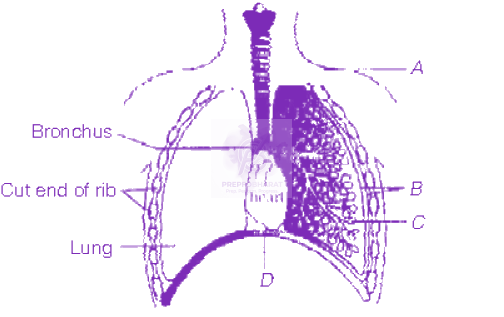
Which one of the following is the correct statement for respiration in humans?
The figure given below shows a small part of human lung where exchange of gas takes place. In which one of the options given below, the one part A, B C or D is correctly identified along with its function. 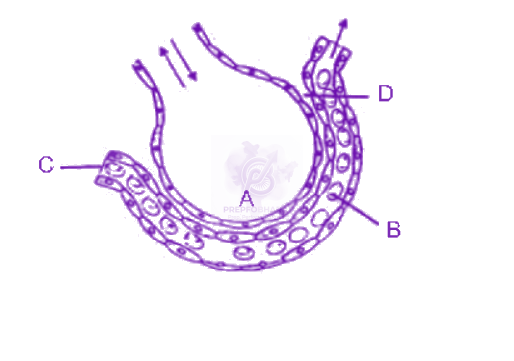
Two friends are eating together on a dining table. One of them suddenly starts coughing while swallowing some food. This coughing would have been due to improper movement of
Which one of the following is a possibility for most of us in regard to breathing, by making a conscious effort?
A large proportion of oxygen is left unsused in the human blood even after its uptake by the body tissues. This $\mathrm{O}_2$
Which two of the following changes $(1-4)$ usually tend to occur in the plain dwellers when they move to high altitudes $(3,500 \mathrm{~m}$ or more)? (1) Increase in red blood cell size (2) Increase in red blood cell production (3) Increased breathing rate (4) Increase in thrombocyte count Changes occurring are
Listed below are four respiratory capacities (1 - 4) and four jumbled respiratory volumes of a normal human adult (1) Residual volume $2500 \mathrm{~mL}$ (2) Vital capacity $3500 \mathrm{~mL}$ (3) Inspiratory reserve $1200 \mathrm{~mL}$ volume (4) Inspiratory capacity $4500 \mathrm{~mL}$ Which one of the following is the correct matching of two capacities and volumes?
The haemoglobin of a human foetus
The haemoglobin of a human foetus
What is vital capacity of our lungs?
What is vital capacity of our lungs?
Which one of the following item gives its correct total number?
Which one of the following statements is incorrect?
The majority of carbon dioxide produced by our body cells is transported to the lungs: