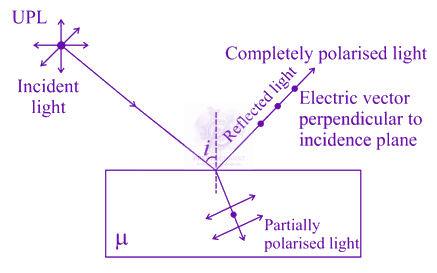
when reflected light rays and reflected rays are perpendicular, reflected light is polarised with electric field vector perpendicular to the plane of incidence.
Also. Brewster's law μ=tani.
NEET UG 2018 — Physics Optics
Unpolarised light is incident from air on plane surface of a material of refractive index μ. At a particular angle of incident i it is found that the reflected and refracted rays are perpendicular to each other. Which of the following options is correct for this situation?
Held on 30 Apr 2018 · Verified 9 Jul 2026.
i=sin−1(μ1)
Reflected light is polarized with its electric vector perpendicular to the plane of incidence
Reflected light is polarized with its electric vector parallel to the plane of incident
i=tan−1(μ1)
Sign in to track your attempts and accuracy.
Sign in to keep a private note on this question. Nothing you write is ever public.
Two thin lenses of focal lengths f₁ = +20 cm and f₂ = -10 cm are in contact. The power of the combination is:
The refractive index of glass is 1.5. The speed of light in glass is:
In a certain camera, a combination of four similar thin convex lenses are arranged axially in contact. Then the power of the combination and the total magnification in comparison to the power $(p)$ and magnification $(m)$ for each lens will be, respectively
A microscope has an objective of focal length 2 cm , eyepiece of focal length 4 cm and the tube length of 40 cm . If the distance of distinct vision of eye is 25 cm , the magnification in the microscope is :
The intensity of transmitted light when a polaroid sheet, placed between two crossed polaroids at $22.5^{\circ}$ from the polarization axis of one of the polaroid, is ( $\mathrm{I}_0$ is the intensity of polarised light after passing through the first polaroid):
Work through every NEET UG Optics PYQ, year by year.